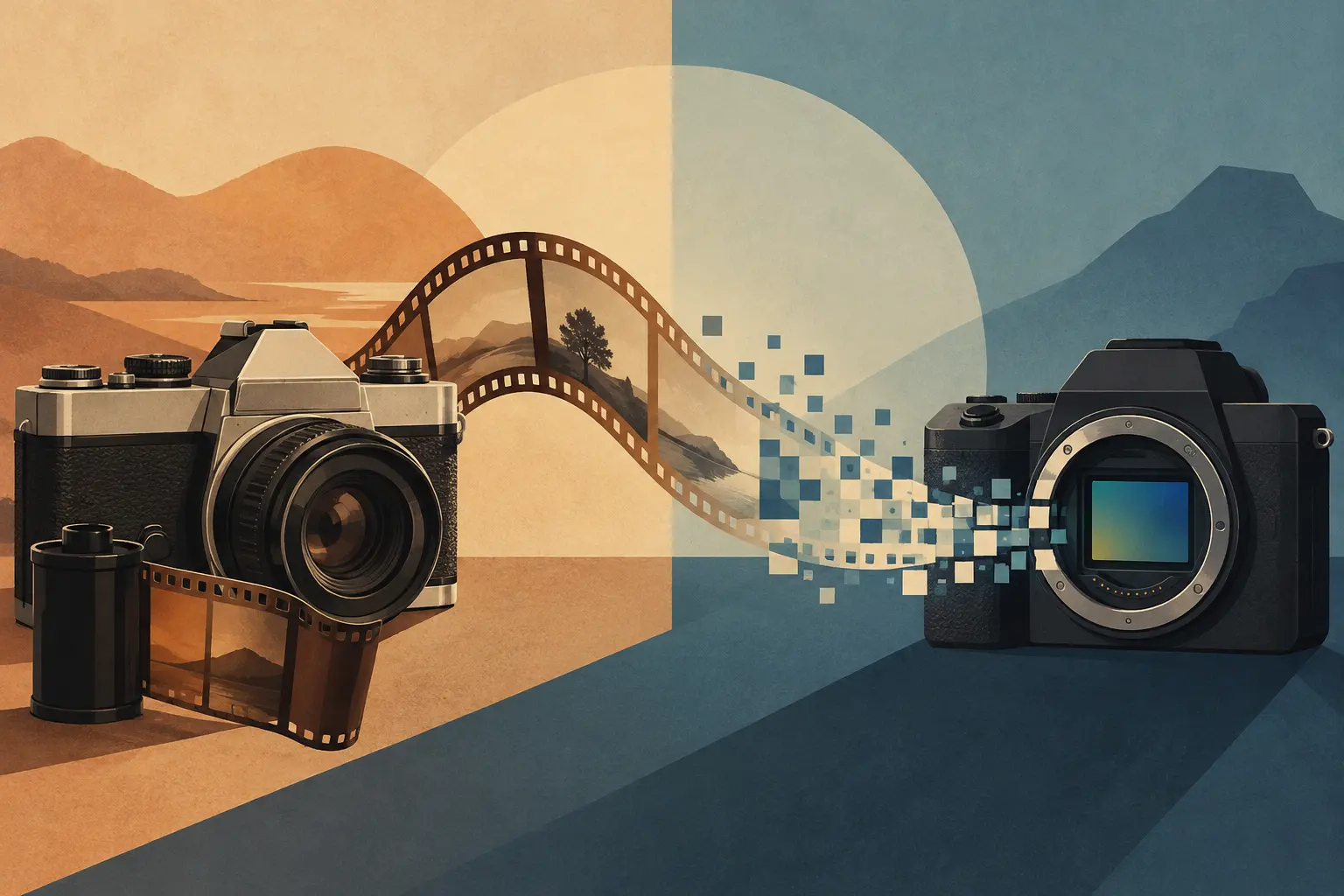
The transformation of visual imagery between 1970 and 2009 was not a single event but a gradual process that redefined the relationship between the viewer and the medium. During this period, photography and video shifted from technical disciplines reserved for professionals or enthusiasts to becoming ubiquitous components of daily life. This change did not only alter content production but also modified how societies document, share, and remember their reality. Available evidence suggests that this transition relied on the standardization of analog formats, innovation in digital sensors, and the evolution of audiovisual distribution systems.
The Peak of the 35 mm Format
The 1970s consolidated the 35 mm format as the dominant standard in the film industry. Emblematic films of the era, such as Star Wars (1977) and Apocalypse Now (1979), demonstrated the versatility and narrative capacity of this medium. The availability of single-lens reflex (SLR) cameras facilitated access to professional-quality equipment, which boosted photojournalism. Although the "golden age" of photojournalism is often associated with earlier periods, the 1970s maintained a high level of demand for images in print media, consolidating photography as a fundamental tool for social and political documentation.
The Emergence of Digital Technology
In the 1980s, the paradigm shift began to take shape with the introduction of the first digital cameras. A relevant milestone was the development of the Kodak DCS 100 in 1988, which represented one of the first serious attempts to capture images in digital format. Although these devices were expensive and bulky, they marked the beginning of the transition from photographic paper to electronic chips. Simultaneously, the entertainment industry saw the rise of CD-Video players, which allowed the mass distribution of audiovisual content via compact discs, offering a more portable and durable alternative to traditional video tapes.
Accessibility in the 1990s
The 1990s accelerated the adoption of digital technology due to cost reductions and image quality improvements. DV camcorders and home video cameras with memory cards made digital recording accessible to the average consumer. By the end of the decade, the launch of the Sony Cyber-shot DSC-V1 in 1999 consolidated digital photography as an everyday practice. This device, by eliminating the need for film and developing, removed the economic and logistical barriers that had limited mass photographic production.
The Democratization of the Image
These technological advances were intrinsically linked to profound social changes. The democratization of the image allowed anyone to document their surroundings without the need for advanced technical knowledge. The ability to capture, store, and share images digitally reduced the distance between the creator and the audience. This process not only facilitated the creation of personal archives but also laid the foundations for new forms of cultural expression and social communication.
The Role of Sharing Platforms
In the early 2000s, internet infrastructure allowed the emergence of online photo-sharing services. Platforms like Flickr, launched in 2004, became central nodes for visual content distribution. These services not only allowed image sharing but also fostered the creation of communities around specific photographic interests. The constant flow of visual content that characterizes the current digital age has its roots in these early platforms, which normalized the idea that the image is a shared and accessible good.
Limitations of Historical Evidence
It is important to note that the narrative of a linear transition from analog to digital simplifies a more complex reality. For decades, both formats coexisted, and the choice between them depended on economic, aesthetic, and practical factors. Furthermore, the availability of detailed sources on the specific social impact of each device is limited. The provided evidence offers a general framework but does not allow for an exhaustive analysis of regional or demographic variations in the adoption of these technologies.
Conclusion
The period between 1970 and 2009 represents a turning point in the history of visual culture. The evolution from the 35 mm format to pocket digital cameras illustrates how technology can transform entrenched cultural practices. Photography and video ceased to be specialized media to become universal communication tools. This legacy continues to influence how we interact with visual information today, establishing the foundations for contemporary digital culture.
- Decade
- 1970s
- Region
- Global
- Level
- Introduction
- Entities
- Internet, Sony, Star Wars
Sources and references
- El factor temporal y el ritmo como distintivo entre fotografía y vídeodoi.org · 2026-10-22
- La Sala Parpalló y su contribución a la fotografía en Valencia (1980-1995)openalex.org · 2026-10-22
- Historia de la fotografía | Museo Nacional de Ciencia y ...translate.google.com · 2026-10-22
- La historia del fotoperiodismo y su impacto en la sociedadmymodernmet.com · 2026-10-22
- Fotografía e historia en América Latinaissuu.com · 2026-10-22