The history of text software is not limited to the evolution of graphical interfaces, but is rooted in the ability to store information in a way that is readable by machines and people for decades. While commercial word processors introduced the complexity of proprietary binary formats, plain text editors established a standard of durability that remains relevant in digital preservation. This distinction is fundamental to understanding how we learned to interact with the computer not only as a creation tool, but as an archive.
The distinction between processing and editing
There is a deep technical and conceptual difference between a word processor and a text editor. Wikipedia articles and other encyclopedic sources point out that each text processing program maintains its own file format to store documents. This particularity creates an obsolescence problem: if the proprietary software disappears, the file format may become unreadable. In contrast, plain text is a universal standard that does not depend on a specific application to be read. This technical independence allows a text file created in the 80s to be opened without modifications on a modern operating system.
The role of the editor in historical research
In the field of digital humanities, the plain text editor has become an essential methodological tool. Academic documents indicate that the use of plain text editors is preferable for managing metadata and preparing texts for computational analysis. This is because these editors allow manipulating the structure of the text without adding layers of formatting that distort the original content. For the researcher, the text editor is not just a writing tool, but a curation instrument that guarantees the integrity of the data.
Memory limitations and the interface
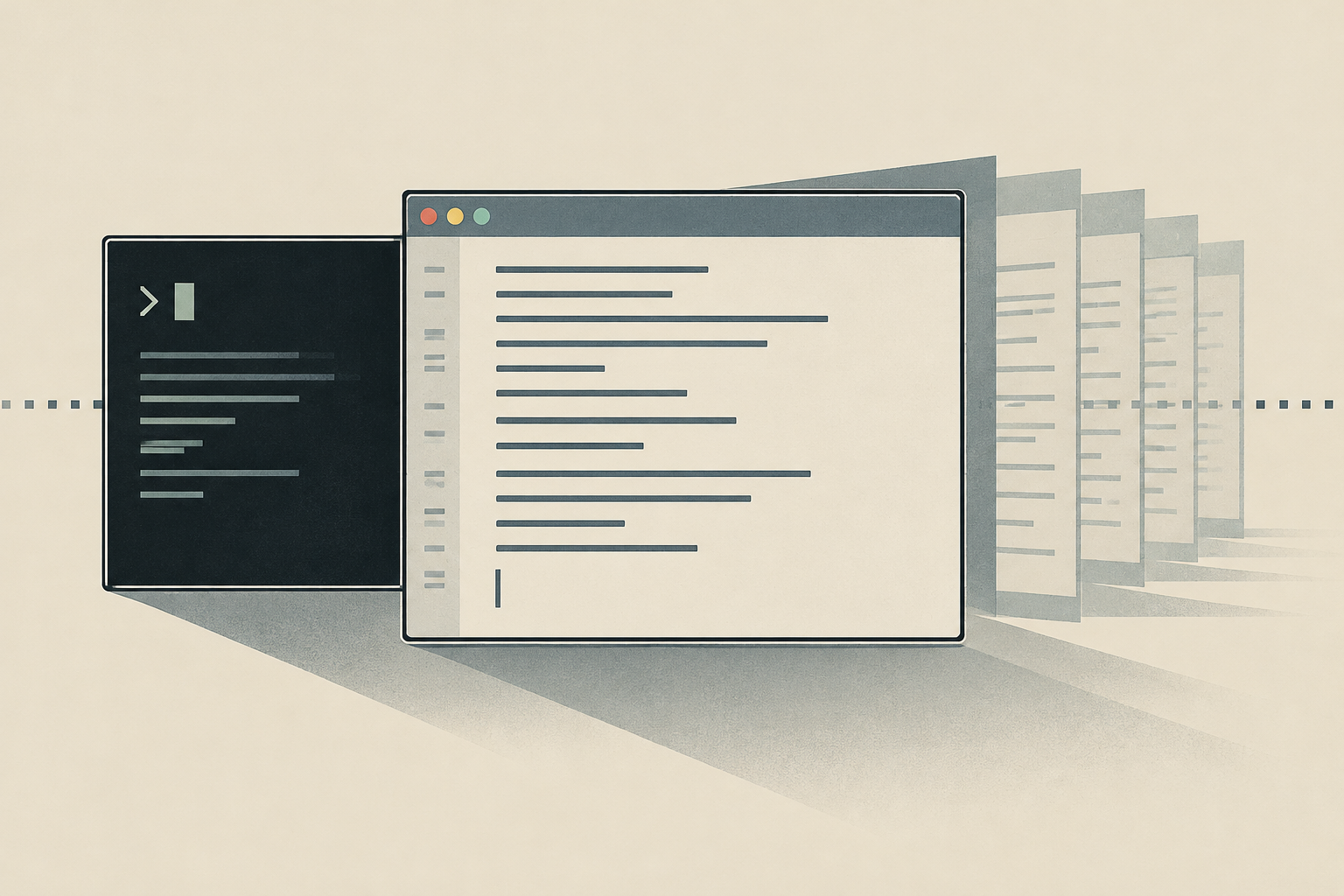
In the early decades of personal computing, memory was a scarce resource. Text editors, being lighter than word processors, allowed working on systems with limited resources. This technical constraint influenced the way users learned to write on the computer. The command line interface or the simple text screen required a direct understanding of the file structure. The user was not interacting with a blank page, but with a stream of characters. This user experience formed a generation of users who understood text as data, not just as visual content.
The transition to the graphical interface
The arrival of graphical user interfaces (GUI) in the 90s transformed the perception of text software. Word processors became more accessible to the general public, but also more closed. Text editors, on the other hand, specialized in technical niches, such as programming or system administration. This bifurcation reflects a division in digital culture: on one hand, the creation of documents for human communication; on the other, the manipulation of data for interaction with the machine. Both traditions coexist in current software, but with very different purposes and formats.
Preservation and file formats
The question of which formats allow the preservation of programs is central to digital preservation. Plain text, being an open and simple format, is the ideal candidate for long-term preservation. However, evidence shows that even text files can lose their context if the tools used to create them are not documented. A text file without metadata is an isolated piece; with metadata, it becomes a historical document. The documentation of editing tools, therefore, is as important as the preservation of the text itself.
Legacy in current applications
The ideas that emerged in the era of plain text editors are still present in current applications. The ability to search and replace, the management of multiple files, and the integration with version control systems are features we inherited from those early programs. In addition, the concept of plain text has resurfaced in the web era, where formats like Markdown allow simple writing that converts to HTML. This continuity demonstrates that the simplicity of plain text is not a limitation, but an advantage in a world where the complexity of proprietary formats threatens the durability of information.
Conclusion
The plain text editor is not just a technical tool, but a witness to the evolution of the relationship between humans and machines. Its ability to preserve information over time makes it a key element of digital memory. By studying these programs, we not only learn about the history of software, but about how we have built the foundations of digital communication. The lesson it leaves us is clear: the durability of information depends on the simplicity and openness of its formats.
- Decade
- 1990s
- Region
- Global
- Level
- Enthusiast
- Entities
- No linked entities
Sources and references
- Bases de datos, febrero 2010openaccess.uoc.edu · 2026-10-13
- Herramientas Digitales para Investigación Histórica | PDFes.scribd.com · 2026-10-13
- Procesador de texto - Wikipedia, la enciclopedia librees.wikipedia.org · 2026-10-13
- Conceptos, materiales y métodos en humanidades digitalesultreia.ucv.es · 2026-10-13
- “Recogito-in-a-box”: de la anotación a la edición digitalmodernlanguagesopen.org · 2026-10-13
- Vimes.wikipedia.org · 2026-10-13