A home computer is not understood solely through the specifications of its central unit. The media it could accept, the physical unit in which they were stored and the words used to describe them also matter. Archival records make it possible to investigate this material relationship, with one essential caution: identifying a floppy disk or a drive does not prove what someone did with it at home.
The medium is not the content
The Catalan Standard for Archival Description (NODAC) states that the physical unit in which electronic documents are stored should be recorded. Its examples include CD-ROM, DVD, DAT, floppy disk, hard drive and ZIP drive. This list helps establish a basic distinction: a format or medium is one part of a description, not an automatic explanation of the content or its use.
A reference to a floppy disk can identify a type of storage object. Without further information, it cannot establish which files it contained, which computer read it, when it was used or whether it passed between several people. Those questions require other evidence. A catalogue record can begin an investigation, but it cannot replace the evidence needed to describe a particular experience.
What a catalogue record can say
The National Library of Spain’s Cataloguing Rules cover locally accessed computer files held on physical media such as reel, cassette, cartridge or floppy disk, designed to be inserted into equipment. This wording documents a category of access and lists media; it does not, by itself, establish a specific domestic routine.
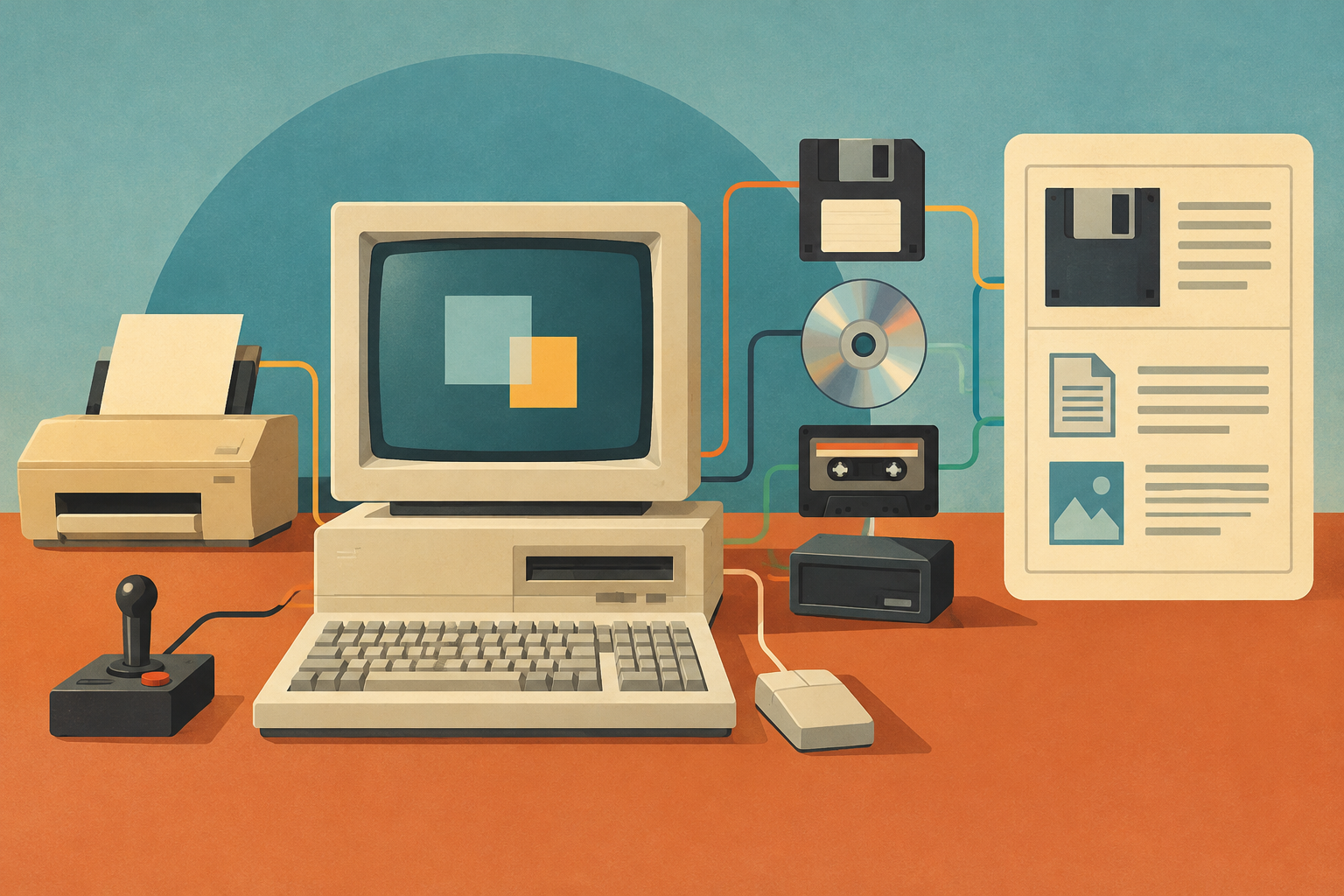
A description can help place an object in a material chain: there is electronic content, a medium that holds it and equipment capable of reading it. But a record does not always identify every element or connection. If it does not name the peripheral, computer model or context of use, those gaps should not be filled with imagined scenes from everyday life.
Physical units and context
NODAC stresses the importance of recording the physical storage unit. This has practical consequences for anyone consulting or preserving documentation: “electronic document” does not fully describe where its medium is kept. A record may distinguish a floppy disk from an optical disc or ZIP drive, but naming a format does not tell us whether the medium is complete, whether its reader survives or whether its data remain accessible.
The Ministry of Culture bulletin included among the sources describes a publication accompanied by a floppy disk. It is a useful example of a medium forming part of a work’s documentary set. It is not enough, however, to conclude that all home floppy disks served the same purpose or to infer how they connected to a particular computer.
The limits of description
The registration and documentation manual in the University of Guadalajara repository mentions CDs, floppy disks and databases when discussing formats. The text on historical databases distinguishes documents by characteristics including their electronic medium and level of dissemination. Taken together, these references support a discussion of classification and description, not a detailed history of household habits.
That limit does not make cataloguing useless. On the contrary, it shows what can be asserted and what evidence should be sought next. Explaining a particular practice would require, as appropriate, user manuals, technical documentation, advertising, attributable testimony or records explicitly linking a medium to a machine and an activity. None of these details should be assumed from the format name alone.
Reconstructing without filling the gaps
Research into home computers can begin with a simple question: what is preserved alongside the machine, and how is it described? The answer helps map media and units and recognizes that the computing experience also depended on elements beyond the technical specification. Moving from that observation to a narrative of domestic use requires additional evidence.
A catalogue is therefore a guide for asking questions, not a machine for manufacturing memories. If it identifies a medium, that fact is recorded; if it does not specify its contents, reader or context, that part of the history remains open. Respecting this boundary makes it possible to study computers as material sets—equipment, peripherals and storage—without confusing a technical possibility with a demonstrated use.
- Decade
- Contemporary
- Region
- Spain
- Level
- Enthusiast
- Entities
- No linked entities
Sources and references
- LAS BASES DE DATOS HISTÓRICASagora.edu.es · 2026-10-08
- 01 ARCHIVÍSTICA Y GESTIÓN DE DOCUMENTOSwww.cultura.gob.es · 2026-10-08
- Norma de Descripción Archivística de Cataluña (NODAC) ...cultura.gencat.cat · 2026-10-08
- manual de registro y documentaciónobservatoriocultural.udgvirtual.udg.mx · 2026-10-08
- Reglas de Catalogaciónwww.bne.es · 2026-10-08