Format is more than a wrapper
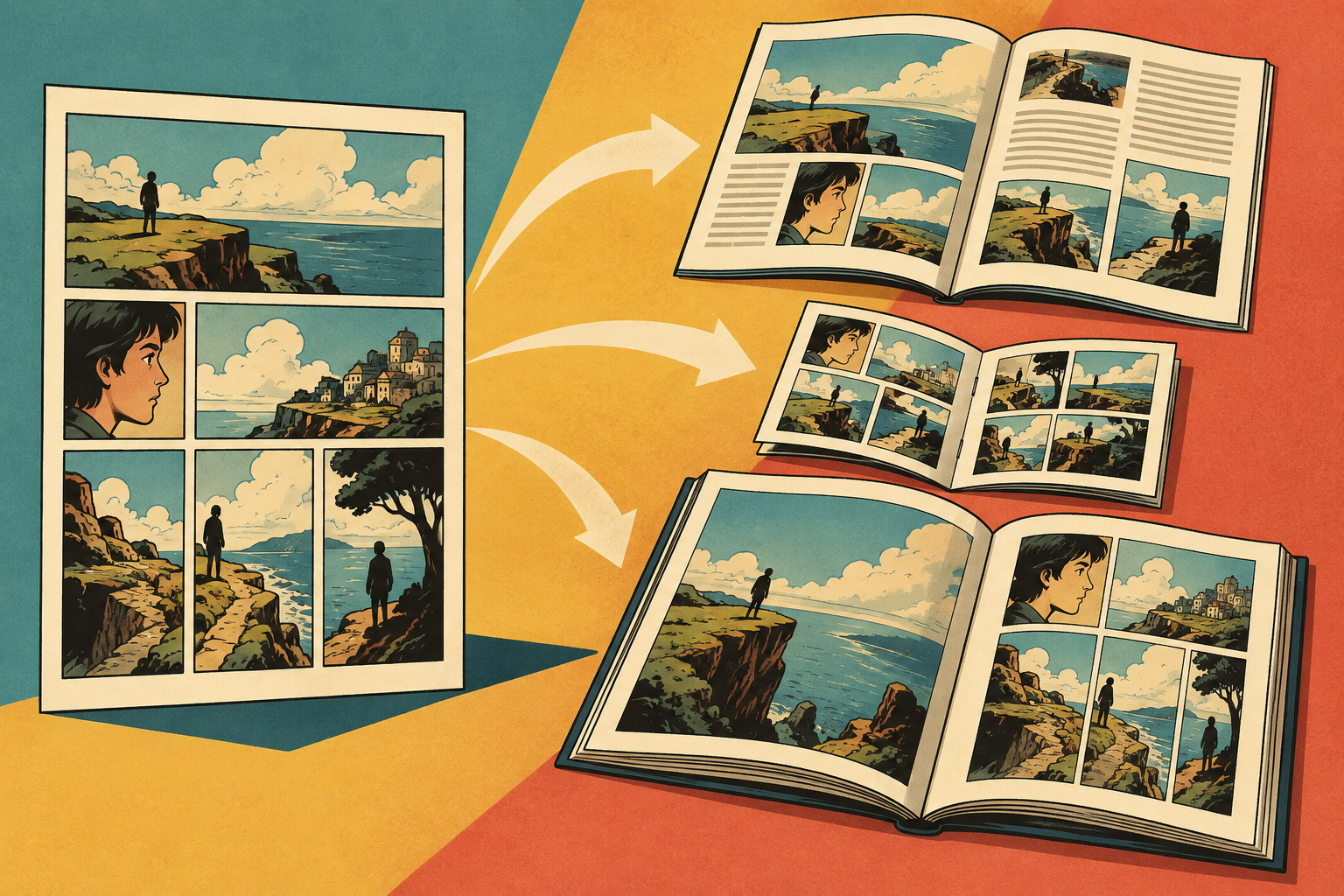
Reading comics means relating images, words and space. Page size, sequence and the way instalments are assembled set conditions for that reading. They do not do the narrative work by themselves, but they shape where readers encounter each fragment and how they move from one to the next. Asking about format therefore means more than asking about paper or binding.
The title of Rubén Varillas’s article, “El cómic, una cuestión de formatos (2): revistas de cómics, fanzines, mini-cómics, álbumes y novelas gráficas,” offers a specific route: consider different publication forms together rather than treating one as the natural model. The supplied record identifies it as an article in CuCo, Cuadernos de cómic, published in 2014. It does not, however, provide the article’s text or specific conclusions. The title is evidence of the subject under discussion, not grounds for attributing arguments that cannot be checked here.
Serial publication also organises reading
A magazine can establish a relationship between a work and a publishing rhythm; an album or graphic novel, by contrast, appears in Varillas’s list as another format worthy of consideration. This suggests an editorial question, not a universal rule: what changes when readers encounter a story in instalments or assembled in a volume? The point of entry, the gap between episodes and the opportunity to revisit earlier pages may differ. These are possibilities arising from publication forms, not effects demonstrated for every work by the evidence supplied.
The examples of MAD and Archie show why it is useful to look beyond the drawing. The supplied account of MAD describes a monthly magazine and records later changes to its distribution and to the balance between new material and reprints. For Archie, it notes that the flagship series returned to number 1 in 2015 with a new look and designs adapted for a new generation of readers. These details do not measure how audiences responded. They do show that frequency, circulation, numbering and presentation can change, and belong to a publication’s editorial history.
A range of formats, a range of questions
Fanzines and mini-comics appear beside magazines, albums and graphic novels in Varillas’s title. That list resists a simple division between one “professional” form and another “alternative” one: the categories named there are varied, and the article’s title brings them into a discussion of format. Without the full text, it would be unwise to infer technical definitions, sizes, production methods or historical relationships among them.
Nor can a label replace the actual publication. Reading depends on features that can be checked in the work itself: how panels are arranged, where breaks occur, how pages connect and how a volume is organised. The bibliographic record for the study does not include sample pages that could support such an analysis. Close reading would require access to the work, or an authorised reproduction, as well as its bibliographic details.
Circulation and exhibition: other ways to encounter comics
The route by which a work reaches readers matters alongside its physical description, although the available evidence is uneven. The MAD entry reports changes in distribution: by late 2019 the magazine had left newsstands and was available through the direct market and subscriptions; in 2020 it shifted to a format consisting almost entirely of reprints. Those details concern that publication and should not be generalised to the industry as a whole.
María Pilar Méndez’s study, “Las exposiciones de cómics. Historia y contexto global,” offers another framework for circulation: exhibition. Its abstract says comics exhibitions have been common since their beginnings, even if they may seem recent. The University of Seville’s Communication Library also describes a broad comics collection. Together, these sources point to different settings—publication, distribution, library and exhibition—but do not allow us to reconstruct how each setting changed the reading of a particular work.
What can be said, and what remains open
The evidence supports a limited conclusion: studying comics means attending to editorial forms and conditions of circulation, not only characters or plots. Varillas’s article explicitly presents a plurality of formats; the information on MAD and Archie offers identifiable examples of editorial change; and the study of exhibitions reminds us that comics also appear in settings beyond individual reading.
The sources do not provide a complete history of each format, compare print runs, reconstruct prices, establish which editions readers preferred or demonstrate reading effects without further research. A sound next step would be to compare the complete study with copies of publications and verifiable editorial records. For now, format, edition and circulation are best treated as connected questions: together they help describe how a comic is presented, but each answer needs its own evidence.
- Decade
- Contemporary
- Region
- Global
- Level
- Enthusiast
- Entities
- CuCo, Cuadernos de cómic, MAD, Rubén Varillas, Revistas de cómics, fanzines, mini-cómics, álbumes y novelas gráficas
Sources and references
- El cómic, una cuestión de formatos (2): revistas de cómics, fanzines, mini-cómics, álbumes y novelas gráficasdoi.org · 2026-10-08
- Conferencia: "Comunicación y Comics". Gerardo Vilcheswww.youtube.com · 2026-10-08
- Las exposiciones de cómics. Historia y contexto globalerevistas.publicaciones.uah.es · 2026-10-08
- Cómics en la Biblioteca de Comunicaciónbib.us.es · 2026-10-08
- Mad (revista)es.wikipedia.org · 2026-10-08
- Archie Comicses.wikipedia.org · 2026-10-08