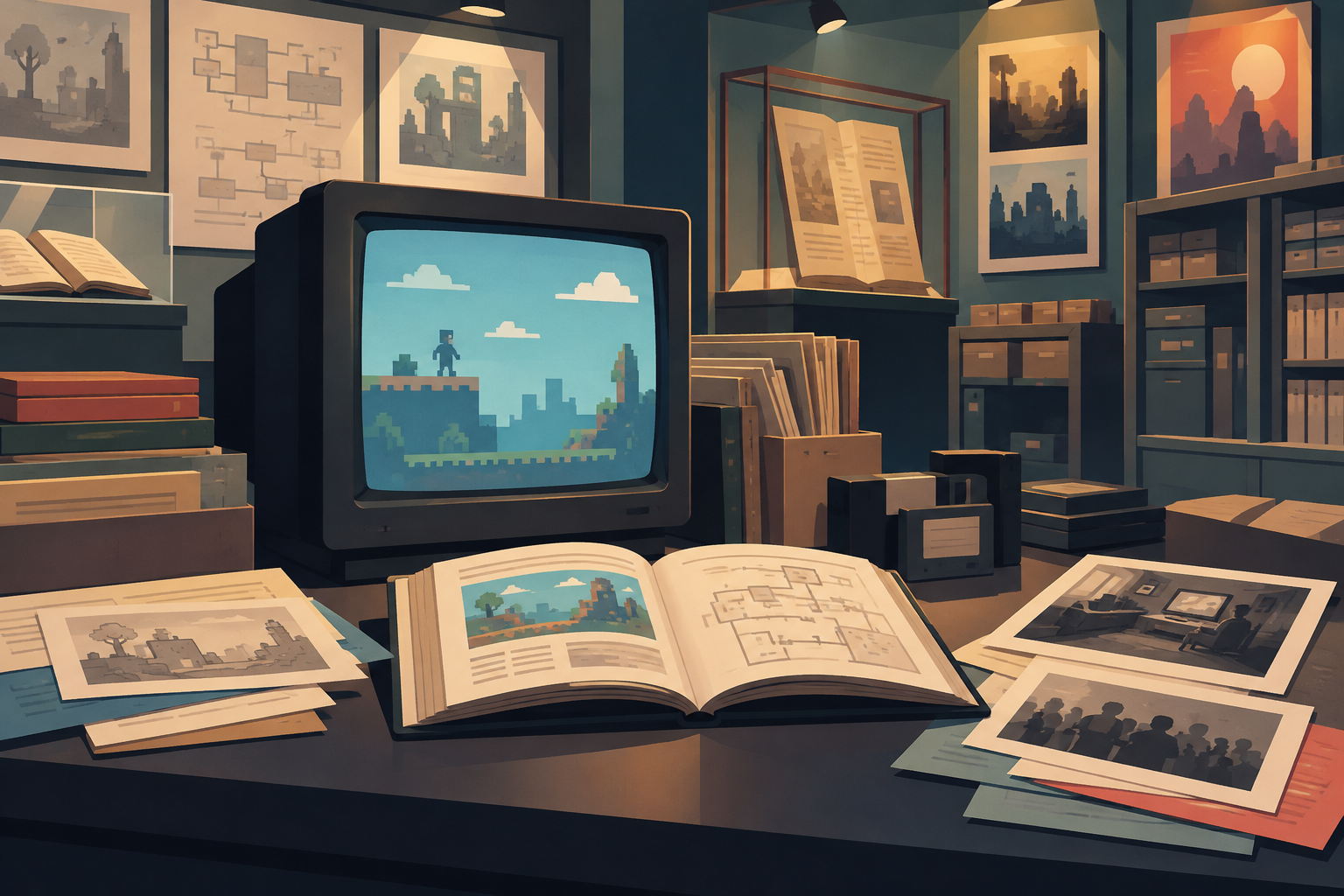
Preserving a video game does not simply mean keeping an object on display. At least, the initiatives and texts available here point to a broader practice: locating materials, documenting a history, proposing ways to interpret it and asking what it means for a video game to belong in a museum. These projects do not all do the same thing, and the descriptions consulted do not provide enough detail to establish how each task is carried out. That distinction matters: separating what an institution says it intends to do from what can be verified prevents a preservation mission from being mistaken for evidence of results.
A heritage made of materials and questions
The Museo del Videojuego says it has worked since 2000 to locate, document and preserve materials related to the history of video games and computing. The wording offers a useful indication of its scope: it refers not only to games but also to materials connected with their history. However, the information available does not list those materials or describe the methods used. We can identify the stated purpose, but cannot reconstruct an inventory or a protocol from that sentence alone.
Microsiervos’s account of Embracer Games Archive describes the initiative as dedicated to preserving the cultural legacy of video games, which it characterizes as works of art that have influenced generations. This is a statement of cultural perspective, not a sufficient account of its holdings, selection criteria or results. Read alongside the Museo del Videojuego’s description, it points to shared ground—the preservation of a history—without implying that the two organizations work in the same way.
A museum is more than a display case
A 2023 article titled “Museums and video games. The renewal of…” places museums among the institutions using video games to share their collections. The fragment available here does not reveal the full argument or specify which cases the article examines. It does, however, support an editorial question: a video game can enter a museum as an object to preserve, but it can also serve as a way to communicate other collections.
The difference between those uses matters. In one case, attention is centered on the history of games; in another, a game may act as a means of engaging with a different kind of heritage. The supplied sources do not describe how such experiences are designed or what effect they have on visitors. It is therefore better to present this distinction as a reading of the approaches described, rather than as an assessment of their outcomes.
Making games from heritage
The International Council of Museums describes two Argentine projects in which the Carmen Funes Archive-Museum, in Neuquén, produced video games based on its heritage. The summary says both were designed for a specific purpose, but the available fragment does not complete that description. It is not possible to say what mechanics they use, which audiences they address or how they were evaluated.
Even with that limitation, the case adds a different perspective: a museum may not only preserve existing games or use them to communicate its collections; it may also produce games using its heritage as a starting point. This shifts the question from “Which game is kept?” to “What relationship between game and collection is being built?” That is an interpretation of the case as described, not a conclusion about the two projects themselves.
Education and the museological debate
Educathyssen presents a programme on education in museums through video games and notes that the status of the video game as a museological element remains the subject of debate in the academic community. The page places that discussion alongside the existence of educational initiatives. The video game thus appears both as a tool for interpretation and as a question of definition: what role does it have in a museum, and for what purpose is it included?
MUVIC, the Museu del Videojoc de Catalunya, describes itself as a cultural and museum project dedicated to preserving, studying and sharing the history of video games through temporary and touring exhibitions. Its statement brings together three aims—preservation, study and communication—and identifies a specific exhibition format. The page consulted here does not provide a schedule, an exhibition catalogue or details of its research. Even so, it lets us distinguish a declared mission from the occasional presence of games in an exhibition.
What the sources allow us to say
A programme for a session titled “Video games: a cultural product to preserve” lists video games, libraries, museums and conservation in its description, along with the names of participants. The material identifies the topic and some people associated with the event, but it does not provide a transcript or arguments attributable to each participant. We should not reconstruct their contributions from the title.
Taken together, these sources show different activities and frameworks: locating and preserving materials, using games to share collections, making games connected to heritage, and considering educational or museological questions. They do not establish one definitive meaning of preservation or describe the methods of each project in comparable detail. For anyone studying video game culture, that caution is productive too: it prompts questions about what is preserved, how it is documented, what role publications and accompanying materials play, and what experience each institution aims to communicate. Answering those questions would require the full studies, project materials and records—not memories used to fill in what the available fragments do not say.
- Decade
- Contemporary
- Region
- Global
- Level
- Enthusiast
- Entities
- Museum, Museo del Videojuego
Sources and references
- Museos & videojuegos: dos proyectos desarrollados en ...icom.museum · 2026-10-08
- Vista de Museos y videojuegos. La renovación de los ...revistas.uma.es · 2026-10-08
- Jornada "El videojuego un producto cultural a conservar"www.youtube.com · 2026-10-08
- Qué hacemos | Museo del Videojuegowww.museodelvideojuego.com · 2026-10-08
- MUVIC – Museu del Videojoc de Catalunya | Castellanomuvic.cat · 2026-10-08
- La conservación de la historia de los videojuegos en el ...www.microsiervos.com · 2026-10-08
- Educación en museos a través del videojuego (I)www.educathyssen.org · 2026-10-08