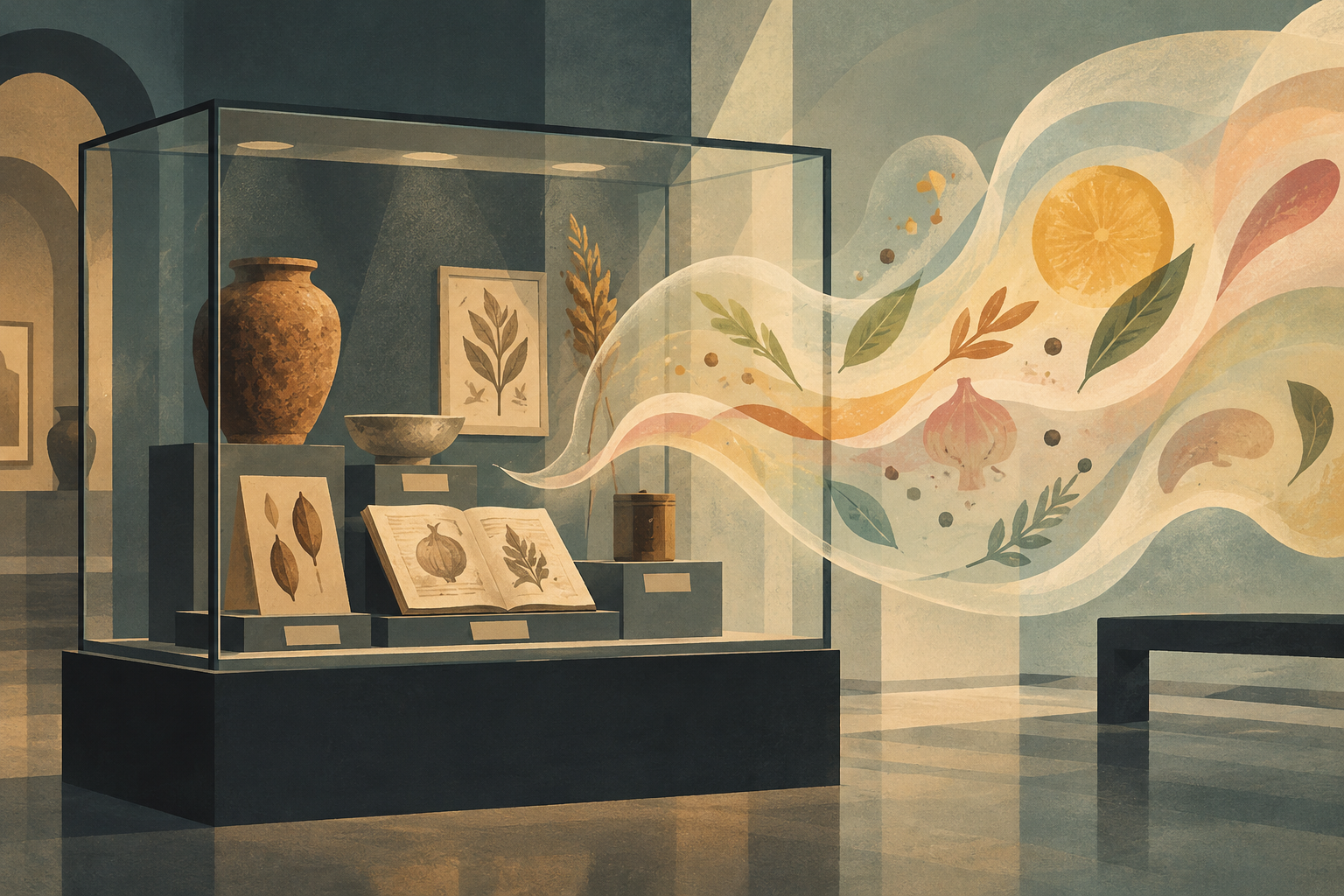
Food can seem to offer a direct route into the past: a package, recipe, or utensil may outlast the people who used it. But preserving such traces is not the same as preserving taste or reconstructing an entire experience. Eating is not only a material activity; it is also sensory, emotional, social, and cultural. Each dimension raises different questions for researchers and curators. Food heritage, then, cannot be understood simply as a collection of objects. It also depends on decisions about what to preserve, how to interpret it, and what claims the surviving evidence can support.
From food to heritage
Academic research examines the connections between culture and food through fields such as anthropology. Work on food heritage is not limited to deciding whether a particular food or cuisine merits recognition: it also points to consensus and tension over what counts as heritage and how it should be represented. The available evidence establishes that these discussions exist, but does not settle them with a single definition or specify positions that the sources do not describe.
Gastronomy can be presented as cultural heritage. Material on Peruvian gastronomy, for instance, describes it as an important cultural expression of Peru. This offers a way to see how food may gain a place in heritage discourse. On its own, however, it does not establish a full history of recognition or describe the practices of the people who cook and eat.
The museum and an incomplete experience
Food poses a particular challenge in ethnographic museums: its biological, sensory, emotional, social, and cultural dimensions are difficult to transmit in full. Objects are part of the answer, but not the whole answer. A vessel can show a material form; an image or text can add information; context can connect those pieces to a practice or community. Even together, these resources do not reproduce the experience of eating.
That limit does not make an exhibition useless. It changes what can reasonably be expected of one. A display case can document traces and place them in relation, but it cannot replace lived experience or justify filling gaps with assumptions. The distinction between showing an object and claiming how it was used matters: the latter requires evidence of its own.
Packages, recipes, and traces
A package, a sweet, or a cookbook may offer clues about commercial promotion or domestic practices. Such materials can prompt questions about circulation, representation, and use. Without additional documentation, however, they cannot establish with confidence what habits a group followed, how often it consumed a product, or what meaning it attached to it.
Caution matters because objects do not speak for themselves. A surviving cookbook proves that a document exists, not that everyone cooked its recipes. A wrapper can be studied for its design or presence in a collection, but it does not by itself show who bought the product or how they consumed it. Interpretation becomes more rigorous when it separates what can be observed from what is inferred and makes the unknowns explicit.
Preservation means assessing risks
Preventive conservation adds another dimension to the issue. It involves assessing the condition of a collection and the dangers posed by its environment. For materials connected with food, this perspective is a reminder that preservation is not simply storage: it requires attention to both the objects and the conditions that may threaten them.
The available information does not specify treatments for particular food-related objects or support technical recommendations. It does, however, establish conservation as a practice of assessment, distinct from research into cultural meaning. The two can work together, but they address different questions: how to maintain a collection, and what the materials in it can be shown to mean.
What remains outside the display case
Archives and museums organize questions as well as safeguard evidence. Their selections make some parts of food culture visible while leaving other dimensions difficult to record, especially those that depend on the senses and shared experience. Acknowledging this limit does not diminish collections; it prevents them from being credited with a capacity they do not have.
The conclusion is straightforward: an archive cannot reproduce taste. It can bring together objects, images, texts, and context to document aspects of food, and it can show how food comes to be recognized as heritage. But claims about habits, meanings, or experiences require specific evidence. Food memory is more credible when it clearly distinguishes the trace that survives from the life that trace cannot recover.
- Decade
- Contemporary
- Region
- Global
- Level
- Introduction
- Entities
- Museum
Sources and references
- Food Studies en español: Investigación actual en ...digital.sandiego.edu · 2026-10-16
- GASTRONOMÍA PERUANA PATRIMONIO CULTURAL DE LA ...catedraunesco.usmp.edu.pe · 2026-10-16
- El patrimonio alimentario en los museos etnográficos. 2019www.academia.edu · 2026-10-16
- Conquista y comidadn720004.ca.archive.org · 2026-10-16
- Patrimonios alimentarios : entre consensos y tensioneshorizon.documentation.ird.fr · 2026-10-16
- Lo inmaterial en el museo. Museos y patrimonio alimentarioriunet.upv.es · 2026-10-16
- LA CONSERVACION PREVENTIVA EN LOS MUSEOSwww.museosdetenerife.org · 2026-10-16