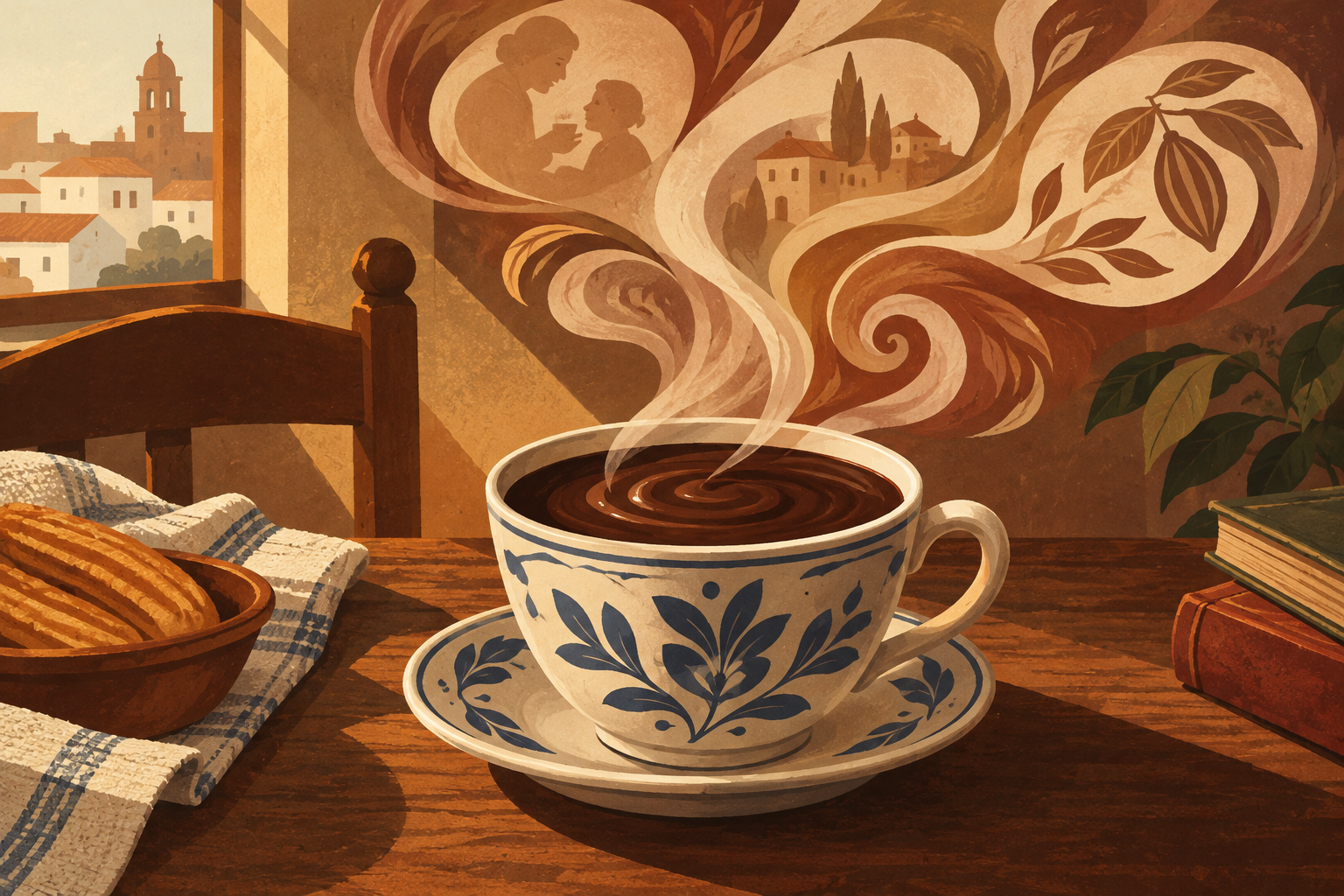
Hot chocolate has a recognizable place in Spanish food culture, but that familiarity does not justify imagining a single custom shared by everyone. The available references describe a tradition of preparation and a tool, the chocolatera, associated with beating chocolate as it melted to produce a foamy drink. This is a concrete clue to how technique could shape the experience. It is not enough, however, to reconstruct household schedules, occasions, family recipes, or how often people drank it. A careful account begins by separating documentary traces from later generalizations.
A history built from clues
The evidence gathered here is limited and uneven. A page on the history of chocolate in Spain and Alicante describes the chocolatera as a machine that beat chocolate as it melted with heat, forming a foamy liquid. Other references place the development of solid chocolate among improvements in the chocolate industry in the late nineteenth century. A tradition associated with the Monastery of Piedra is also mentioned, though the available excerpt does not develop that history.
These details point to changes in how chocolate was prepared and presented. They do not amount to a complete chronology, nor can they establish on their own when each practice became widespread. Particular care is needed when moving from a technical description to a claim about everyday life.
The chocolatera and texture
The chocolatera matters here less as a picturesque object than as a tool. According to the description available, it beat the mixture as it warmed and helped produce a foamy consistency. Texture, then, was not incidental to the preparation: it depended on a specific action and on a utensil designed to perform it.
That link between technique and result helps explain why the memory of a drink can also preserve a memory of how it was made. But these sources do not tell us which models circulated, who used them, or how often. They provide no precise recipes, ingredients, or regional comparisons either. The machine offers a clue to the process, not a complete account of every Spanish table.
From preparation to product
The reference to the consolidation of solid chocolate in the late nineteenth century signals an important industrial change, but the supplied material does not detail its causes or its effects on domestic consumption. It does allow a cautious distinction between chocolate prepared as a drink and chocolate presented in solid form. These modes of consumption are related, but they are not interchangeable.
The history of a product is not automatically the history of its customs. Changes in industrial processes do not prove that a household practice disappeared, remained unchanged, or took the same form everywhere. Establishing such claims would require more specific documents and testimony than are available here.
Social meaning without turning it into myth
Preparing a drink to share can be part of household social life; the evidence supplied, however, contains no specific testimony describing gatherings, celebrations, or family routines. It is therefore better to present shared consumption as a cultural possibility associated with the preparation, not as a proven fact about every Spanish family.
The distinction matters. A tradition may survive in accounts, local practices, or family memories without being uniform or unchanging. The idea of a domestic ritual is suggestive, but its reach should be assessed through sources tied to particular households, periods, and regions. What can be stated is that beating the drink and producing a foamy texture belong to its documented history.
What the sources leave open
The references are brief and varied in character: a popular account, an encyclopedic entry, and excerpts about industry and history. They offer no quantitative data, direct testimony, or comparison between generations. Nor do they establish when the chocolatera began to be used in each region, how long it remained in use, or how it related to present-day practices.
That limit does not make the subject irrelevant; it defines the appropriate scale for discussing it. Rather than declaring a single national custom, we can look at how a utensil and a technique help explain the material form of a drink, and how that preparation may acquire meaning in everyday memory.
A tradition best understood precisely
Spanish thick hot chocolate can be understood as more than a product: its history includes preparation methods and a texture associated with a specific tool. The evidence does not demonstrate an identical ritual in every home, nor does it allow us to reconstruct its social evolution in full. It does support a firm, bounded conclusion: the way chocolate was beaten and served belongs to its cultural history, and telling that history accurately requires distinguishing what is documented from what still needs proof.
- Decade
- 1990s
- Region
- Spain
- Level
- Introduction
- Entities
- Chocolatera
Sources and references
- Origen y evolución del chocolatewww.spend-in.com · 2026-10-16
- Historia del chocolate - Wikipedia, la enciclopedia librees.wikipedia.org · 2026-10-16
- Historia del chocolate en España y Alicante | Tarta de manzanatartademanzanacasera.com · 2026-10-16
- Historia del Chocolatewww.nestlefamilyclub.es · 2026-10-16
- Industria chocolatera en Españaes.wikipedia.org · 2026-10-16