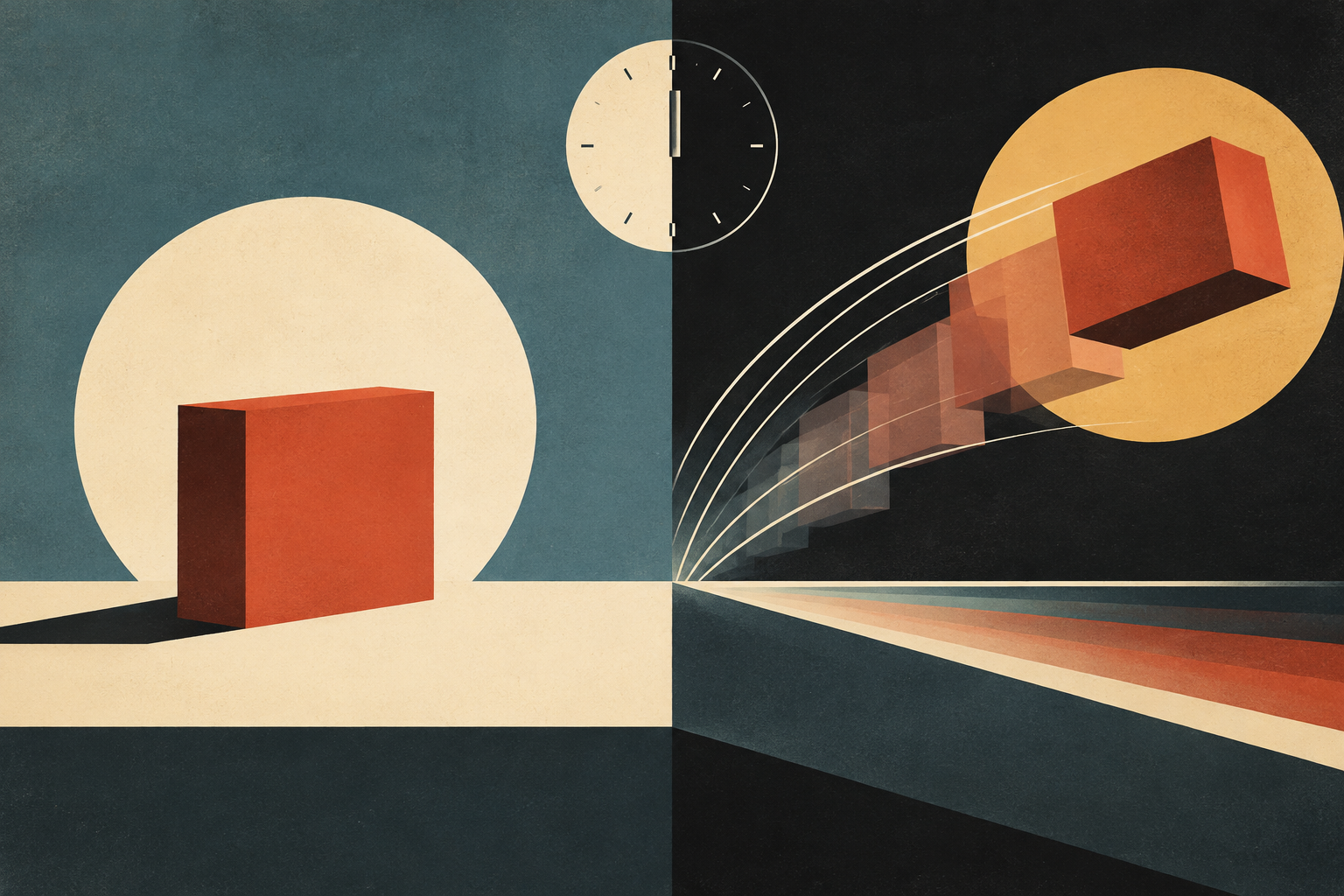
A product launch does not necessarily begin when an item reaches a shop or is presented to an audience. It also begins earlier, in the images that prepare its arrival and anticipate how it will be seen. Product photography can be ready to accompany a press release, an online store and advertising on launch day. Corporate video, meanwhile, offers a way to arrange actions and processes over time. These are not interchangeable media: each organizes attention differently.
That difference matters beyond a technical choice. A still image invites viewers to pause over a surface; a sequence introduces duration, movement and rhythm. In commercial communication, both forms can help establish a recognizable visual identity, but the available evidence does not show that choosing one or the other by itself causes a launch to succeed. The firmer ground lies in the production practices and contexts of use that can be observed.
An image that must be ready
Launch photography has a practical role and a specific timetable. One guide to launch photography says images should be prepared before an event because they may accompany a press release, an online shop and advertising published on the day itself. Photography, then, is not only a record made after the fact; it helps shape how a product is presented from the outset.
Its stillness allows viewers to linger over composition and visible detail. That does not mean every photograph fully reveals an object or that every use calls for the same framing. The available documentation supports advance preparation for several channels, but it does not establish a universal visual formula or specify particular lighting and production choices.
Time enters the frame
Video adds a dimension that photography cannot provide in the same way: duration. A product can appear in motion, in use or within a succession of actions. Rhythm organizes what is shown and how long each element receives attention. An academic article identified by its distinction between the temporal factor and rhythm addresses precisely this difference between photography and video. The supplied information, however, does not include its full argument, so more specific conclusions cannot safely be attributed to it.
In corporate production, photography and video can be planned from a shared brief to create coherent pieces. One studio’s description lists teams, facilities, processes and campaigns among possible subjects. This suggests that video need not be limited to a direct product presentation: it can also show settings and activities. It does not establish that every campaign combines both media or that one format always takes precedence.
Channels and kinds of attention
Photography suits materials that need an image readily available for consultation, such as catalogs, websites or advertising. Video suits temporal narratives and channels that accommodate movement, including some social formats and presentations. These are associations of use, not hard rules: the evidence provided contains no comparative publication data and does not show that any channel belongs exclusively to one format.
The medium changes the audience’s experience. A photograph can remain visible while someone reads a description; a video guides attention through a sequence. In both cases, the image selects which features appear and which remain outside the frame. A launch is therefore also an act of editing: it decides what to show, in what order and in what context.
Coherence without promises of trust
Keeping a visual relationship among different pieces can help audiences recognize them as part of the same presentation. The cited commercial material proposes producing photography and video from a shared brief to achieve coherence. That intention must be distinguished from proof of an effect: the available sources offer no audience studies measuring trust, and they cannot show that visual consistency guarantees a particular response.
This caution matters because promotional language often presents trust as the direct result of a professional image. The sources here describe services and common uses, not experiments establishing causation. It is possible to analyze how a visual presentation is built; it is not possible to infer from that presentation alone how particular consumers will respond or how much a product will sell.
What changes, and what remains
Photography and video do not represent successive stages in which one technology replaces another. The first retains its ability to offer an image that can be consulted at a glance; the second expands presentation into action and time. In a launch, they may work as complementary pieces if the campaign brings them together. They may also be used separately, depending on the material and channel; the evidence does not support broader generalizations.
The cultural shift lies in the expanded scope of presentation: a product can appear not only as an object but also within a sequence of use or a process. Yet not every moving image creates an immersive experience, just as a photograph is not necessarily a simple representation. Visual form opens possibilities and sets limits, while context determines how audiences encounter them.
A reading with clear limits
The supportable claims are specific: product photographs can be prepared for circulation before a launch; corporate production can bring photography and video together under a shared direction; and video introduces duration and rhythm into representation. The supplied evidence is not enough to reconstruct the historical development of these practices, compare results across brands or measure commercial impact.
Both media are best understood as tools for organizing a first presentation, not as guarantees of success. Photography holds the gaze; video carries it through time. A launch takes visual shape through decisions to combine—or separate—these two ways of showing, and those decisions can be examined without mistaking them for proof of sales or trust.
- Decade
- 1990s
- Region
- Global
- Level
- Enthusiast
- Entities
- No linked entities
Sources and references
- El factor temporal y el ritmo como distintivo entre fotografía y vídeodoi.org · 2026-10-15
- Fotografía para lanzamientos de marca y producto - eventecheventech.mx · 2026-10-15
- Producción de fotografía y video corporativowww.estudio2957.com · 2026-10-15
- construye una marca, genera confianza y ...www.instagram.com · 2026-10-15
- Fotografía de marca: tipos, ejemplos y creación.translate.google.com · 2026-10-15
- Fotos para eventos de marca y lanzamiento de productoswww.fotofuneventos.com · 2026-10-15