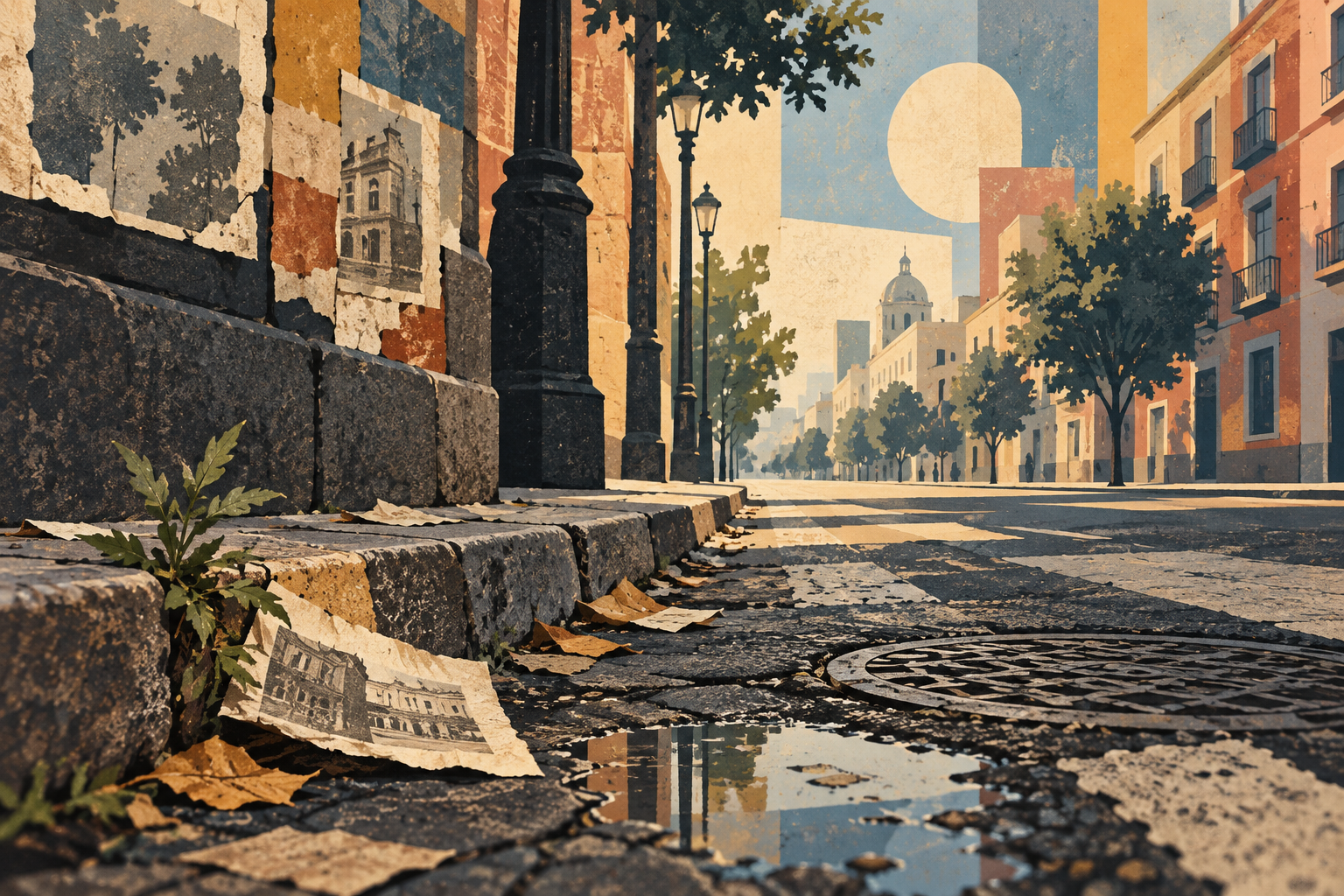
A space that leaves traces
The street is often described as a place to pass through. In everyday life, however, it is also a setting for meeting, work, exchange and the circulation of news. That double role matters to history: practices beyond the home can leave documentary traces, though they rarely appear together in a complete account. To read the street as a source is not to imagine what an ordinary day looked like, but to ask what the available records allow us to say.
The history of everyday life pays attention to settings that can fall outside narratives focused on institutions or major events. These include the home and the street, the private and the public, intimacy and sociability. The relationship is not the same in every place or for every group. Any broad claim about “the street” therefore needs to be anchored in a particular context and in materials that can be examined.
From the square to the circulation of notices
The evidence available points to varied uses of urban space. A study of everyday life in Madrid treats the street as a space of social relations, while research on the city and press advertisements describes posters, pamphlets and loose sheets alongside the oral circulation of notices. The street emerges not only as a physical setting but also as a network of communication: people could encounter printed messages and news passed by word of mouth.
That evidence raises a specific historical question: how communities communicated before contemporary media organized much of the flow of information. But it does not, on its own, tell us who read each notice, who spread it, or how the practice differed among neighborhoods and social groups. The cited research identifies a possible mechanism; it does not justify treating it as a universal experience.
Archives and their different scales
Institutional archives can provide material for studying the relationship between space and daily life. The Bogotá Archive, for instance, presents documents connected with water in everyday life in 1949 and the characterization of some neighborhoods around that resource. The subject opens a way to examine how a material need can shape questions about households and the urban environment. The evidence supplied here, however, does not specify the documents in the collection or the particular conclusions drawn from them.
Newspapers, family archives and academic studies can complement institutional records when they are available and examined in context. These sources are not interchangeable: each records different things and has its own silences. An advertisement may show what message circulated, but not how many people received it. An administrative document may describe a neighborhood from an institution’s perspective rather than from the experience of each resident. Comparing materials can sharpen questions; it cannot automatically erase their limits.
Reading without filling in the gaps
The street as archive is first of all a method. It encourages researchers to look for traces of commerce, communication and sociability in documents that may not have been created to record everyday life. It also requires a distinction between observation and inference. A source’s mention of a street or notice does not, by itself, prove how that space was used, what it meant to residents, or which groups were excluded from it.
That caution matters especially when writing about whole communities. Surviving records may privilege institutional voices or activities that generate more paperwork. The experiences of people who appear less often in archives can be difficult to reconstruct. The answer is not to fill the gap with a plausible scene, but to state what evidence is missing and seek other kinds of source where they are available.
History built from specific questions
The cultural value of this approach lies in changing the scale of attention. Rather than treating the street as a neutral backdrop, it allows us to ask who met there, what circulated and what traces were recorded. The materials on Madrid, printed and oral notices, and Bogotá’s documents about water offer different starting points; they do not, by themselves, amount to a complete comparative history.
The firmest conclusion is also the most limited: public space can be studied as part of everyday life when claims rest on specific documents and acknowledge their limits. The street does not preserve collective memory intact. It preserves uneven traces that historical work can carefully relate to one another. Read this way, ordinary movement becomes a verifiable question, not an invitation to invent the past.
- Decade
- 1990s
- Region
- Global
- Level
- Introduction
- Entities
- No linked entities
Sources and references
- El agua en la vida cotidiana de 1949 y la caracterización ...archivobogota.secretariageneral.gov.co · 2026-10-15
- Introducción a la historia de la. vida cotidianawww.memoriapoliticademexico.org · 2026-10-15
- (PDF) Mestizaje, vida cotidiana y cultura materialwww.researchgate.net · 2026-10-15
- 67918 - Historia de la vida cotidianazaguan.unizar.es · 2026-10-15
- BVCM000171 Vida cotidiana en Madrid. Primer tercio del ...www.madrid.org · 2026-10-15
- Vida cotidiana y ciudad a través de los anuncios de prensa ...journals.openedition.org · 2026-10-15