The usual narrative of animation focuses on the final product, the consumable object that reaches the screen. However, there is a layer of prior documentation that constitutes the true record of creation: production materials. Sketches, workbooks, and technical documents preserved in academic and professional archives are not merely decorative relics, but primary evidence of the decisions that configure a character's identity. This analysis examines how these documents reveal the iterations and adjustments that a synopsis cannot capture, offering a distinct perspective on visual history.
The Primacy of the Working Document
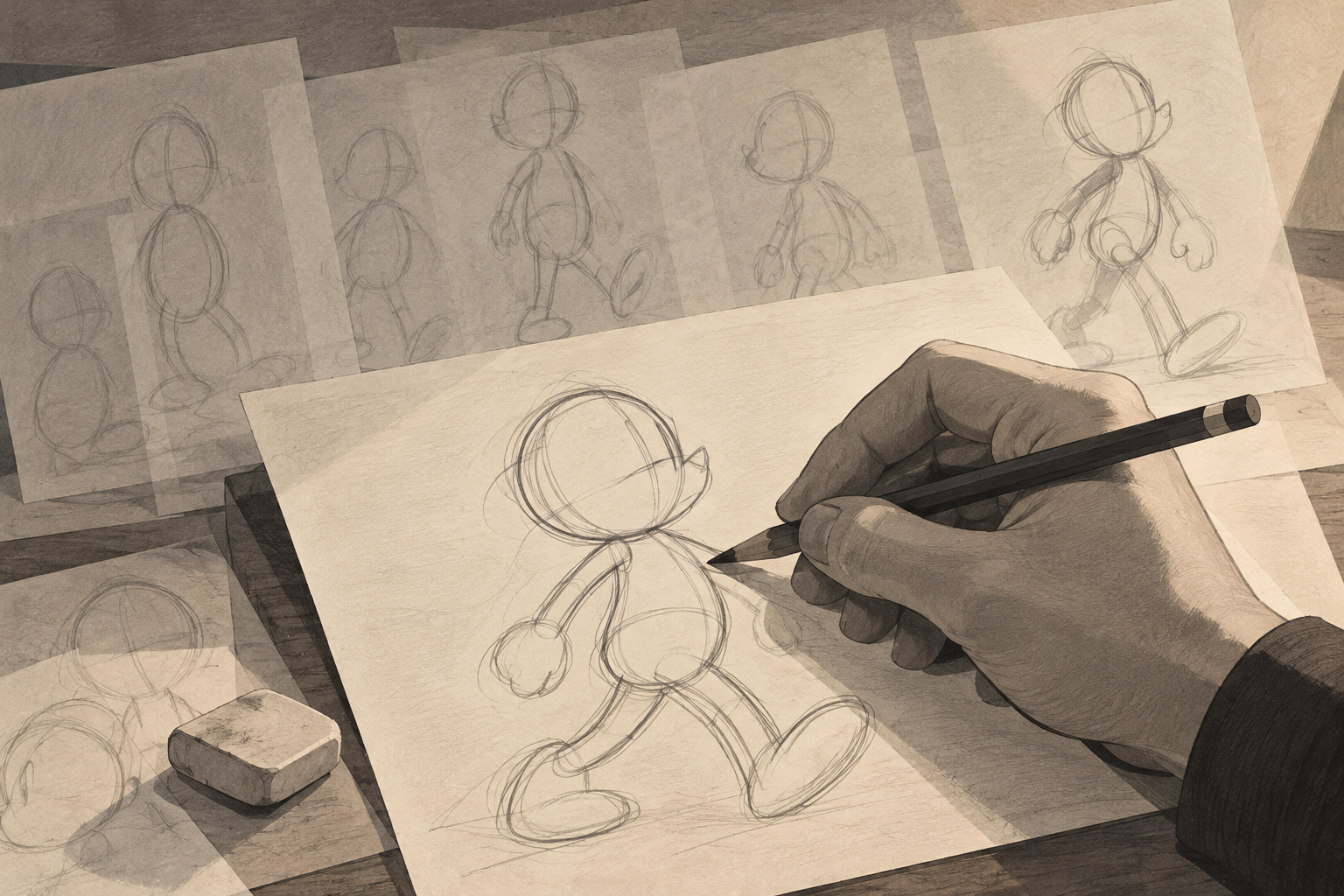
In the history of film and television, attention is usually directed to the result. Nevertheless, production archives contain the trace of the process. These materials document the stages of pre-production, production, and post-production, but with a special emphasis on the design phase. By studying them, one observes that a character is not born complete, but is built through multiple revisions. This documentation allows researchers to understand how visual and narrative identity is acquired, an aspect that the final product, by its polished nature, tends to hide.
The Case of Out of the Inkwell
A key reference for understanding this methodology is the series Out of the Inkwell, produced by Max Fleischer between 1918 and 1929. This series emerged from experimental shorts made between 1914 and 1916 to demonstrate the rotoscope. The technique involved projecting a film through an easel with a glass panel, on which the image was traced frame by frame. This technical process generated specific documentation of movements and strokes that differs from traditional animation. The use of Dave Fleischer, Max's brother, as the model for the character Koko the Clown, illustrates how physical reality was translated into graphic design through direct visual records.
The Golden Age and Standardization
Character development in Disney's golden age, documented in primary sources, shows a distinct evolution. Here, the adjustment of stroke and body structure sought specific expressiveness. Unlike the initial technical experimentation of Fleischer, the documentation from this era reflects a search for coherence and repeatability. The workbooks from this period not only show design changes but the systematization of movement and proportion rules. This transition from experimentation to standardization is visible in the archives and marks an inflection point in production technique.
Limitations of Documentary Memory
Despite their value, these materials have limits. There is not always complete documentation for every decision. As noted in contemporary expanded animation projects, documenting something for which there is no prior record is a challenge. The fissures and gaps of memory are inherent to the archive. The absence of footage or specific notes can leave zones of uncertainty about original intentions. Therefore, analysis must distinguish between what is documented and what is inferred, avoiding attributing absolute certainties to processes that are only partially known.
Process as Language
Production technique is not just a means, but a language in itself. The strokes, corrections, and annotations in workbooks communicate information about the work culture of the studios. The connection between animation and film studies is strengthened by recognizing that the archive is a readable text. Researchers can read these layers of decision to understand how visual languages evolve. This perspective places animation not only as entertainment, but as a field of study with its own documentary grammar.
Relevance for Current Research
For enthusiasts and academics, access to these materials offers a depth that traditional criticism does not provide. It allows reconstructing the logic behind the forms. In a context where digitalization facilitates access to dispersed archives, the importance of these documents grows. It is not about replacing the vision of the final product, but complementing it with the reality of the workshop. The history of animation is enriched by including the voice of working documents, which testify to the tension between idea and execution.
Conclusion
Sketches and workbooks are silent witnesses to animated creation. Their study reveals that the process is as important as the result. By analyzing material evidence, one better understands the technical and artistic complexity that defines a character. This approach invites looking beyond the screen, toward the archive, where the tangible memory of visual innovation resides.
- Decade
- 1950s
- Region
- Global
- Level
- Enthusiast
- Entities
- Televisión, Out of the Inkwell, Revisiones
Sources and references
- Animando la historia – Animación ampliadatranslate.google.com · 2026-10-17
- Historia y principios de la animación | PDF | Fuerzaes.scribd.com · 2026-10-17
- Notas para el curso de Animación por Computadoraproyectodescartes.org · 2026-10-17
- Snow White and the Seven Dwarfses.wikipedia.org · 2026-10-17
- Out of the Inkwelles.wikipedia.org · 2026-10-17