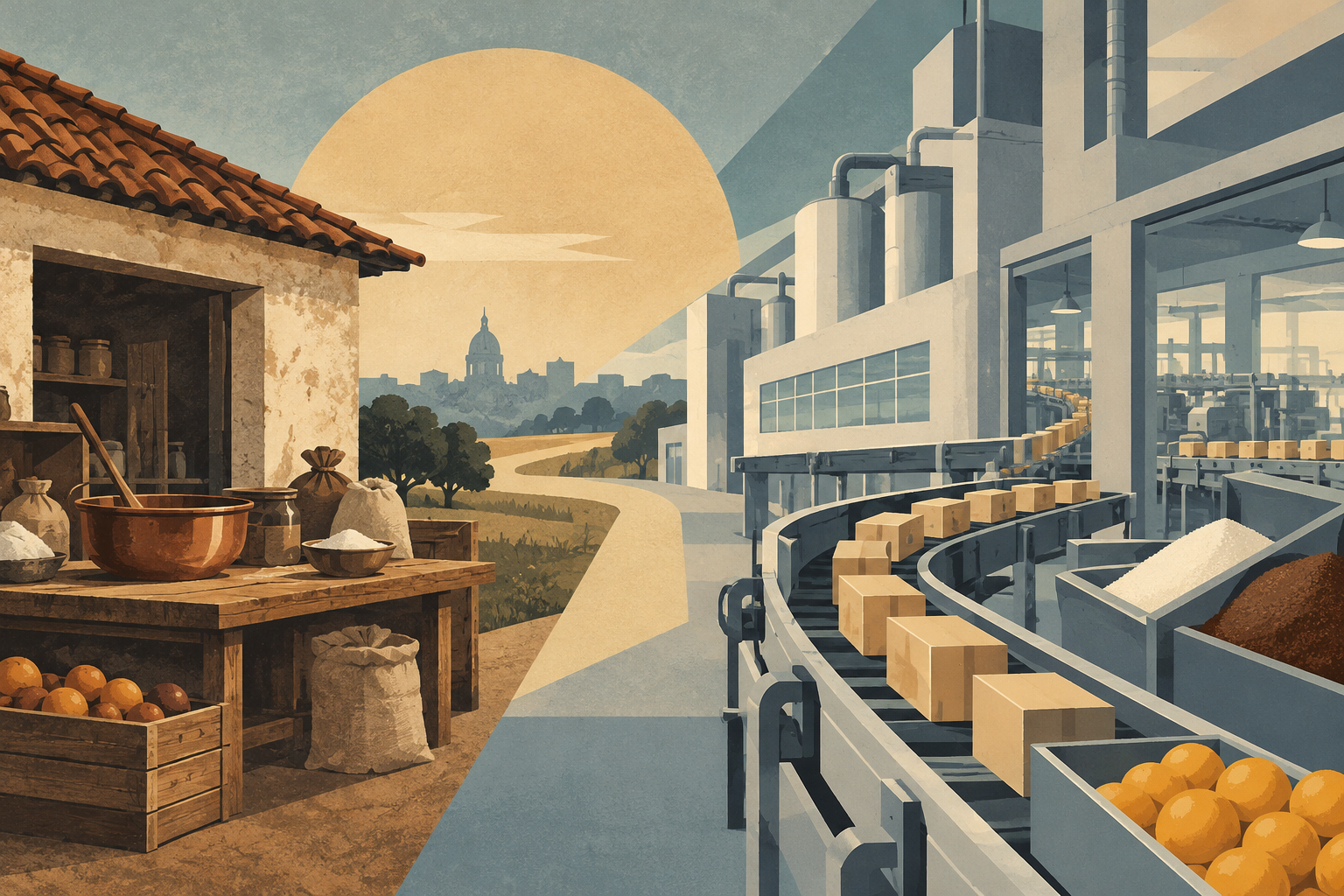
The history of Arcor does not begin in a boardroom, but in the specific economic context of early 1950s Argentina. Founded in 1951 in the city of Arroyito, Córdoba province, the company emerged from a group of entrepreneurs who identified an opportunity in the local market. This geographical and temporal origin is fundamental to understanding not only the corporate trajectory, but also the social dynamics that allowed its growth. It is not a narrative of isolated success, but a case study on how State policies and private initiative converged to reconfigure the national food industry.
The protectionist context as a catalyst
To understand the birth of Arcor, it is necessary to look beyond the company itself. According to academic documents, such as those published in the Repba journal, the company was born in the heat of the protectionist measures implemented during the import substitution industrialization process. This macroeconomic framework was not a simple backdrop, but a determining factor. Tariff barriers and local production promotion policies created an environment where national brands could compete without the immediate pressure of foreign competition. Arcor benefited from this protection, allowing it to establish and grow in a market that was being actively shaped by the State.
From domestic practice to standardized brand
One of the most interesting aspects of the available evidence is the distinction between domestic practice and commercial promotion. Before the expansion of brands like Arcor, the preparation of food and candies was predominantly a domestic activity. Food was cooked at home, and products were consumed in a family and local context. The arrival of Arcor and other similar companies introduced a qualitative change: the standardization of consumption through packaging and brands. This not only implied greater product availability, but also a transformation in consumer perception. The brand became a guarantor of quality and a form of identity, partially displacing trust in artisanal or domestic production.
Initial specialization in chocolates and biscuits
Historical documents indicate that Arcor initially specialized in chocolates and biscuits. These products were not chosen at random; they were mass consumption goods with high growth potential. The industrialization of chocolate and baking was already gaining ground in Argentine table culture. By focusing on these sectors, Arcor could leverage existing demand and position itself as a key supplier. The quality of these products, combined with accessible prices, was one of the keys to its initial acceptance. The company sought to offer quality food at an accessible price for everyone, a mission that resonated with the aspirations of a society in the process of modernization.
Expansion into a multinational group
Although Arcor began as a local company, its subsequent evolution transformed it into a multinational group. According to corporate and academic sources, the company expanded into other business divisions, such as agribusiness and packaging. This diversification was not a random jump, but a strategic adaptation to the global market. By controlling more links in the value chain, from raw materials to packaging, Arcor could optimize its costs and ensure the quality of its products. This expansion reflects a long-term vision and an adaptability that distinguished it from other companies of the time. The transition from a local brand to a multinational actor is a complex process involving investments, alliances, and a deep understanding of international markets.
The tension between documented facts and cultural interpretations
It is crucial to distinguish between documented facts and interpretations of Arcor's cultural impact. While the founding date, place of origin, and initial specialization are verifiable data, the cultural impact of the brand is more subjective and open to interpretation. Some argue that Arcor contributed to the homogenization of tastes, while others highlight its role in democratizing access to quality food. This tension between the factual and the interpretive is inherent to corporate history. When analyzing Arcor's trajectory, we must be aware of the limits of available evidence and avoid falling into exaggerations or simplifications. Corporate history is a narrative construction that must be approached with rigor and context.
Limitations of evidence and the role of primary sources
The available evidence on Arcor comes from a variety of sources, including academic articles, corporate reports, and historical documents. However, it is important to recognize the limitations of these sources. Primary sources, such as corporate reports, may be biased by the need to present a positive image of the company. On the other hand, academic articles offer a more critical perspective, but may be limited by access to private archives. The combination of these sources allows for a more complete understanding, but not one free from uncertainties. When working with this evidence, it is fundamental to maintain a critical stance and question dominant narratives. Arcor's history is an example of how the interaction between the State, the market, and society can lead to the creation of brands that transcend national borders.
Conclusion: A case study in food industrialization
Arcor's trajectory from Arroyito to becoming a multinational group is a valuable case study for understanding food industrialization in Argentina. It is not just a story of business success, but a reflection on the economic, political, and social forces that shaped the consumer market. The founding of Arcor in 1951, in the context of protectionist policies, marks a turning point in the relationship between the consumer and the food product. By analyzing this history, we can gain insights into how local brands can grow and adapt to global changes, and how State policies can influence the development of the national industry. Arcor's lesson is that business success is not an isolated phenomenon, but the result of a complex interaction of factors that must be understood in their historical and social context.
- Decade
- 1950s
- Region
- Latin America
- Level
- Introduction
- Entities
- Arcor
Sources and references
- (DOC) El nacimiento de Arcorwww.academia.edu · 2026-10-17
- Arcor - Wikipedia, la enciclopedia librees.wikipedia.org · 2026-10-17
- Quiénes Somoswww.arcor.com · 2026-10-17
- Origen y Fundación de Grupo Arcor: Historia y Evolución ...www.studocu.com · 2026-10-17
- Historia y expansión de Arcor | PDF | Alimentos | Businesses.scribd.com · 2026-10-17
- Repba Revista de Economía Política de Buenos Airesojs.economicas.uba.ar · 2026-10-17