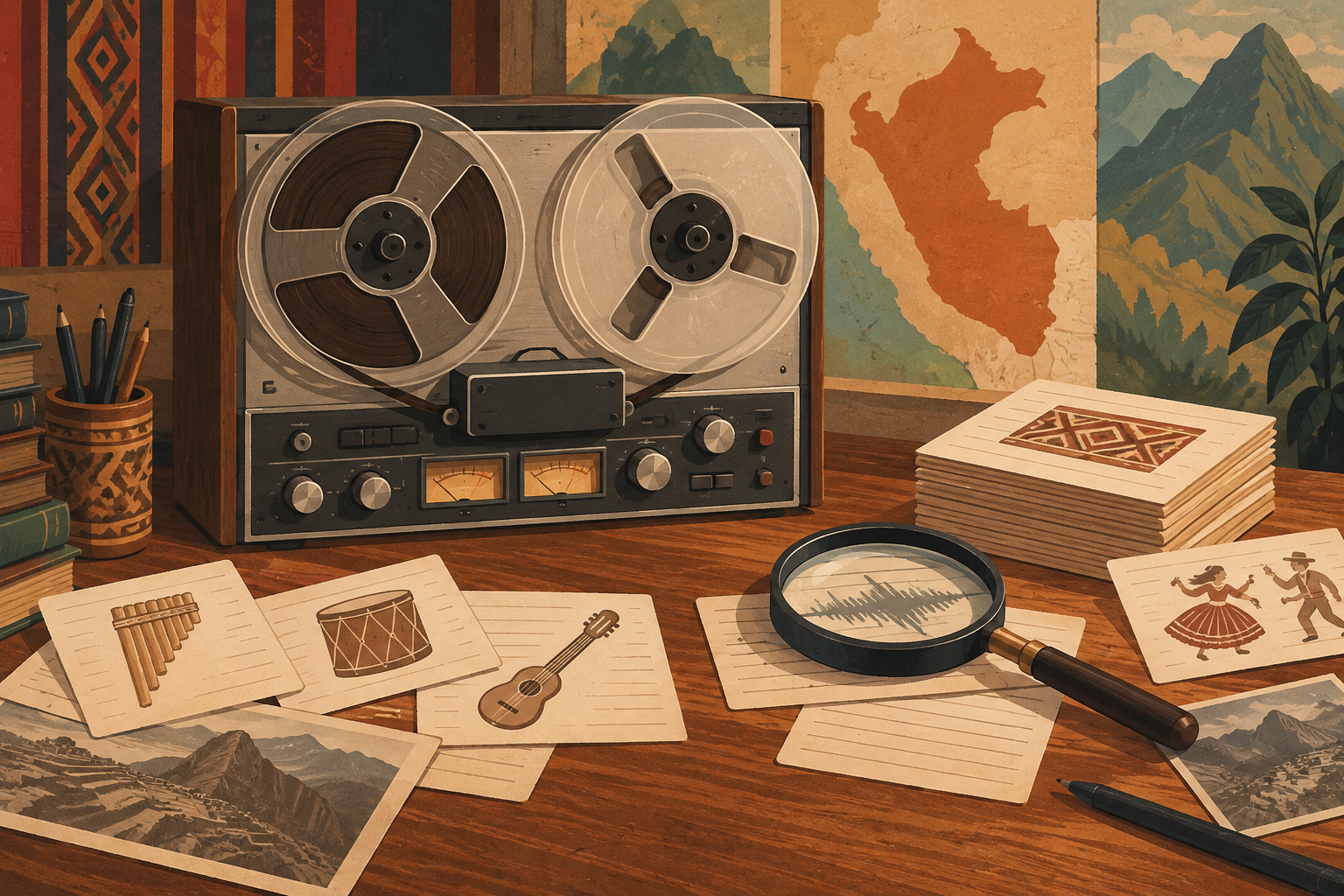
The notion that a music archive serves as a faithful mirror of popular culture is a simplification that recent research has dismantled. R. Chocano’s 2025 study offers a critical look at Peru’s Folkloric Music Archive, established between 1949 and 1952. Far from being a mere container of sounds, this archive was the result of complex decisions where academic interests, institutional limitations, and international contact networks converged. Understanding this dynamic is key to grasping how a nation’s sonic memory is constructed and which voices remain on the margins of official history.
The Transnational Context of Creation
The emergence of the archive did not occur in a vacuum. According to available evidence, its formation took place in a transnational context where various agendas related to folk music converged. This implies that decisions about what to record and how to catalog it were not purely local but were influenced by streams of thought and archival practices that crossed borders. The notion of what constituted a legitimate or valuable tradition was, therefore, mediated by international dialogues that shaped local categories.
Intellectual Agendas and Sonic Selection
A central contribution of the study is the attention to the intellectual agendas that guided the collection of materials. Not all sounds present in Peruvian society at the time were considered worthy of recording. Selection was an act of power and cultural definition. Determining which sounds entered the archive and which were left out involved establishing aesthetic and ethnographic hierarchies. This filtering process reveals that the archive does not capture the totality of musical diversity, but a curated version of it, aligned with certain academic and political discourses of the era.
Institutional Challenges in Management
The management of these materials faced significant institutional challenges. The logistics of recording, the preservation of media, and the organization of funds were not trivial tasks. A lack of resources or standardized protocols may have limited the scope of the archive. These practical obstacles interacted with theoretical decisions, creating a documentary reality that reflects both the intentions of its creators and the material limitations of their time. The accidented management of these authentic sounds, as the article is titled, suggests that the process was neither linear nor free from internal conflicts.
Constructing the Category of Folklore
The term folklore is not a neutral label but a historical construction. The study allows us to examine how the institutional context and exchanges between countries participated in defining this category. What was understood as folklore in 1950s Peru was not an immutable essence, but a category in formation, molded by the need to order cultural diversity under parameters comprehensible to academia and the State. This construction directly affects how the authenticity of preserved traditions is interpreted.
Authenticity as an Object of Study
Authenticity is a problematic concept in ethnomusicology. The article proposes treating it not as an inherent quality of music, but as an object of inquiry. This means analyzing how the perception of authenticity is produced and which interests benefit from it. By denaturalizing the concept, one avoids the trap of assuming that the archive contains the pure truth of a tradition, recognizing instead that it contains an interpretation of that tradition, validated by specific institutions and power networks.
Limitations of Available Evidence
It is important to note that the analysis is based on the article’s abstract and secondary sources. Detailed information on the technical media used, the specific identity of the musicians recorded, or the exact structure of the cataloging is not available. For a complete understanding, it would be necessary to consult the full text and the primary sources of the archive. This limitation requires a cautious stance when making concrete claims about the specific contents of the documentary fund.
Conclusion: The Archive as Process
Peru’s Folkloric Music Archive of 1949-1952 is not a static object but a historical process. Its study reveals that the preservation of popular culture is always an act of selection and construction. By understanding the intellectual agendas and transnational connections that shaped it, one gains a more critical perspective on how cultural memory is formed. The archive does not just store sounds; it also stores the decisions that determined which sounds deserved to be remembered.
- Decade
- 1950s
- Region
- Latin America
- Level
- Enthusiast
- Entities
- Sounds
Sources and references
- La valoración de colecciones como herramienta para la ...revistas.javeriana.edu.co · 2026-10-17
- Una aproximación para la conservación de instrumentos ...www.academia.edu · 2026-10-17
- Archivo del Museo de Música de Mariana, siglos XVIII-XIXwww.unesco.org · 2026-10-17
- Escuchar un paíswww.museoreinasofia.es · 2026-10-17
- La accidentada gestión de sonidos auténticos: Agendas ...www.cambridge.org · 2026-10-17