The visitor experience has a visual form
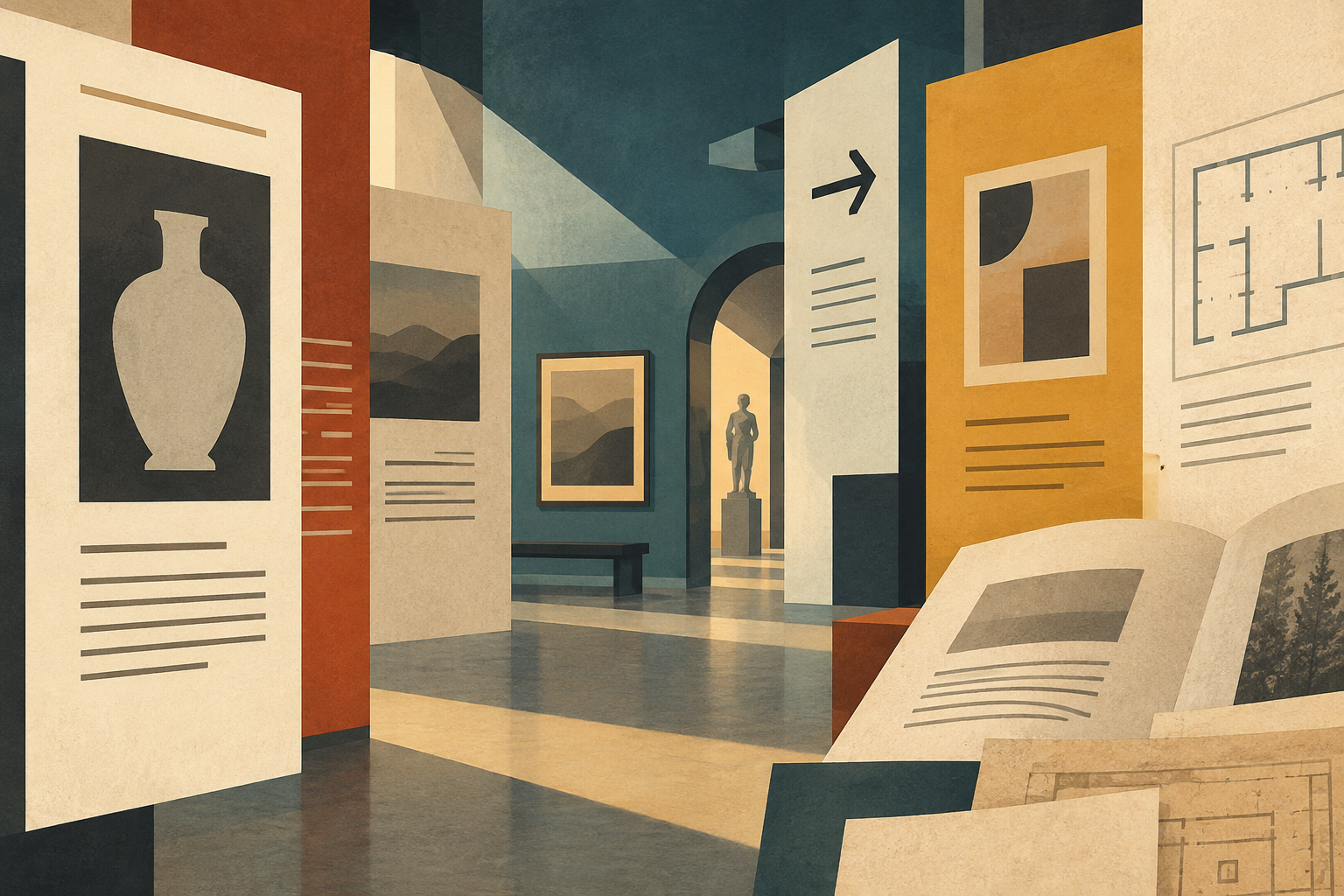
Entering a museum means encountering more than objects. Signs, labels, catalogues and other graphic elements also guide us. The available evidence on museum graphics identifies these supports as part of an institution’s communication. They are not an afterthought to the visit: they help structure it and make information accompanying the collections legible.
This offers a way to consider design beyond the isolated object. A label, for example, mediates the relationship between an object and a visitor; a sign indicates a route; a catalogue gathers information in another format. Treating these materials as mediators is an editorial interpretation, grounded in the documented fact that they belong to museum graphics and communication.
Design selects and orders
Institutional design makes some information visible and establishes hierarchies among it. A sign emphasizes a direction; a label distinguishes one set of details from another; a catalogue arranges content across pages. These choices can reasonably be analysed as forms of visual organization, without assigning a particular intention to an institution when the supplied sources do not document one.
The cultural interest lies not only in whether a graphic item is attractive or recognizable. What it contains, how it relates to other documents and what image of the institution it conveys also matter. One of the supplied research records addresses the communicative effectiveness and social function of brands in advertising and design. This provides a useful framework for asking questions about visual communication, but does not by itself establish how any particular museum graphic system or campaign worked.
The archive broadens the field of study
The source on museum archives describes them as documenting an institution’s history and development, its collections, exhibitions and programmes. The Prado Museum’s archive page states that it holds several documentary collections, including records produced and received by the museum itself. The Museo Cerralbo page dates the establishment of its archive as such to 1924, following the state’s acceptance of the testamentary bequest of the 17th Marquis.
These examples show that institutional archives need not be limited to documents about collection objects. They may also preserve materials connected with a museum’s activities. For design research, this suggests a specific line of enquiry: whether labels, signage, catalogues or other graphic materials are documented in the available holdings. The sources gathered here do not establish which particular items each institution preserves, so that question must remain open to direct archival consultation.
From administrative record to cultural source
The supplied writing on museum archives discusses their organizational role and their potential as spaces of communication. Another text concerns the conservation of documents in relation to design and cultural heritage. Together, these references support an important distinction: a document may help an institution manage its work while also offering evidence about how it communicates.
That second function should not be assumed for every item. Establishing it would require identifying the document, understanding its provenance and determining what it contains. Researchers could then examine how text, image, wayfinding and institutional context work together. This caution prevents a general interpretation—that graphic materials communicate—from becoming an unverified claim about a specific object or collection.
What is preserved, and what remains to be checked
The sources support the relevance of organizational archives and graphic elements to museum communication, but they do not provide an inventory of historical designs or a chronology of their development. Nor do they establish authorship, creation dates or audience responses for particular labels or campaigns. Further work would require consulting specific holdings and catalogues and checking findings against institutional documentation.
That limit does not make the subject less worthwhile; it defines what can responsibly be said. Treating museum graphics as part of the archive makes it possible to ask verifiable questions about how information was organized, which formats were used and how institutional activity was presented. Design then ceases to be mere background: it becomes a dimension of the visitor experience and a potential source for studying the museum’s visual culture.
- Decade
- Contemporary
- Region
- Spain
- Level
- Introduction
- Entities
- Museo Cerralbo, Museum
Sources and references
- Publicidad y diseño: la eficacia comunicativa y función social de las marcas: evolución y adecuación al contexto socialdoi.org · 2026-09-30
- La gráfica del museo también comunica: diseño, archivo y ...www.retropause.com · 2026-09-30
- Archivos de Museo: Funcionamientoevemuseografia.com · 2026-09-30
- Archivo - Museo Nacional del Pradowww.museodelprado.es · 2026-09-30
- Archivo - Museo Cerralbo - Ministerio de Culturawww.cultura.gob.es · 2026-09-30
- Contexto, nº 2ria.asturias.es · 2026-09-30
- Archivos de museos. Una oportunidad para liderar el ...edicionsedic.es · 2026-09-30
- Diseño y patrimonio cultural: cómo asegurar la conservación ...turia.uv.es · 2026-09-30