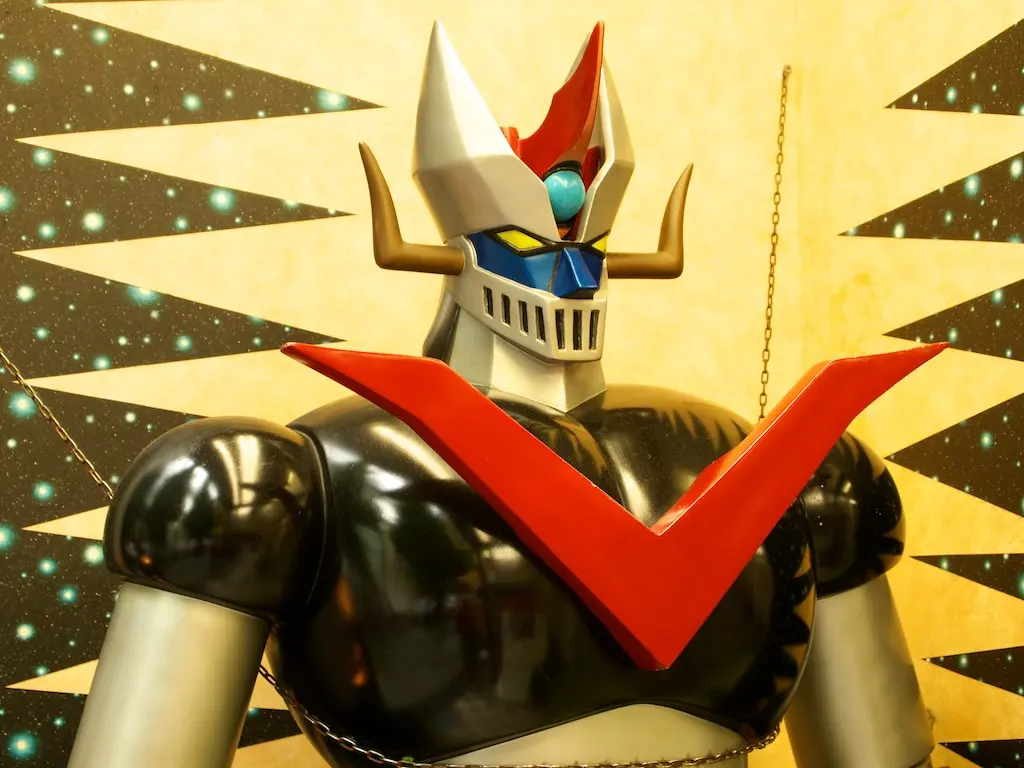
Mazinger Z, an anime series that premiered in 1972 and is associated with Go Nagai, holds a notable place in the history of television adventures featuring giant robots. Its contribution can be described without turning it into an absolute origin: the series foregrounded the relationship between a person piloting a machine of extraordinary scale and the conflict that machine makes possible. That framework proved influential, although the evidence available here cannot precisely establish how much any later work drew from it.
The cultural interest of Mazinger Z lies in the robot’s image and in the way it organizes action around control. It is not merely futuristic machinery in the setting; the human pilot connects technology to choice and risk. This offers a useful way to understand the mecha image’s durability: mechanical power becomes narratively legible through a human figure.
A milestone, not an absolute beginning
The evidence dates Mazinger Z to 1972 and presents it as a work associated with the emergence of mecha series. A broader claim—that it was the first mecha series or single-handedly founded the genre—is not established by the materials available. The supplied excerpt on anime history traces Japanese animated films back to the 1910s. That places the series within a much longer tradition, though it does not by itself settle the specific chronology of animated robots.
It is therefore more accurate to describe Mazinger Z as a notable contribution to the consolidation of a popular form, rather than an isolated invention. The distinction matters: genres develop through conventions and successive works, and the sources gathered here do not provide enough documentation to assign definitive priority.
The pilot as a link between machine and story
The original article’s description does identify a giant robot controlled by a human hero as a central element. This arrangement turns a fantastic scale into an intelligible dramatic situation: the machine may be enormous, but its actions are tied to human decisions. Technology and heroism are not separate themes in this kind of adventure; they are parts of the same narrative mechanism.
The shorthand formula of hero, giant robot, and antagonist can work as a broad description, but it should not be mistaken for a single rule governing the entire genre. Nor does it explain the variety of later robot stories. Its interpretive value lies in pointing to the meeting of technological spectacle and individual agency that Mazinger Z helped make legible to television audiences.
Circulation beyond Japan
The original text attributes an international reach to the series in Latin America, Europe, and Asia, alongside commercial success and the creation of spin-offs. This suggests that Mazinger Z did not remain confined to its context of origin. Transnational circulation matters because a television work can become a cultural reference not only through its story but through its availability in different territories.
The supplied material, however, gives no broadcast dates, channel details, audience figures, or regional distinctions. We can report that the series was exported to these areas according to the original account, but cannot establish how it was received in each country or which specific factors explain its popularity. Its global influence should be understood as a reported trajectory, not a uniform reception.
Comparisons with later works
The original article names Gundam, from 1979, and Mobile Police Patlabor, from 1989, as titles related to the Mazinger Z formula. Their dates place them later, but sequence alone does not prove direct influence. Without documented statements, comparative scholarship, or production sources, it is more careful to speak of thematic continuity or shared genre conventions than of a demonstrated chain of cause and effect.
This caution does not diminish Mazinger Z’s significance. It distinguishes cultural legacy from a verifiable genealogy. A work can serve as a recognizable reference for thinking about a genre without every later resemblance being a quotation or direct consequence.
What can be said about its production
The original description mentions traditional animation and a vivid palette, but supplies no documentation to clarify methods, production processes, or the use of rotoscoping. Rotoscoping appears as a claim without further support in the evidence, so it should not be repeated as a confirmed fact. The claim that the series was the genre’s first to feature a female protagonist also cannot be verified here; the same text describes its central figure as a hero, leaving an unresolved contradiction.
The material also mentions a digitized DVD edition released in 2000, but includes no information to verify its date, scope, or characteristics. These limits do not prevent a discussion of the series’ cultural importance; they mark the difference between interpretation and documented fact.
Its influence makes more sense in context
Mazinger Z remains interesting as a work that joined the spectacle of the giant robot to the active presence of a human pilot and circulated beyond Japan. It is more rigorous to see it as a milestone in the consolidation and spread of mecha imagery than as the sole cause of everything that followed. This reading recognizes its weight without exceeding the evidence: its historical place is significant, but claims of absolute priority and direct influence require sources not available here.
Documentary gallery
- Decade
- 1980s
- Region
- Japan
- Level
- Introduction
- Entities
- Televisión, Anime
Sources and references
- Anime Complejo. La ambigüedad narrativa en la animación japonesadoi.org · 2026-10-23
- La narración compleja en el anime postclásico: La ambigüedad narrativa en la animación comercial japonesadoi.org · 2026-10-23
- Historia del animetranslate.google.com · 2026-10-23
- La historia y evolución del anime Parte 1: (1970www.instagram.com · 2026-10-23
- 🔥 ¿Cuáles son los animes más populares de todos ...www.instagram.com · 2026-10-23