Format is more than a container
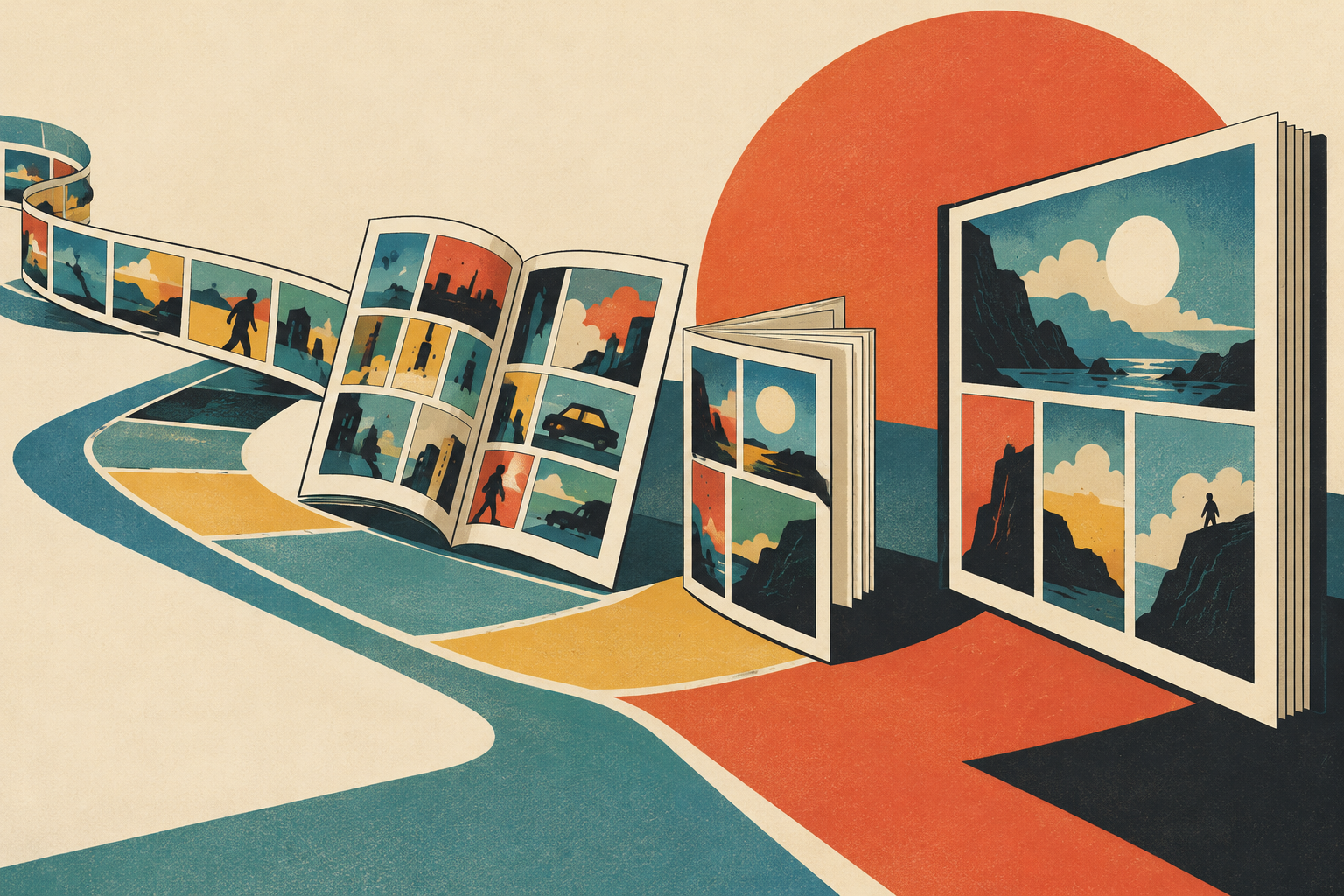
A drawn story reaches readers as a sequence of images and words, but also as an editorial object. The study by Rubén Varillas cited here places formats at the centre of the discussion: comic magazines, fanzines, mini-comics, albums and graphic novels. Its title and bibliographic record identify the field of analysis; by themselves, they do not justify attributing specific conclusions to the author that the available material does not reproduce.
They do, however, support a useful question for reading comics: what changes when a narrative appears in a magazine, a short booklet or a volume? The answer is not contained in a label alone. It requires attention to the relationship between page, sequence and material conditions of circulation.
The page as a reading unit
Comics combine drawing, text and page design. Readers move through panels, pauses and transitions; page size and image placement form part of that experience. Talking about format therefore invites us to notice not only what is told, but how visual information is arranged.
This is an analytical approach, not a claim about a specific title. Without actual pages to compare, we cannot say that any given format always creates a faster or slower pace. The more modest proposal is that when examining a work, we should consider page scale, the amount of material in each unit, and how each instalment or section organizes continuity.
Publishing in a magazine or a volume
Varillas’s reference distinguishes comic magazines and albums among the categories it studies. That distinction allows an editorial comparison to be posed: a periodical and a volume offer different reading frameworks, even though a format label alone does not determine a work’s structure.
In a magazine, the reader encounters an object that gathers content; in an album, reading is presented in a volume. This describes general differences between kinds of object, not a history of distribution or a universal rule about storytelling. A specific case would require copies, publishing information and evidence about circulation, none of which the cited sources provide here.
Fanzines and mini-comics as categories
The same study includes fanzines and mini-comics. Their inclusion in research on formats shows that they are among the categories considered in thinking about comic publishing. Without further information, it does not authorize general claims about who produced them, how they circulated or what technologies they used.
As tools for reading, these terms open up questions: what are the object’s dimensions? How is it organized? What information accompanies the comic? What traces of editing does it preserve? Each publication must be examined to answer. Here, format is an invitation to describe, not an automatic explanation of the work.
Circulation leaves traces too
Archival context helps explain why preserving more than an isolated image matters. Spain’s Ministry of Culture says that state museum archives keep documentation about objects from the time they are deposited. The National Archaeological Museum describes its historical archive as a research source for its departments and external researchers. These are general references on institutional archives, not documentation about a specific comics collection.
Applied cautiously, this perspective suggests recording, where evidence exists, publishing details and associated documentation alongside a copy. That preserves clues for investigating how the object was presented and kept. It does not, by itself, prove where a publication was sold, who read it or what impact it had.
What can be said, and what remains open
The available evidence identifies an academic article by Rubén Varillas titled “El cómic, una cuestión de formatos (2): revistas de cómics, fanzines, mini-cómics, álbumes y novelas gráficas,” published in CuCo, Cuadernos de cómic. It also provides general institutional information about archives and documentary preservation. It does not include the full study, analyses of copies or records of print runs, editions or readers.
This account therefore raises analytical questions rather than presenting conclusions as verified facts about particular cases. To establish which editorial changes altered a reading experience, we would need comparable versions of a work and evidence of their differences. Format is a starting point; reading it precisely requires returning to the objects and their documentation.
The publishing object is part of the story
Considering format does not mean reducing comics to their support. It means recognizing that drawn storytelling meets its readers through pages, sequences and published objects. Varillas’s list of categories offers an initial map for comparison. Archives, in turn, point to the value of associated documentation.
The verifiable conclusion is limited but useful: to understand how a work is read, it helps to describe both its graphic narrative and its editorial form. What that form changed in any particular case must be established through specific publications, not inferred from a label.
- Decade
- Contemporary
- Region
- Global
- Level
- Enthusiast
- Entities
- Museum, Museo Arqueológico Nacional, CuCo, Cuadernos de cómic, Rubén Varillas, Revistas de cómics, fanzines, mini-cómics, álbumes y novelas gráficas
Sources and references
- El cómic, una cuestión de formatos (2): revistas de cómics, fanzines, mini-cómics, álbumes y novelas gráficasdoi.org · 2026-10-12
- El arte contemporáneo y el museo llevados al cómicopenalex.org · 2026-10-12
- Archivo histórico - | Ministerio de Culturawww.man.es · 2026-10-12
- ARCHIVOS DE LOS MUSEOS ESTATALESwww.cultura.gob.es · 2026-10-12
- Archivos del comúnwww.museoreinasofia.es · 2026-10-12
- Archivo - Museo Nacional del Pradowww.museodelprado.es · 2026-10-12