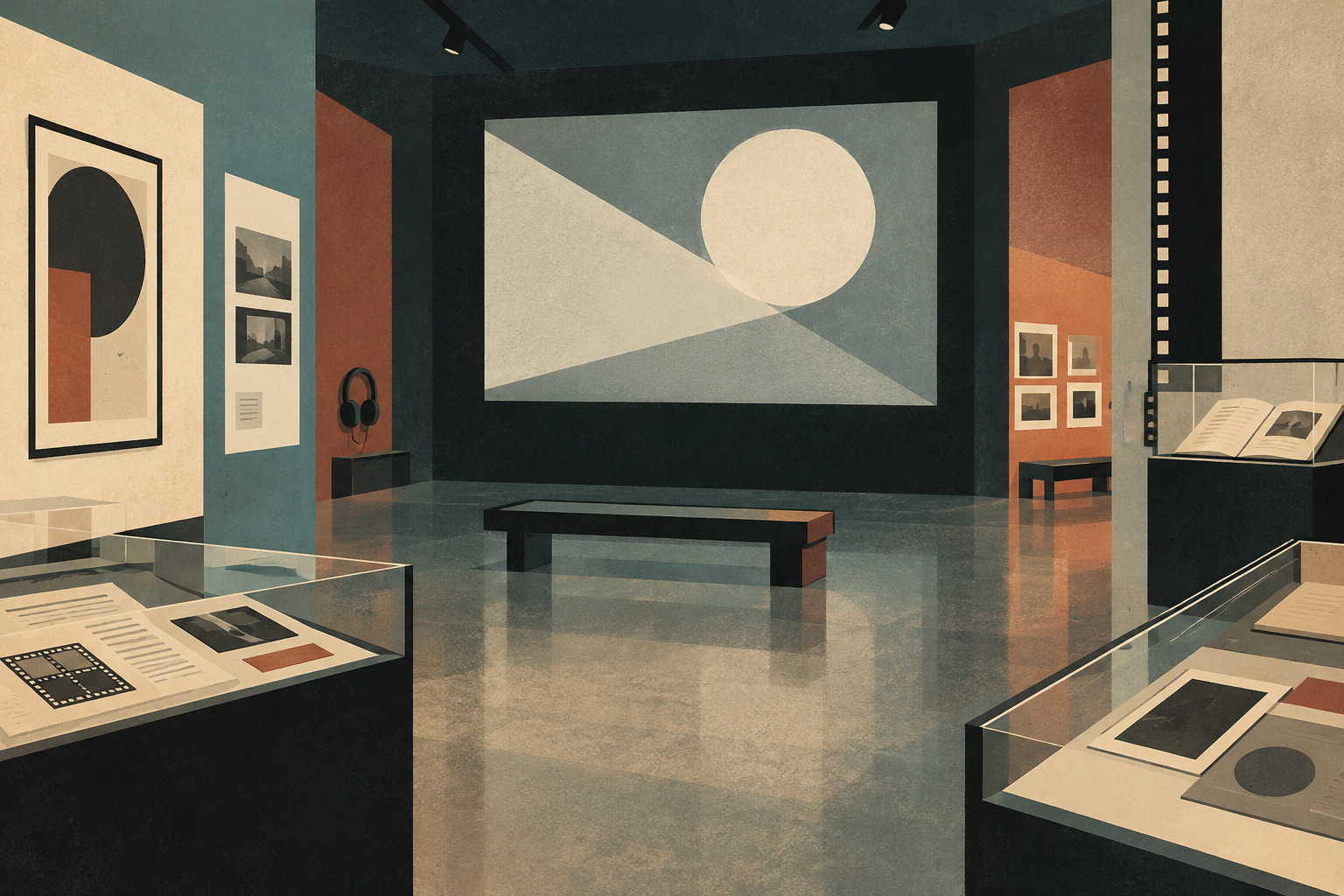
A film does not enter a museum alone. It may appear alongside documents, apparatus, exhibition materials or explanations of the circumstances in which it circulated. This company does not replace the work or automatically recreate the experience of seeing it in a theatre. It offers another way to ask how the film became visible, how it was preserved and what can still be established about it.
The exhibition is not the film
The question “What does a cinema museum preserve?” can suggest that the answer is simply copies. Yet the debate presented by revista PH is framed through the work of museums and archives, while Mercedes Iáñez Ortega’s academic study addresses cinematic heritage in the museum. Even their titles point to a problem broader than the survival of a work: how to think about and present heritage connected with cinema.
The distinction matters. A projected film is a temporal experience; an exhibited object, document or explanation offers other forms of consultation. Bringing them together can help pose questions about relationships, but does not by itself prove what an audience saw, how it interpreted the film or how much of that experience survives. This caution prevents an exhibition from being mistaken for a substitute for the work.
Context leaves traces too
The UNESCO resource on film museums and archives describes the preservation and display of moving-image artefacts “in their social context.” That wording encourages us to read materials not as decorative accessories but as possible evidence for studying the circulation and understanding of images. The description also mentions MOMI and overlapping chronologies in the evolution of cinema; by itself, it is not enough to detail its galleries or visitor route here.
The editorial consequence is practical: each displayed item should be legible both as an object and as something that may support a documented claim. A label does not prove the complete history of a material. A device does not, without further documentation, establish that it was used for a particular film. Relationships between objects may be interpretive; the evidence behind them should be identified separately.
Posters, documents and devices are questions, not shortcuts
Posters and editions can inform us about how a film was presented, provided that they are identified and placed in context. But a poster alone cannot prove that audiences accepted its promise, just as a home edition cannot sum up every way of watching a work. Claims about reception require sources that document reception, not merely materials that accompanied a film.
The Spanish Ministry of Culture page for “Cine en el Museo” presents historical cinema as a way to approach the past and understand how history is interpreted today, through reenactment. This describes a programme and an approach; it does not establish that a reenactment is direct evidence of what happened. The cinematic image must be distinguished from the later interpretation made through it.
Theatre and video: a question that needs more evidence
Did reception change between the theatre and video? The sources assembled here cannot answer that for a particular film, period or audience. They supply no audience figures, reception testimony, home-circulation data or comparisons between editions. Turning the question into a conclusion would go beyond the evidence.
They do help define what further research would require. A comparison would need verifiable material on exhibition and distribution, identifiable editions, critical documentation and reception sources. It would also need to specify what “change” means: access to the film, viewing conditions, interpretation or cultural status. These dimensions are related, but they are not interchangeable.
The archive as a way of reading
The article “Cine en el museo,” listed by OpenAlex as a 2012 publication by Paula de Felipe Martínez, Santos Zunzunegui Díez, Lola Hinojosa Martínez and Rebeca Romero Escrivá, is a useful bibliographic route into the debate. The supplied record establishes its title, publication type, year and names; it does not allow us to attribute specific arguments to its authors that are absent from the available description.
Archivoz’s review of a work by Mercedes Iáñez places the preservation of cinematic heritage within the context of museums and cultural memory. It is a review, not the full text of that work. Marking the difference is part of responsible reading: a secondary source can guide further research, but it cannot justify presenting as verified what its description does not establish.
What can be said, and what remains open
The available references support a general point: museums and archives can approach cinema through works, artefacts, contexts and forms of interpretation. They do not, however, provide a documented history of how reception changed between theatre and video. Nor do they identify a particular film whose poster or home edition can be analysed here.
An exhibition’s value, then, does not lie in passing objects off as the film, but in showing what questions they make possible and what evidence is missing. Reading cinema in the museum this way resists automatic nostalgia and makes the boundary between document and interpretation visible. The work remains central; the archive helps us understand the conditions of its presence without pretending to preserve the entire experience of watching it.
- Decade
- Contemporary
- Region
- Global
- Level
- Enthusiast
- Entities
- Museum
Sources and references
- Cine en el museoopenalex.org · 2026-10-12
- Pensar el patrimonio desde los museos del cine | revista PHwww.iaph.es · 2026-10-12
- Cine en el Museo - | Ministerio de Culturawww.man.es · 2026-10-12
- Museos y archivos del cineunesdoc.unesco.org · 2026-10-12
- El Patrimonio cinematográfico en el Museo Cinema heritage ...digibug.ugr.es · 2026-10-12
- Reseña de: “La conservación del patrimonio ...www.archivozmagazine.org · 2026-10-12