The medium does not tell the whole story
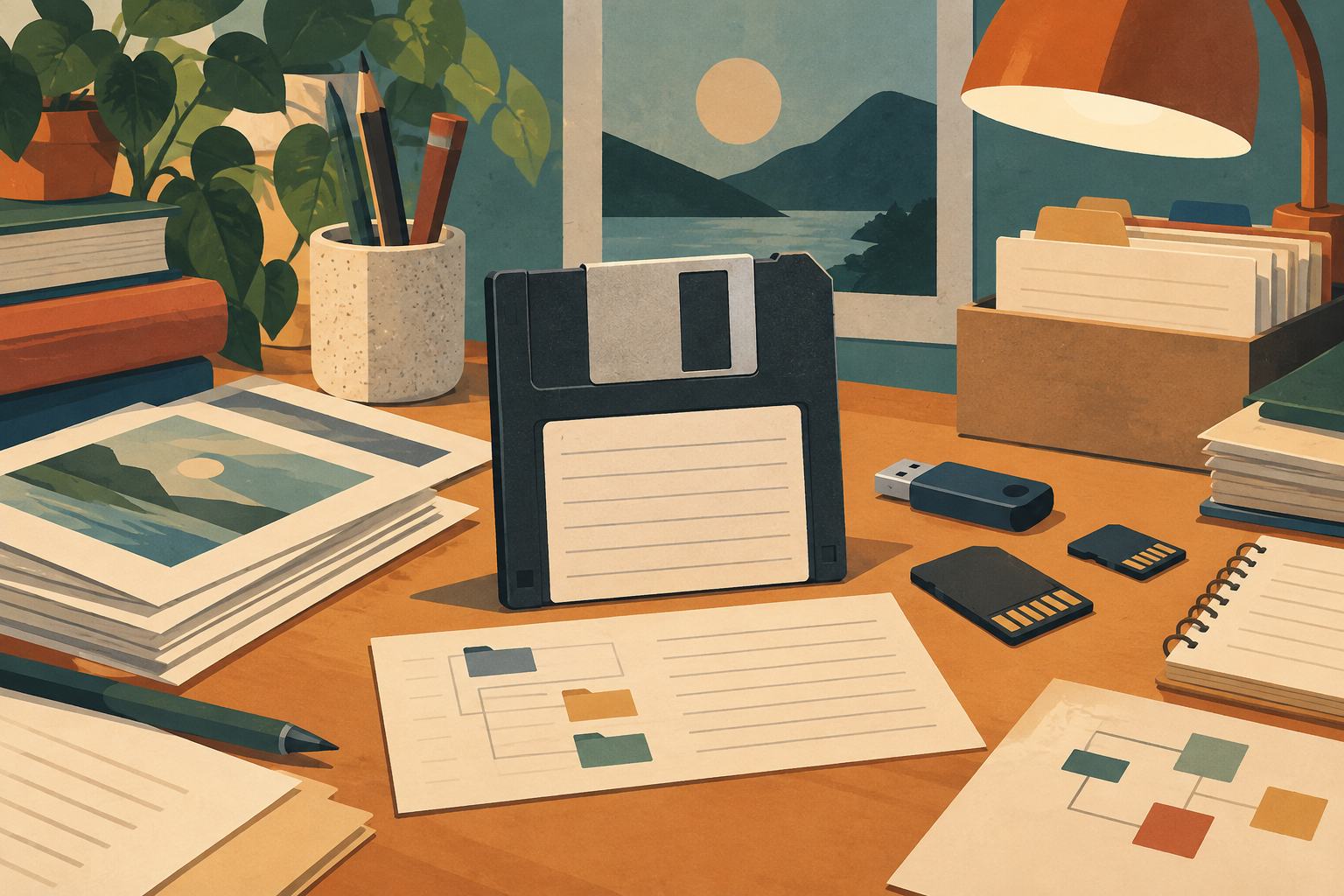
At first glance, a floppy disk seems to have an obvious purpose: storing information and carrying it from place to place. But when preserved as a document, its exterior form is not enough to explain what it contains, who produced it, which program may have created it, or how it relates to other material. The archival sources available here provide a useful way into that question, although they do not describe a specific domestic experience on their own.
The editorial question, then, is not how every computer was used in every home—the supplied evidence cannot reconstruct that—but which documentary traces help us understand the relationship between machine, medium and content.
One physical category, another documentary one
The article “Historical Databases” includes the floppy disk among electronic media, alongside the digital optical disc. This classification makes an important distinction visible: the medium is a physical object, while the information it holds is another dimension of the document. Naming the medium is not the same as fully describing the stored data.
Catalonia’s Archival Description Standard (NODAC) makes the principle more specific by stating that the physical storage unit should be recorded for electronic documents. Its examples include CD-ROM, DVD, DAT, floppy disk, hard drive and ZIP drive. The list supports the claim that identifying the medium is part of archival description; it does not prove that these media were used in the same way, or with equal frequency, in homes.
The medium appears in catalogues too
The cataloguing rules of Spain’s National Library refer to locally accessed computer files contained on physical devices such as reels, cassettes, cartridges or floppy disks. The excerpt places the floppy disk within a cataloguing practice: identifying digital materials associated with a tangible medium and describing them so they can be found.
A Ministry of Culture archival bulletin offers a different kind of trace. In a bibliographic record, it lists a 622-page publication accompanied by a floppy disk. Here the medium does not appear alone, but as a material supplement to a book. It is a concrete example of print publication and digital storage coexisting, but it does not justify generalising that combination to all home computers or to an entire period.
From description to context of use
A UOC study on archives, historical memory and society lists media such as floppy disks, microfilm, photographs, video and cassettes when discussing documentation. The enumeration emphasises that archives must deal with media possessing different characteristics. Blanca Rodríguez Bravo’s study of document classifications based on medium provides a related academic framework: physical form can serve as a classification criterion, but it does not exhaust a document’s meaning.
Taken together, these references teach us to read the floppy disk as part of a documentary system. Research into domestic use would require other evidence: manuals, advertising, personal archives, inventories, attributable testimony, or preserved documents whose provenance and context can be established. The mere appearance of “floppy disk” in a standard or catalogue does not prove what a family did with one.
What an archive can preserve
A description of the medium can help identify the object and record where it is held. However, the NODAC excerpt does not explain recovery procedures, compatibility or technical preservation. Nor do we have information here about data formats, capacities, brands or models. Adding such details would turn documentary research into an unsupported technical specification.
It also matters to distinguish the object from its content. A medium may survive physically even when its data cannot be read, or a catalogue may record its existence without reproducing its contents. The supplied sources support the need to describe the medium and recognise locally accessed computer files; they do not establish the preservation status of any particular floppy disk.
A domestic reading, with limits
To understand how computers entered the home, peripherals and storage media offer a promising route because they connect the machine with material tasks: storing, carrying and documenting information. But promise should not be mistaken for a conclusion. This selection consists mainly of archival and cataloguing sources; it illuminates how a medium is recorded, not how every individual used it.
The floppy disk therefore appears on two levels: as a physical unit that must be described, and as part of larger documentary collections. That dual status allows us to ask better questions about home computing, but answering them requires other sources.
What remains to be researched
A fuller article should compare equipment manuals, peripheral documentation and personal collections with verifiable provenance, as well as examine how the media and their contents were catalogued. On the current evidence, the strongest conclusion is limited: in archival and bibliographic records, the floppy disk is not merely a recognisable image, but a medium whose physical identity should be recorded and related to the document it accompanies or contains. The domestic routines surrounding that object remain open to investigation.
- Decade
- 2000s
- Region
- Spain
- Level
- Enthusiast
- Entities
- No linked entities
Sources and references
- LAS BASES DE DATOS HISTÓRICASagora.edu.es · 2026-10-01
- Los archivos, entre la memoria histórica y la sociedad del ...openaccess.uoc.edu · 2026-10-01
- Revisión de las clasificaciones documentales basadas en el soporteopenalex.org · 2026-10-01
- 01 ARCHIVÍSTICA Y GESTIÓN DE DOCUMENTOSwww.cultura.gob.es · 2026-10-01
- Norma de Descripción Archivística de Cataluña (NODAC) ...cultura.gencat.cat · 2026-10-01
- Reglas de Catalogaciónwww.bne.es · 2026-10-01