A broad term, not a visual recipe
Anime often brings to mind a recognizable look, but the available evidence supports a broader definition. The supplied encyclopedic entry describes it as traditional or computer animation of Japanese origin and notes that it can address many genres and audiences. That does not describe a single formula; it places a body of works within a medium with varied possibilities. It is useful to treat the label as a category of origin and circulation, not as a guarantee that every production shares the same appearance or purpose.
Technique changes, but not through a simple replacement
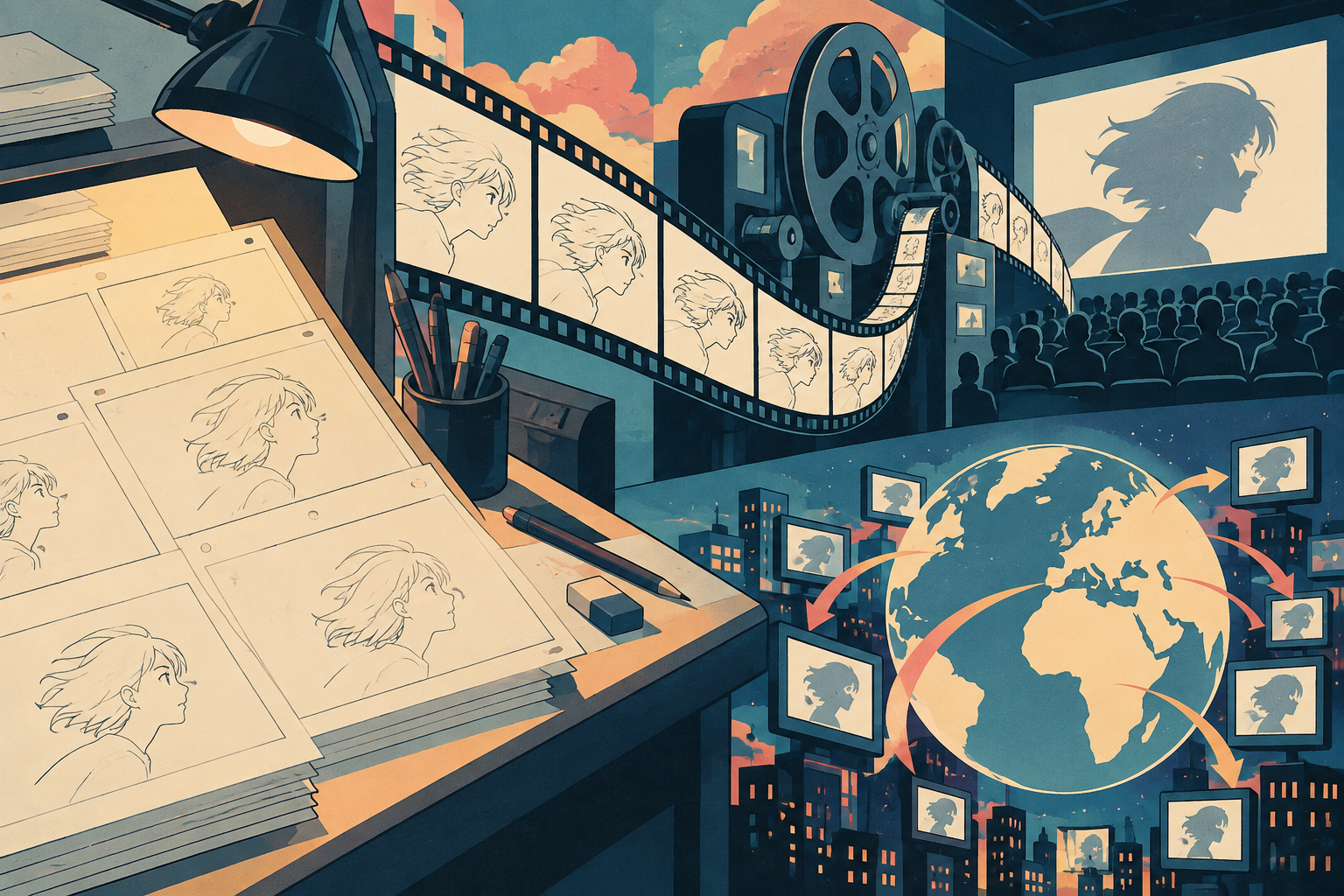
The available description explains that Japanese animation was traditionally hand-drawn, and that some digital tasks, such as retouching and editing, were adopted before coloring and certain visual effects came to be routinely handled with digital tools. This broad sequence cautions against telling the story as a clean leap from analogue to digital. The source does not provide a detailed chronology by studio or allow a precise date to be assigned to each change. It does support an account of adaptation: tools become part of processes that combine graphic and technical decisions.
Movement, framing and attention
The same entry makes a broad comparison between Japanese and Western animation: it says that some anime productions tend to focus less on continuous movement and more on detailed settings and camera devices such as pans, zooms and angles. This is a general characterization, not a rule to apply to every title. Its value lies in recalling that animation is not only about moving figures. Staging, composition and the guidance of the viewer’s gaze are part of the experience too. Without analysis of specific works, this general observation cannot be turned into a description of every film or series.
An industry also studied as a business model
The evidence includes an academic article titled “Japanese animation products as an expression of a business model: The case of anime production.” Its title documents that anime has been examined through the relationship between products and business models. There are also bibliographic records for studies of narrative ambiguity and complex storytelling in anime. These records identify lines of research, but they cannot replace reading the full texts or justify summarizing arguments that the supplied information does not show. The cautious conclusion is that anime can be studied both as an audiovisual form and as an industrial and narrative phenomenon, without assigning unsupported conclusions to those publications.
Circulation is part of the history
The anime entry mentions television, home video, cinema, subtitling, dubbing and streaming services when describing its dissemination. It also states that the medium achieved international success, especially from the 1980s onward. This suggests that reception outside Japan depends on more than production: formats, translation and access channels also matter. The source, however, does not detail markets, figures, release dates by country or specific distribution cases. It would therefore be inappropriate to turn this general account into a complete chronology of international expansion.
What can be said, and what remains open
These materials support presenting anime as a diverse category, with techniques that have incorporated digital tools, particular visual devices and circulation across several audiovisual windows. They also support noting the existence of academic research on its business model and storytelling. They do not establish production costs, the precise evolution of studios, the reception of particular audiences or the relative weight of each channel in specific periods. This distinction does not weaken the history; it prevents a synthesis entry and bibliographic records from being mistaken for exhaustive research. Anime emerges less as a fixed template than as a field where image, production and circulation intersect.
- Decade
- 2000s
- Region
- Japan
- Level
- Introduction
- Entities
- Televisión, Anime
Sources and references
- Los productos de animación japoneses como expresión de un modelo de negocio. El caso de la producción “anime”.doi.org · 2026-09-29
- Anime Complejo. La ambigüedad narrativa en la animación japonesadoi.org · 2026-09-29
- La narración compleja en el anime postclásico: La ambigüedad narrativa en la animación comercial japonesadoi.org · 2026-09-29
- Historia del anime - Wikipedia, la enciclopedia librees.wikipedia.org · 2026-09-29
- Animees.wikipedia.org · 2026-09-29