The place is part of the reading experience
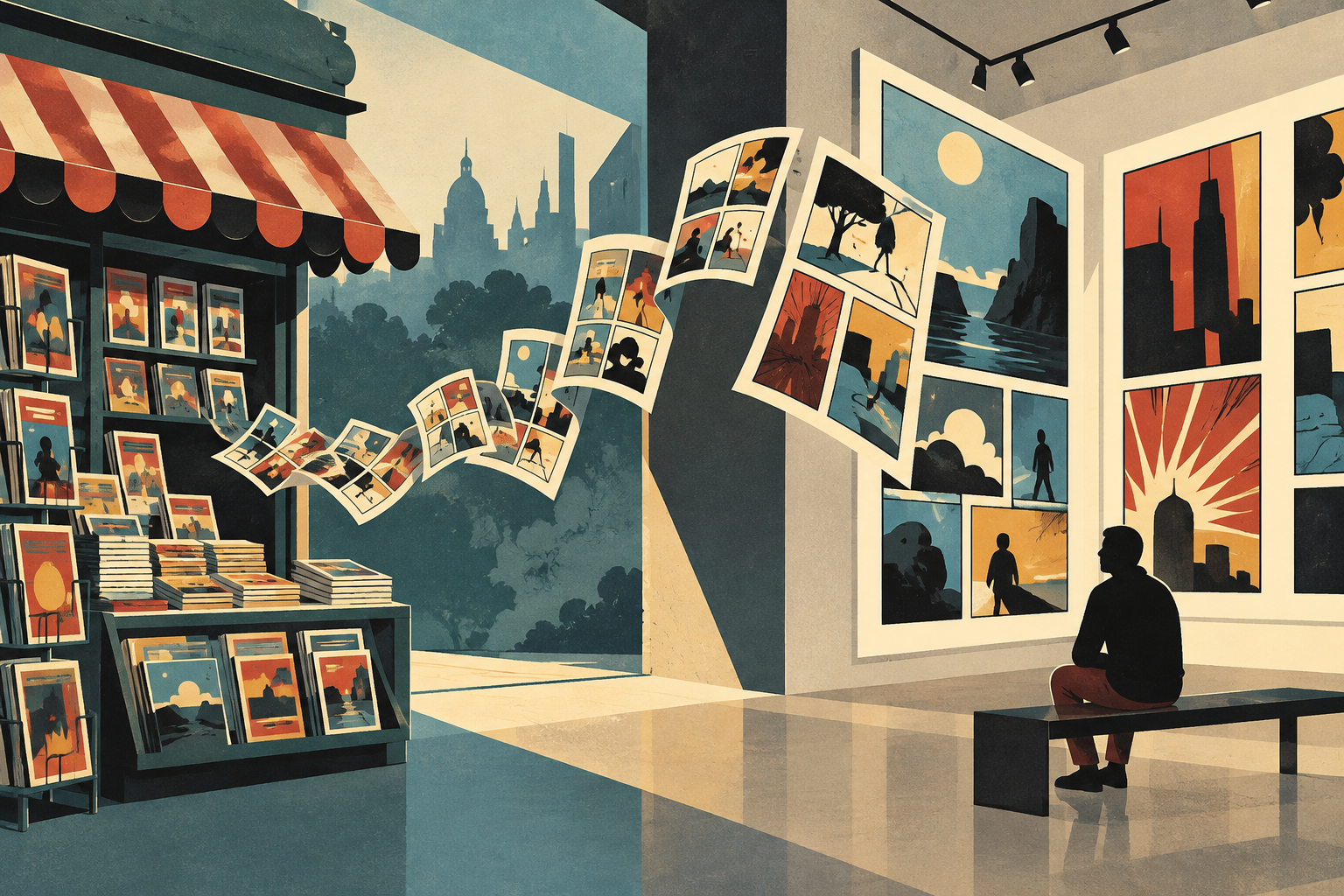
A comic does not reach its reader as a sequence of drawings detached from its support. It is read in ordered pages, within a publication, under particular conditions of circulation. Researching a comic magazine therefore means asking not only what it tells, but where it appears, how it is presented, and how it reaches readers. A RetroPause study of Spanish comic magazines from the 1970s and 1980s describes a shift in the places from which comics are seen, read, and remembered: from newsstand to museum. The study’s title does not establish every editorial change or its effects on individual publications. It does, however, offer a useful question: what happens to a work’s experience when the frame containing it changes?
Format is not a neutral wrapper
An academic article by Rubén Varillas approaches comics through formats and lists magazines, fanzines, mini-comics, albums, and graphic novels. The evidence supplied identifies the article bibliographically by title; it does not support attributing specific conclusions to it about the development of each format. Even so, the list itself reminds us that “comic” does not mean a single editorial form. Different formats can organize length, continuity, the relation between installments, and the work’s place within a publication in different ways.
That matters to reading without requiring the claim that one format is superior to another. A story published in a magazine shares space with other material; a work presented as an album or graphic novel may invite readers to regard it as a different kind of unit. This describes possibilities, not a universal rule. To establish what happened to a particular work, researchers must examine identifiable copies: their pagination, dimensions, page sequence, and any verifiable editorial notes.
The frame changes from newsstand to museum
The study of Spanish magazines links two settings: the newsstand and the museum. Here, the newsstand refers to the circulation setting named by the study; the museum represents a later form of exhibition and remembrance. The supplied evidence is not sufficient to detail print runs, distribution, prices, audiences, or editorial decisions for specific magazines. Avoiding those claims does not weaken the question; it distinguishes what is documented from what would require consulting objects and archives.
Exhibition introduces a different kind of mediation, too. MP Méndez’s article on the history and global context of comic exhibitions indicates that exhibitions have a history and may seem more recent than they are. Its summary also mentions a 1971 reference titled “Comics in the Museum,” published in BANG! The available information does not describe a particular Spanish exhibition or support generalizations about all museum practice. It does support a narrower point: the appearance of comics in museums should not automatically be treated as a recent development.
Which changes might affect the experience?
A change in publication format can alter the conditions in which readers encounter a comic, but the supplied sources do not establish every possible difference. Moving from a hypothesis to a historical account would require comparing identified copies and documenting what changed: dimensions, page count, publication rhythm, reading order, the story’s position relative to other material, or the way the work was preserved and displayed. This list is a research guide, not a description of changes already proved for a particular magazine.
It is also useful to distinguish editorial format from graphic language. Stories are made through images and words, while page design shapes the route through those images. If page arrangement changes, the material path through the story may change; claims that narrative intention or historical reception changed need additional evidence. Comparing versions, where they exist and can be identified, is essential to support that interpretation.
Reading with sources and limits in view
The supplied material brings together a study of Spanish magazines, academic work on formats and exhibitions, and a broad reference on comic magazines. It is not a catalogue of issues or a complete publishing archive. A blog article about comic magazines from the 1950s onward mentions the launch of the French magazine Pilote in 1959. That fact does not establish anything about the Spanish publications discussed here; at most, it reminds us that magazine histories need to attend to individual contexts and their specific documentation.
The soundest conclusion is methodological: format and circulation belong to comic history because they frame reading and remembrance. The sources allow us to raise the question for Spanish magazines of the 1970s and 1980s and to connect it to broader debates about formats and exhibitions. They do not allow us to list concrete editorial changes without examining issues, dates, and documents for each publication. From newsstand to gallery, the frame through which we view comics changes; determining exactly how much the work itself changed requires returning to its pages and the evidence that accompanies them.
- Decade
- 1980s
- Region
- Spain
- Level
- Enthusiast
- Entities
- Museum, Rubén Varillas
Sources and references
- El cómic, una cuestión de formatos (2): revistas de cómics, fanzines, mini-cómics, álbumes y novelas gráficasdoi.org · 2026-10-09
- Del quiosco al museo: qué cambió para las revistas de cómic ...www.retropause.com · 2026-10-09
- Las exposiciones de cómics. Historia y contexto globalerevistas.publicaciones.uah.es · 2026-10-09
- (PDF) Las exposiciones de cómics. Historia y contexto globalwww.researchgate.net · 2026-10-09
- Las mejores revistas de historietas de los años 50 a hoywww.pixartprinting.es · 2026-10-09