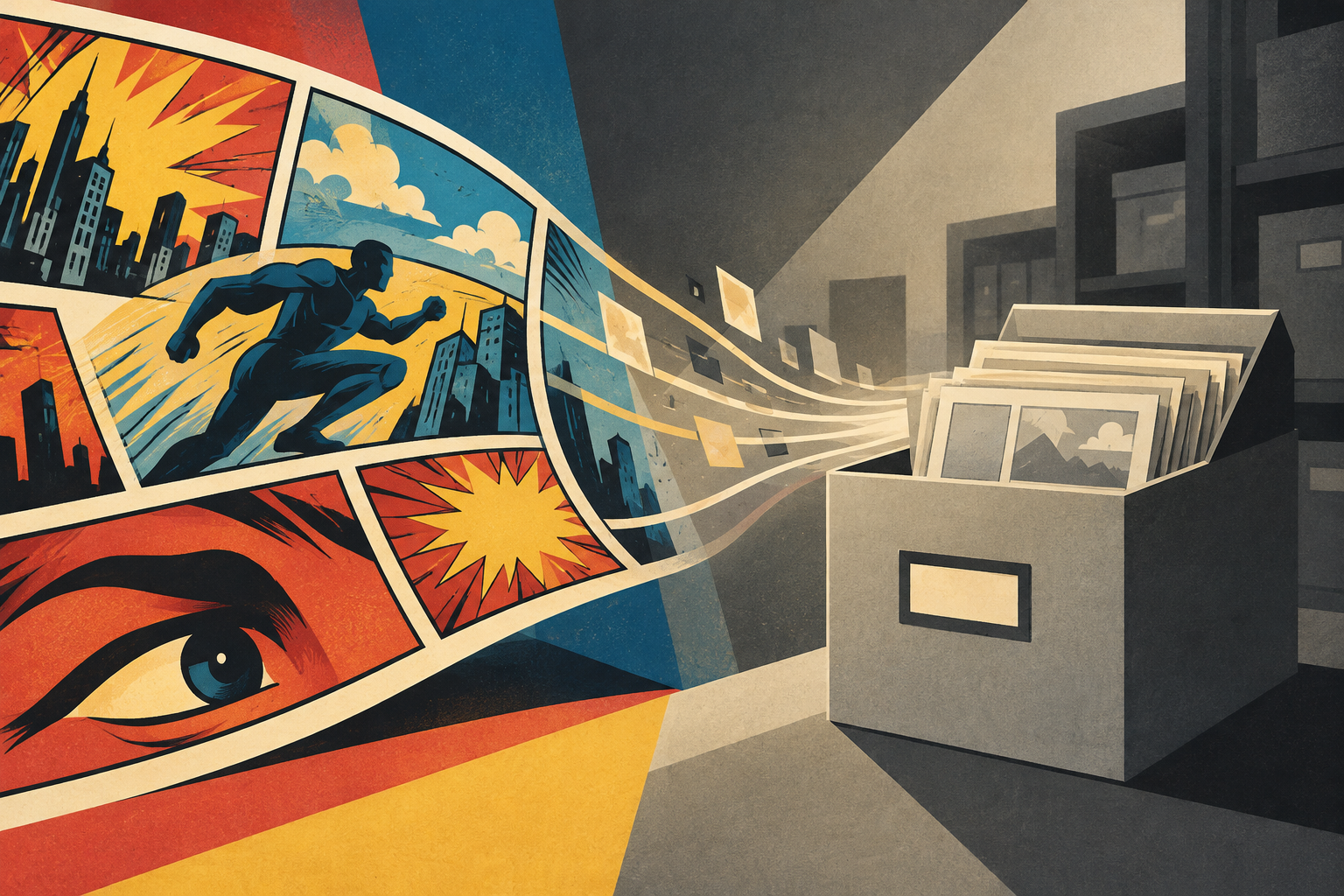
A collectible sticker can seem like a simple unit: an image, a paper support and, often, a place within a series. Yet that reading leaves out an important part of its material history. How it was printed, where it circulated, what other objects it was grouped with and which traces it retains also matter. Read carefully, stickers are both images and printed ephemera: useful documents for studying visual culture, but insufficient on their own to reconstruct the lives of the people who collected them.
More than entries in a series
The habit of arranging stickers by album or collection directs attention to the image and its place in a set. That order is valuable, but it does not exhaust the questions we can ask. The archive described by The Record Institute brings stickers together with posters, postcards, cigarette cards and covers. This breadth makes it possible to consider each item within a wider world of printed matter, rather than treating it as an isolated or exclusively collectible object.
That perspective changes what information we seek. Alongside identifying a motif, we can record the support, the reverse and the item’s physical or documented relationship to others. Grouping may be significant, but only if we know how it was established: a collection preserved together does not automatically prove that its contents originally circulated together.
Images are representations
A 2024 academic study of visual references in stickers from an early album notes that such collections can offer a view of everyday life and the culture of past periods. The claim is useful as long as we maintain a basic distinction: an image documents a representation. By itself, it does not confirm that a scene was common, that it faithfully reflected a community’s experience or that collectors interpreted it in any particular way.
It is therefore worth separating description from interpretation. Description records what appears and the observable material features. Interpretation proposes what it may have meant, ideally with contextual support. A motif may suggest something about values or customs, but the image alone cannot support a historical conclusion of that kind.
Recording without filling the gaps
A working record can begin with verifiable features: image, dimensions if measured, support, visible condition, reverse and how the sticker came to be included in the group under study. In this case, the available sources support an interest in printed ephemera and visual culture, but provide no information identifying a particular album or cataloguing its series and variants.
That absence matters. It prevents us from recommending a specific reference work, attributing a particular series or dating individual stickers. Nor does it authorize a reconstruction of how they were exchanged. Caution is not a refusal to analyse; it allows us to show what is known, what is inferred and what remains open, so that a plausible description is not mistaken for documented fact.
Circulation and preservation
Circulation is a possible part of a sticker’s history, though it cannot always be recovered from the object. Notes, groupings with known provenance or other documentary clues may help frame questions about exchange and preservation. Without such evidence, claims about specific collector networks would go beyond what has been supplied.
An archive is not a transparent mirror of the past, either. It preserves what was gathered and kept, not necessarily a complete sample of what was produced or circulated. The presence of stickers alongside posters, postcards, cigarette cards and covers invites comparisons between printed formats, but does not prove that they shared audiences, uses or routes of distribution.
A valuable source with clear limits
The cultural interest of stickers lies in the combination of image, material and context. As printed objects, they invite questions about representation and preservation; as parts of a collection, they may show relationships between items. But clues are not a complete narrative. The available sources do not establish prices, permit valuations or provide enough evidence to reconstruct particular exchange practices.
The strongest conclusion is also the most limited: studying a sticker as a document requires preserving and describing both what is visible and information about its grouping and provenance, when available. This avoids assigning it an unverifiable history while protecting its potential as a source. A sticker becomes more than a collectible image without becoming, for that reason, direct testimony to a past life.
- Decade
- 2000s
- Region
- Global
- Level
- Enthusiast
- Entities
- No linked entities
Sources and references
- Conservación y Restauración del Patrimonio Cultural en soporte Papel - Museo Jesuítico Nacional de Jesús Maríadoi.org · 2026-10-18
- Rare Vintage Print Media Archivetherecord.institute · 2026-10-18
- Didáctica-Difusión-Museología-Museografíawww.cultura.gob.es · 2026-10-18
- referentes visuales en los cromos del primer álbum de ...dialnet.unirioja.es · 2026-10-18
- (PDF) "¡Devotas estampas!, populares como los cromos y ...www.researchgate.net · 2026-10-18