The perception of comics has undergone a significant shift in recent decades. What was once considered primarily an ephemeral entertainment product is now studied and preserved as a first-order cultural document. This transformation is neither automatic nor universal; it depends on how institutions, academics, and collectors approach the materiality of the work. This article examines how the practice of conservation and archiving redefines the relationship between the reader and the comic, shifting the focus from narrative to the conditions of production and circulation.
From consumer object to heritage
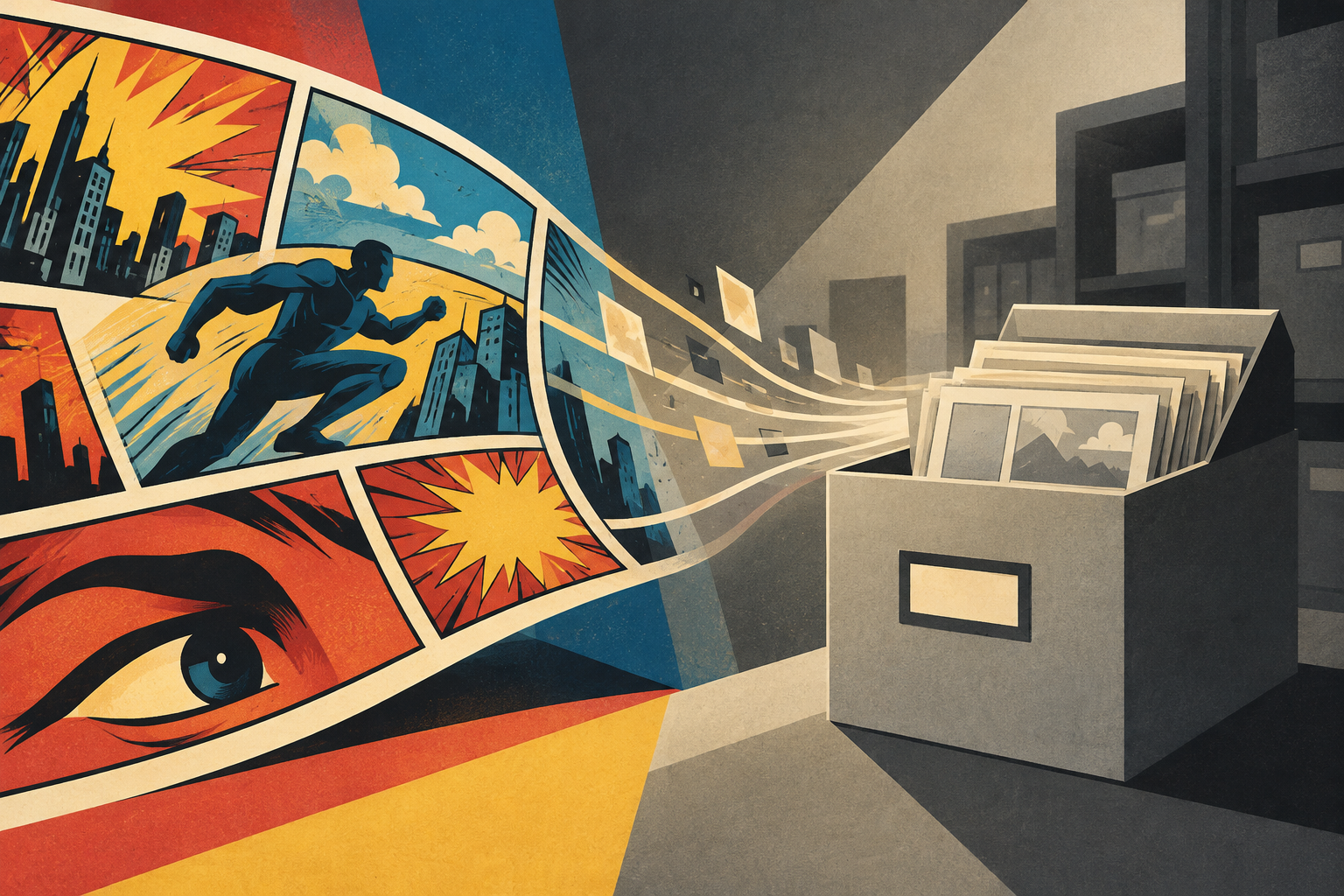
For a long time, comics occupied a marginal place in the dominant cultural discourse. They were associated with light reading, mass consumption, and a short lifespan. However, academics such as Álvaro Pons and Julio Gracia have worked to situate comics within the framework of cultural and artistic heritage. Their central argument is that the graphic work is not just a vehicle for stories, but an artifact that encapsulates aesthetic, technical, and editorial decisions. By treating comics as heritage, their intrinsic value is recognized beyond their immediate narrative function. This approach is gaining ground in museums and libraries, where comic collections are integrated into institutional narratives alongside other forms of visual art.
Exhibition as context
The way comics are exhibited has evolved in parallel with their revaluation. While the exhibition of comics is a common practice since its beginnings, its nature has changed. In the past, shows often focused on covers or final pages, treating the work as an isolated image. Today, exhibitions seek to contextualize the work beyond the cover. Archives, editorial documents, sketches, and correspondence are integrated to reveal the creative process. This approach allows the viewer to understand the editing conditions and constraints imposed by editors, offering a more complete view of comic production. The exhibition ceases to be a simple showcase of objects and becomes a space for research and documentation.
The Chilean case: a century of history
An illustrative example of this trend is the exhibition 'Chile and the world, united by comics'. This show invites visitors to traverse more than a century of comics, from 1905 to the present. Through nearly a hundred pieces, the exhibition highlights the relevance of archives and original collections. It does not limit itself to showing finished works, but explores the interconnection between local production and global currents. This case demonstrates how the archive can serve as a tool to build a coherent historical narrative, linking local memory with the international context. The exhibition underscores that comics are a witness to the social, political, and cultural transformations of their time.
Conservation challenges
The conservation of comics presents specific challenges that differ from those of other artistic media. The ephemeral nature of many materials, such as low-quality papers or unstable inks, demands rigorous preservation criteria. Moreover, comics are objects designed to be read, not just looked at. Conservation must respect this duality, ensuring that the work remains accessible to the reader without compromising its physical integrity. Museums and archives face the task of balancing the protection of the object with its public use. This involves developing handling protocols, environmental control, and digitization that safeguard the artistic and documentary value of the collection.
Format as structure
The format in which comics are presented also influences their perception as heritage. The format, whether magazine, fanzine, mini-comic, album, or graphic novel, organizes the reading experience and defines the conditions of circulation. Each format has its own historical and cultural implications. For example, the comic magazine is linked to the mass editorial industry, while the fanzine reflects independent and community production. When studying comics as heritage, it is necessary to consider how the format conditions the reception of the work. The transition from one format to another can mark significant changes in the visibility and longevity of the work, affecting its long-term preservation.
Limitations of evidence
Although the trend to treat comics as heritage is clear, there are limitations in the available evidence. Not all works have been exhaustively documented, and many archives remain inaccessible or fragmented. Furthermore, the valuation of comics as heritage is not uniform across all regions or communities. In some contexts, the work is still viewed with skepticism or ignored by cultural institutions. It is important to recognize these gaps and not assume that the revaluation of comics is a completed process. Continued research is necessary to better understand the dynamics of preservation and access in different environments.
Conclusion
The transformation of comics into a cultural heritage object reflects a broader change in how we understand media and art. By integrating comics into archives and exhibitions, their value as historical and artistic documents is recognized. This approach not only preserves the work for future generations but also enriches our understanding of contemporary visual culture. The challenge remains how to balance conservation with accessibility, ensuring that comics remain a living and dynamic medium, not just a museum object.
- Decade
- 2000s
- Region
- Global
- Level
- Enthusiast
- Entities
- Museum
Sources and references
- El cómic, una cuestión de formatos (2): revistas de cómics, fanzines, mini-cómics, álbumes y novelas gráficasdoi.org · 2026-10-17
- Del archivo al lector: el valor de las colecciones de cómiclaregenta.org · 2026-10-17
- (PDF) Las exposiciones de cómics. Historia y contexto globalwww.researchgate.net · 2026-10-17
- La exposición “Chile y el mundo, unidos por el cómic ...www.instagram.com · 2026-10-17
- Los desafíos del museo en el cómicwww.zubiaurcarreno.com · 2026-10-17