An individual piece is not yet a collection
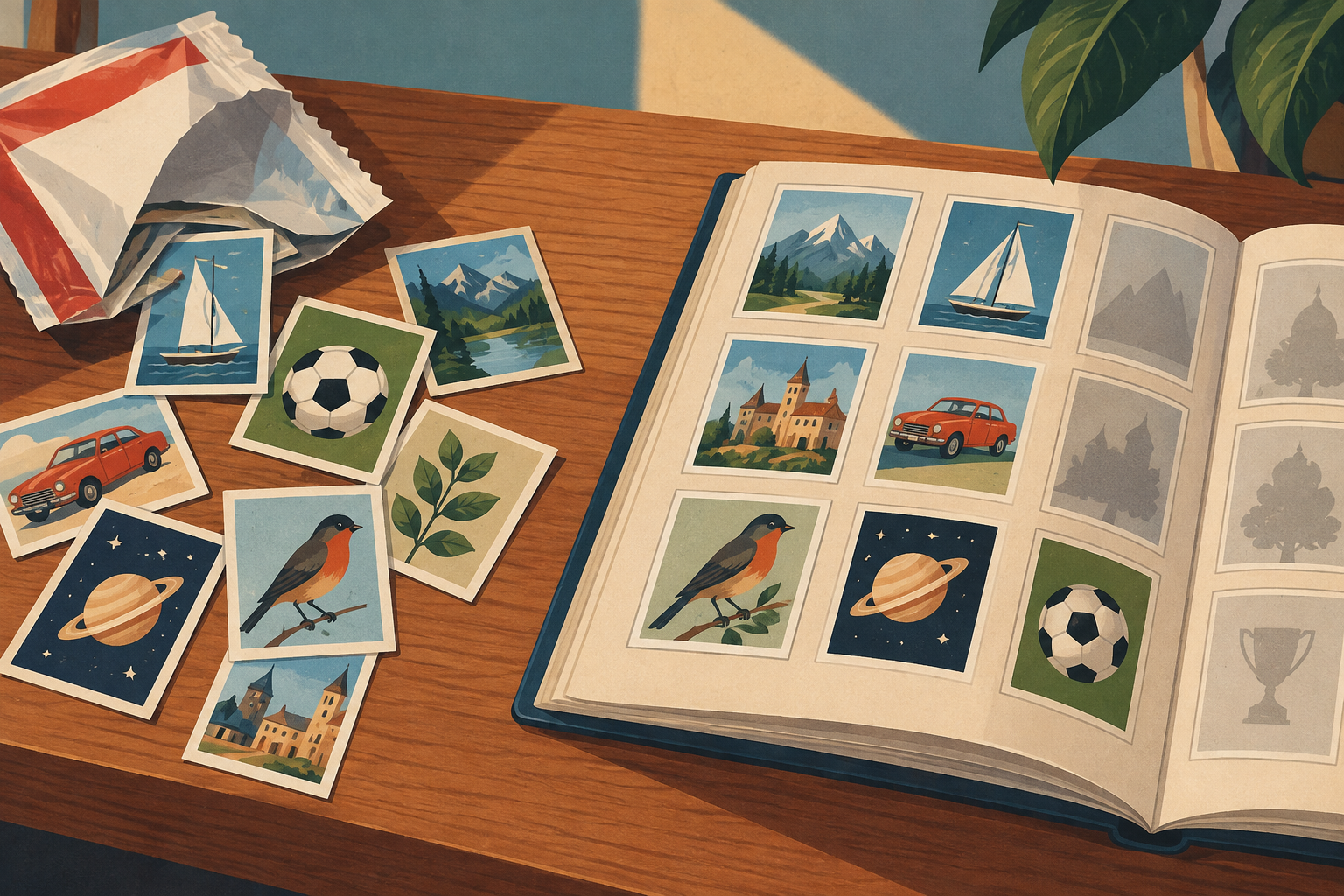
A sticker can circulate as an isolated image, accompany a purchase, or end up stored without order. An album changes that condition: it proposes a whole, assigns places and makes absences visible. The difference may seem simple, but it changes the material experience. The task is no longer only to keep an image; it is also to locate, classify and relate it to others.
The available sources let us observe this shift through particular objects, but they do not reconstruct a universal history. The CER.es catalogue records an album titled Historia del Circo, attributed to Rosés and Ediciones Ada in Barcelona and held by the Museo del Traje. Museotik, meanwhile, describes an album titled Oceanía, published in Barcelona by Publicaciones Reunidas S.A. in 1968. Both records document objects; on their own, they do not tell us how many copies circulated, who completed them or how they were used in individual homes.
The album gives desire a structure
The album organizes a collection before it is complete. Its pages suggest a sequence and give each gap meaning: an absence is not an accidental flaw in the object, but a position the collector can recognize. This interpretation fits the material presence of catalogued albums, though the records consulted do not describe users’ reactions. It is therefore important to distinguish the surviving material structure from the social experience that can only be inferred.
Pixartprinting’s article places stickers in a long history and links their spread to nineteenth-century industrialization. That account provides context, but the short extract available here offers no dates, examples or documentation sufficient to trace a continuous development from that period to twentieth-century albums. It is prudent to treat it as a general pointer, not a detailed chronology.
From everyday product to kept object
A previous RetroPause article frames the move “from wrapper to album”: stickers could accompany consumer products and later become part of ordered collections. The idea helps explain why a small object can acquire a second life. The sticker remains a printed image; what changes is the relationship established with it when it is kept, sought out and placed beside others.
The Colombian Jet chocolate bar points to another form of this connection. The supplied information says that the brand, produced since 1961, issued limited-edition collectible sticker albums. This supports the existence of an association between product and collection, but does not identify the albums, their contents or their dates. It cannot be generalized to every market, nor does it establish how consumers took part.
A history of businesses and circulation
Sources on Panini offer a more clearly defined business example, although differences between them call for caution. Brandstocker dates the company’s creation to Modena in 1961, after the Panini brothers acquired the rights to a football sticker collection. A Cinco Días article recalls that the brothers opened a newsstand in 1945 and says the company began to establish itself in Spain in 1979. These are details reported by secondary sources; the evidence assembled here includes no original corporate documents that would allow each point to be expanded or reconciled.
Panini’s official blog confirms, at least in its current presentation, that albums, stickers and trading cards remain categories of collectible products. It is not enough to establish what all its historical products were like. It does, however, show that “sticker” now coexists with other commercial vocabularies, and that albums do not exhaust the possible forms of collecting.
What an archive preserves
A museum record can establish authorship, title, publishing provenance, place or date, as the records for Historia del Circo and Oceanía do. These fields turn a domestic or printed object into an identifiable item. But a catalogue is not a complete history: it does not necessarily record price, print run, distribution, exchange practices or the memories of those who owned it.
It is also important not to equate the existence of an album automatically with success. A museum’s preservation of one copy proves that a catalogued object exists, not that it represented an entire country or generation. Surviving pages can support the study of design, sequence and materiality; answering questions about circulation and reception would require other documents and attributable testimony.
A collection made of relationships
An album does more than gather images: it proposes relationships between them and a task for the person keeping them. In the documented examples, this form appears in objects with different subjects and publishers, while sources on Panini and Jet show that it could also be linked to products and businesses. The available evidence does not support a single genealogy or a shared experience for all collectors.
What it does support is narrower, and perhaps more useful: a sticker changes status when it enters a system of classification and preservation. The album makes a series legible; its gaps indicate what is missing; and, decades later, an archive helps identify what has survived. These three gestures—ordering, completing and preserving—account for much of the meaning of collecting.
- Decade
- 1960s
- Region
- Europe
- Level
- Introduction
- Entities
- Museum, Museo del Traje
Sources and references
- Álbum de cromos - CER.es - Ministerio de Culturaceres.mcu.es · 2026-09-29
- Una historia de cromos - Pixartprintingwww.pixartprinting.es · 2026-09-29
- Del envoltorio al álbum: cómo los cromos se hicieron ...www.retropause.com · 2026-09-29
- Cromos y coleccionables Paniniwww.panini.es · 2026-09-29
- ¿Quién creó Panini? Origen e historia de los cromos más ...www.brandstocker.com · 2026-09-29
- Álbum de cromos 'Oceanía' - Coleccionesmuseotik.euskadi.eus · 2026-09-29
- Colecciones de cromos míticas de la historia de Españawww.imprentaonline.net · 2026-09-29
- La historia del fútbol cabe en los cromos - Cinco Días - EL PAÍScincodias.elpais.com · 2026-09-29