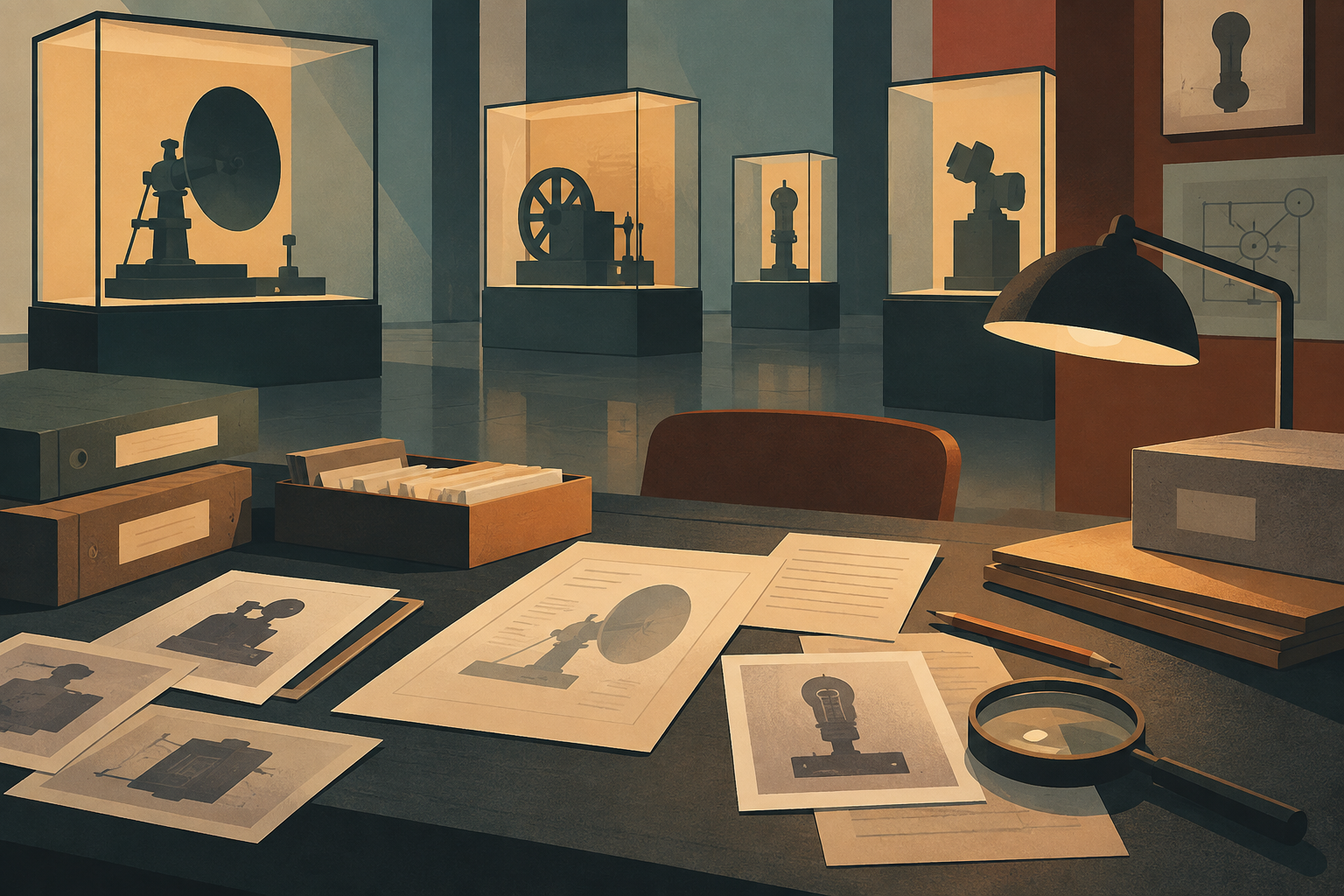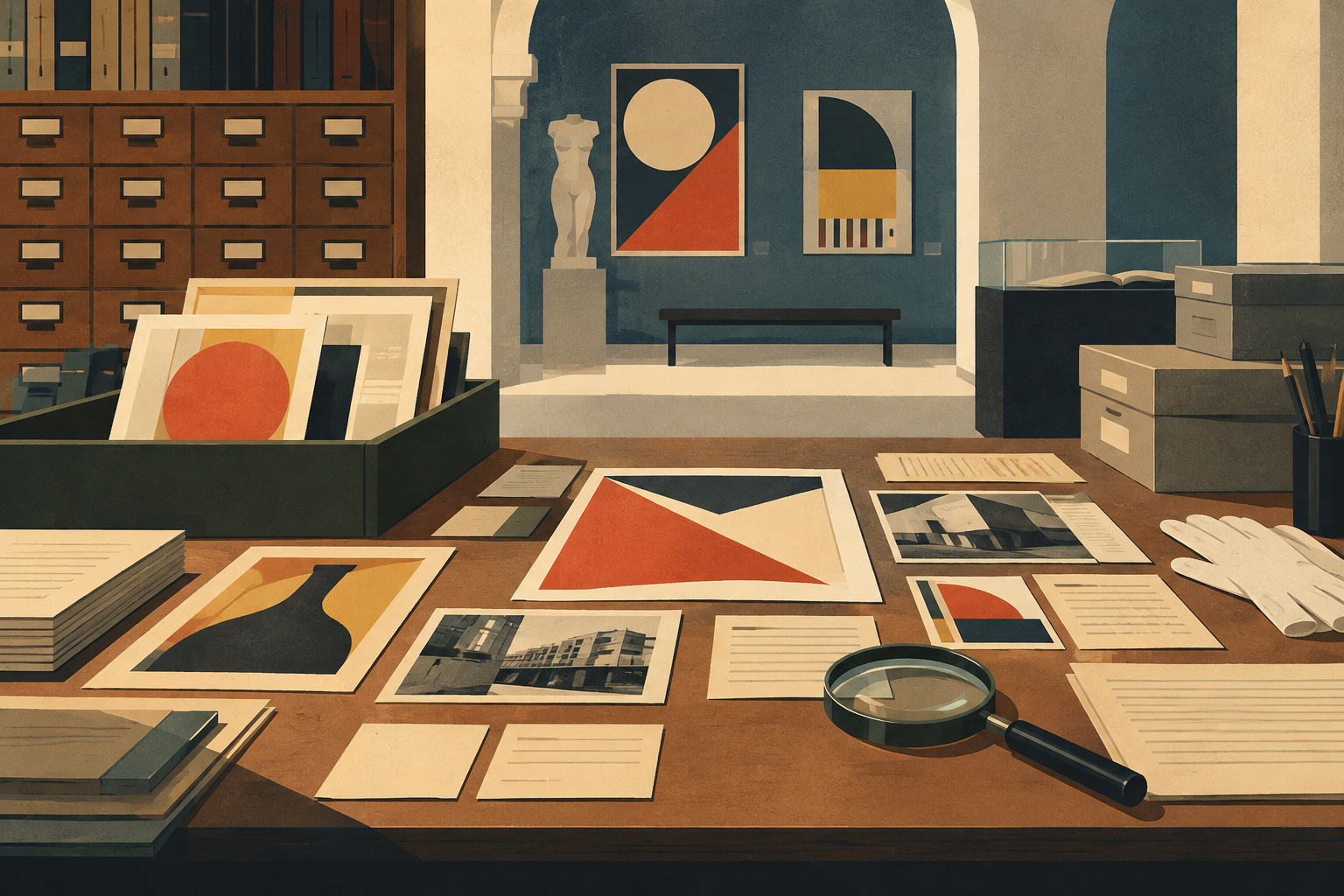
An object does not speak alone
A poster, an advertisement or a graphic piece can seem self-contained: it has an image, a composition and perhaps a recognizable name. But a collection does more than gather striking objects. The order in which it presents them, the information attached to them and the relationships it proposes also shape what we can read. This mediation matters particularly in design and advertising: the same piece can be approached as a message, a visual object or a document of a practice. Those readings are not interchangeable, and none should be confused with claims that the evidence cannot support.
The supplied materials point to several ways of preserving and communicating this heritage. A description of the Alessi archive presents it as a body of documents about the history of the brand and Italian design. The study of MUVAP, a virtual museum active from 2001 to 2016, describes it as a space devoted to documenting the history of Spanish advertising and graphic design. These are different examples, but both prompt a question: how does an archive turn dispersed materials into an account that can be consulted?
Classification is also design
Classification may seem like a task that follows the making of a piece: identifying it, describing it and assigning it a category. Yet classification changes the experience of reading. If an advertisement is presented only under a company name, visitors may approach it as part of a corporate history. If it is grouped with other graphic-design materials, a different kind of comparison becomes possible. Grouping does not alter the object, but it does shape which questions are easiest to ask.
This does not mean a category dictates a single interpretation. It means curatorial decisions should be made visible: what is grouped, what is separated and what information is retained. The material on company museums says that the Alessi archive contains documents connected both to a brand and to Italian design. That description supports two possible scales of reading; by itself, it does not establish the archive’s internal arrangement or the contents of every document. Stating these limits prevents an interpretive possibility from being presented as an institutional fact.
A route provides context, not automatic proof
An exhibition can connect objects and make a history legible. The MUVAP record says its exhibitions documented the history of Spanish advertising and graphic design and presented an artistic dimension. This supports discussion of the project’s documentary and exhibition aims. It does not support a description here of its rooms, visual resources or individual objects, because the supplied evidence does not detail them.
The same caution applies when looking at exhibitions about advertising in museums. Experimenta’s page on Grupo 13 states that the collective of advertising professionals was founded in September 1961 and held its last joint action in 1978. These facts place the collective in time, but they do not, by themselves, describe the design of a particular campaign or how a piece functioned. Such claims would require identifiable primary materials, not simply a reference to an exhibition.
Visual identity and institutional purpose
A museum’s design is not limited to posters or typefaces. It can also be found in the way an institution explains what it holds and invites people to consult it. A 2021 academic project on the corporate identity of the Espacio Abierto de Escultura José Luis Sánchez describes its objective as creating an identity and its associated pieces for the museum. That wording documents the project’s stated scope; it does not on its own show how the identity was later applied or what results it achieved.
A study of cultural marketing in museums, in turn, discusses the introduction of specialized marketing in cultural institutions and describes it as an outstanding issue for many of them. A Ministry of Culture document frames the museum at the intersection of business and spectacle. Together, these texts suggest a design question: how does an institutional identity inform, and how does it persuade people to engage? That is an analytical question, not an answer supplied by audience data or a comparative campaign evaluation; neither is present in the evidence provided.
Reading form without inventing effects
Visual language can suggest hierarchy, direct attention or make some information prominent. But claims about specific effects require evidence. A large headline does not prove that attendance increased; the fact that an archive preserves documents does not establish that all its materials are publicly accessible. Responsible interpretation separates three levels: what is visible in the object, what a source describes and what the observer infers.
This method makes it possible to ask which functional decisions explain a piece: how it organizes information, what it places in the foreground and what relationship it proposes between image and text. If the piece itself or a source documenting its use is missing, the answer must remain open. Advertising and design can be preserved as visual heritage without treating every element as automatic proof of an intention or an outcome.
The archive as part of the account
A museum does not merely receive a finished history. By selecting, describing and relating documents, it shapes the conditions under which that history can be read. The company archive, the virtual advertising museum and projects for institutional identity offer different settings for this work, as far as the available evidence shows. They are not equivalent, and the supplied facts do not permit a detailed comparison.
The strongest conclusion is also the most cautious: in design and advertising, the context of preservation is part of the visual experience. A piece may inform us about graphic decisions, but classification, documentation and display determine which aspects come into view. Looking closely means distinguishing function from appearance and, above all, not filling in through imagination what the archive has not yet demonstrated.
- Decade
- Contemporary
- Region
- Spain
- Level
- Enthusiast
- Entities
- Museum, MUVAP
Sources and references
- Evolución y aplicación del marketing cultural en los museosbid.ub.edu · 2026-10-03
- Los Museos de Empresasevemuseografia.com · 2026-10-03
- MUVAP (2001- 2016): museo virtual que documenta la ...revistas.ucm.es · 2026-10-03
- Centro de Documentación Publicitariawww.lahistoriadelapublicidad.com · 2026-10-03
- Historia del diseño gráfico: origen, etapas y evoluciónwww.jftcomunicacion.es · 2026-10-03
- Diseño de la identidad corporativa de un museo y sus piezasriunet.upv.es · 2026-10-03
- Museos en la encrucijada entre negocio, espectáculo, ...www.cultura.gob.es · 2026-10-03
- Grupo 13: Publicidad, arte y el diseño en el Museo ...www.experimenta.es · 2026-10-03