A vehicle designed as a whole
The Benz Patent-Motorwagen is often presented as the first automobile, but that formula obscures the more interesting historical question: what kind of vehicle was it, and what criteria justify calling it an automobile? The German Patent and Trade Mark Office (DPMA) notes that disputes over the “birth” of the automobile depend partly on how the invention is defined. Its summary of Olaf von Fersen’s research credits Carl Benz with building the first practical motor vehicle, rather than inventing each of its individual components in isolation.
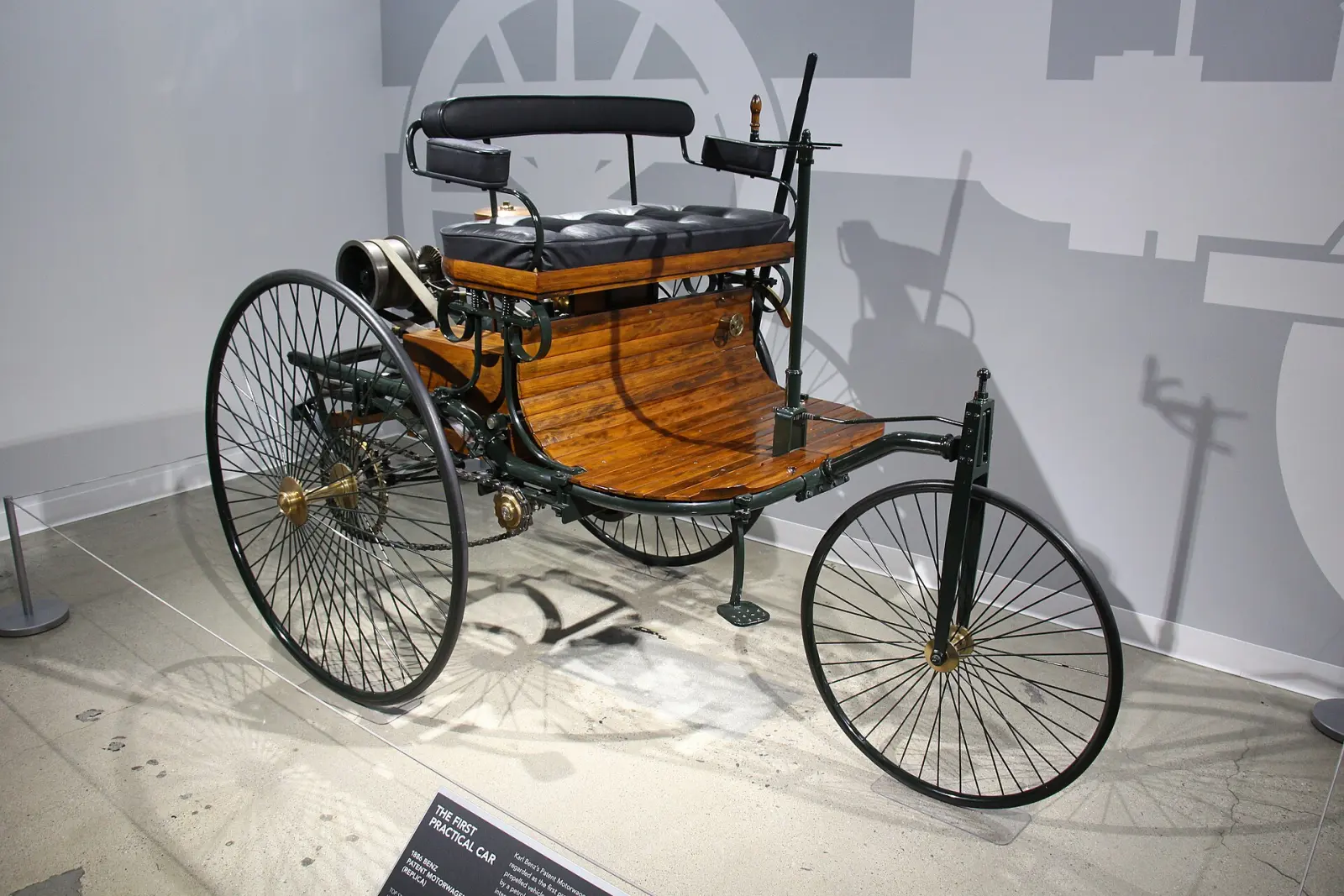
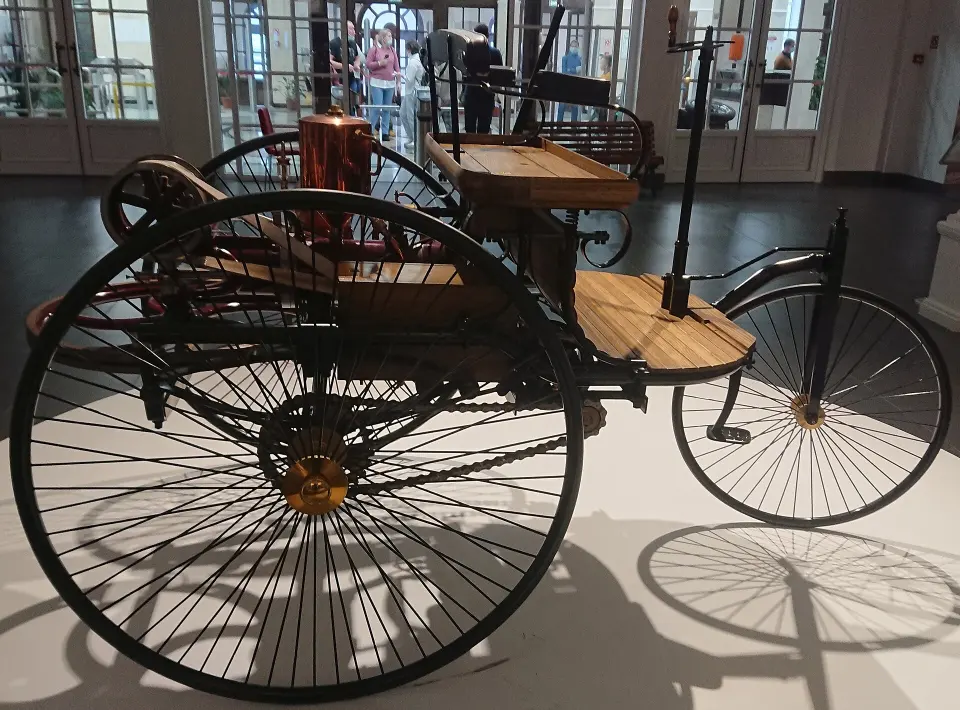
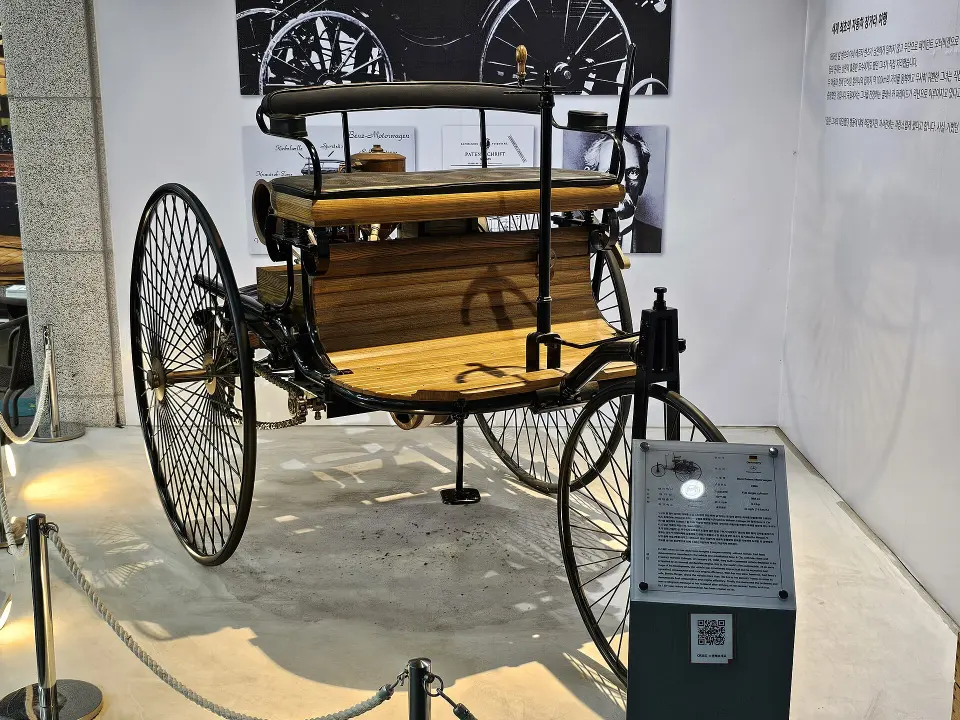
The technical distinction emphasized by the sources is that Benz did not fit an engine to an existing carriage. He designed the engine, frame and drive system as parts of a new vehicle. Mercedes-Benz’s historical archive describes a horizontally mounted, rear, single-cylinder four-stroke engine, a tubular steel frame, a differential and three wire-spoked wheels. It gives the engine output as 0.75 hp (0.55 kW). The vehicle was an integrated answer to the challenge of propelling and controlling a horseless vehicle, not a stationary engine transferred to a conventional body.
The patent and the steering problem
Benz built the vehicle in 1885 and applied for a patent on 29 January 1886. German patent DRP 37435 is titled “vehicle powered by a gas engine.” The manufacturer’s archive calls it the automobile’s birth certificate; the German patent office adds an important qualification: treating Benz’s tricycle as the beginning of the modern automobile depends on criteria such as integrated design and evidence that the vehicle was practical.
The choice of three wheels also reflects an engineering problem, not merely an unusual shape. According to Benz’s retrospective explanation quoted in the Mercedes-Benz archive, he had not found a satisfactory steering solution and therefore chose a three-wheeled vehicle. This avoided having to steer two front wheels with a system he had not yet mastered. The solution was not final: in 1893 he patented double-pivot steering, which was used on the four-wheeled Benz Victoria.
How power reached the wheels
Historical descriptions of the model identify a rear-mounted single-cylinder four-stroke engine, a belt clutch and chain drive to the rear wheels. The differential was part of the overall system. The Mercedes-Benz archive also highlights automatic intake, high-voltage electrical ignition, and water/thermosiphon evaporation cooling.
These features should be understood in their technical context. The vehicle was not a modern car in miniature: with the means available, it had to solve the problems of power generation, cooling, ignition, transmission and braking. Its significance is clearer when we see these elements as a system designed for a self-propelled vehicle than when we compare its performance directly with that of later cars.
From private trials to public demonstration
Mercedes-Benz places Benz’s first tests in a deliberately discreet setting near his factory, before he dared to show the vehicle in public. Its archive records the first public outing as taking place in Mannheim on 3 July 1886. The account describes his son Eugen running alongside the car with a bottle of fuel to replenish it. The episode reveals how experimental the motorwagen remained even after it had been patented.
The vehicle’s story did not end with that demonstration. The Mercedes-Benz archive says that Benz continued developing the idea, brought the product to market and built later vehicles. In 1893 the Victoria offered a four-wheel steering solution; in 1894 the Velo became, according to the same archive, the first production car, with about 1,200 built. This sequence helps distinguish the prototype’s historical importance from the subsequent development of marketable vehicles.
A historical priority, with qualifications
The Patent-Motorwagen is central not because every component was entirely new, but because Benz integrated them into a vehicle conceived around its own propulsion and demonstrated that it worked. The German patent office notes that earlier designs, including the project by Delamare-Deboutteville and Malandin and George B. Selden’s patent, complicate any simple account of a single inventor. In its assessment, however, the absence of documented practical use distinguishes those cases from Benz’s vehicle.
The phrase “first automobile” is therefore most informative when accompanied by a definition: an integrated, tested motor vehicle regarded as practical. Patent 37435 records a decisive date in that history; it does not settle the question of how the invention should be defined. Benz’s tricycle is best understood as a milestone in turning the combustion engine into a complete means of transport, and as the starting point for improvements that still had to address basic questions of handling and use.
Documentary gallery
- Decade
- Before 1950
- Region
- Europe
- Level
- Introduction
- Entities
- Cuatro
Sources and references 6
- Benz Patent-Motorwagen, 1886 - 1894 | marsClassicmercedes-benz-publicarchive.com · 2026-11-26
- Benz Patent Motor Car, the first automobile (1885 – 1886) | Daimler > Company > Tradition > Special Topicsweb.archive.org · 2026-11-26
- DPMA - Geburtstag des Autosweb.archive.org · 2026-11-26
- Benz Patent-Motorwagen: Weit vor der IAAwww.automobil-industrie.vogel.de · 2026-11-26
- Vor genau 130 Jahren ging es loswww.kfz-betrieb.vogel.de · 2026-11-26
- Bertha Benz Memorial Routewww.bertha-benz.de · 2026-11-26