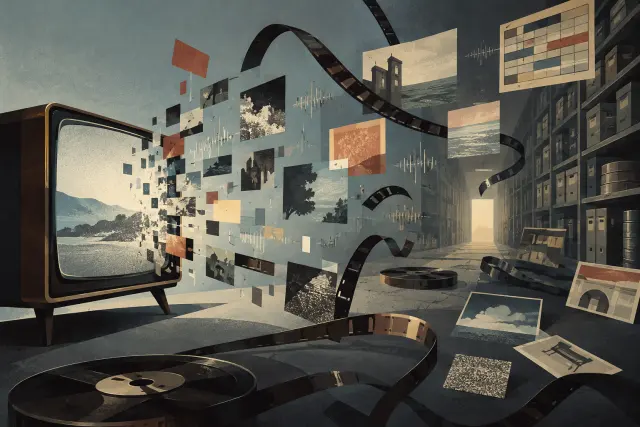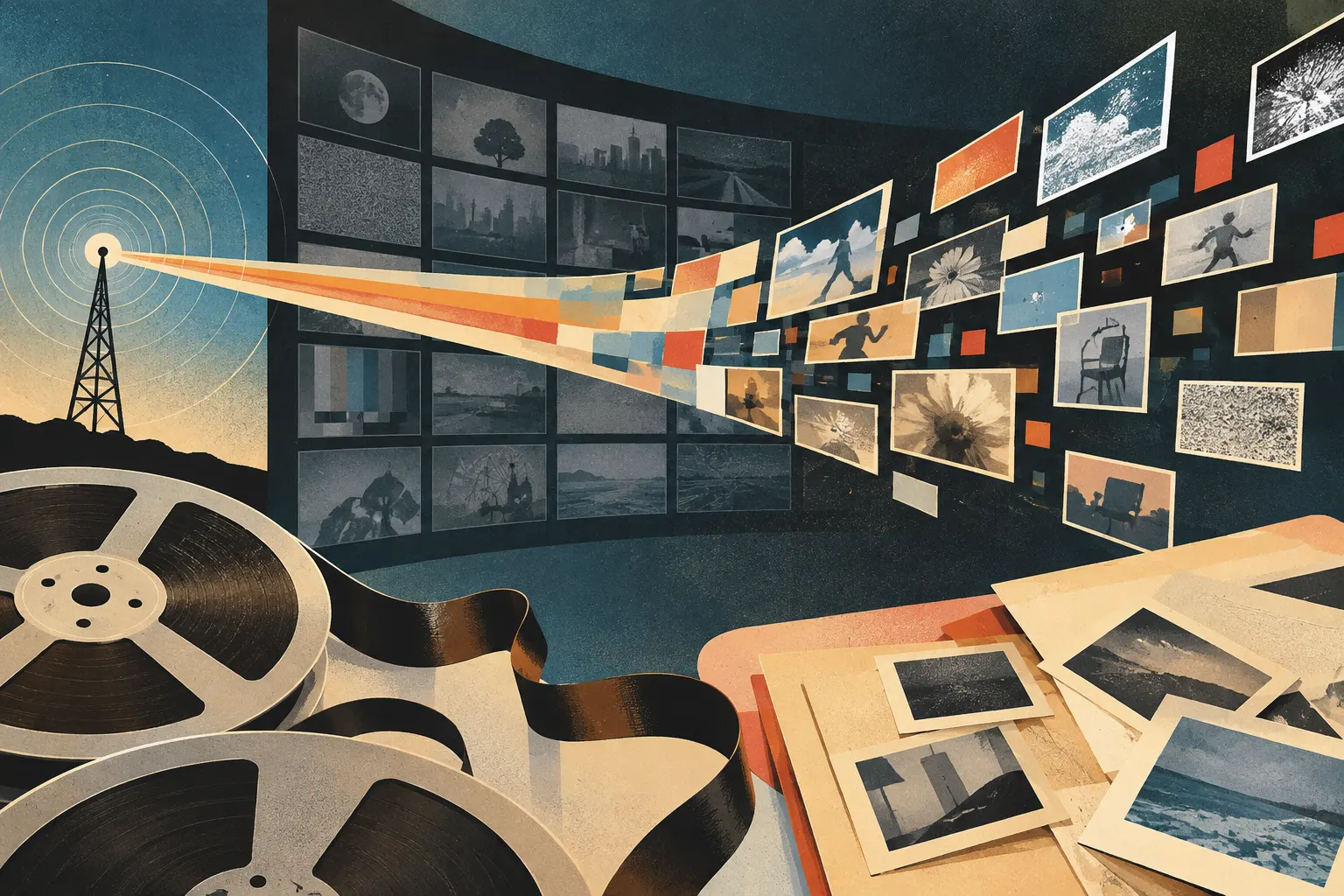
Television’s memory is often presented as a collection of preserved programmes. Yet a broadcast was more than the content of a series or a news bulletin: it also included adverts, trailers, channel identifications and transitions, arranged in a sequence that shaped the viewing experience. When only episodes or thematic excerpts are kept, part of that structure disappears. Reconstructing television therefore means reading audiovisual records alongside traces of how it was scheduled, produced and received.
Flow and its cuts
Raymond Williams described television as planned flow: programmes did not arrive in isolation, but were linked to advertising and other continuity segments. From another perspective, Jesús González Requena understood programming as a macro-discourse integrating diverse units. Both ideas help explain the particular archival problem posed by television: preserving one item may retain its content, but not necessarily its relationship to the other parts of the broadcast.
Archival practice has tended to separate these units. It is common for an excerpt of a programme to survive while not all its broadcasts do; for a news item to be detached from the bulletin in which it appeared; or for advertising and continuity to be archived separately. Broadcasters’ operational archives also selected material according to needs for reuse and rebroadcast. The result is an uneven memory: a surviving item can be highly informative while leaving out the order and context that gave it meaning.
Recording did not guarantee preservation
In television’s early years, many broadcasts were live. The arrival of videotape made it possible to record, erase and record again on reusable tape, but this technical possibility did not mean broadcasters wanted to preserve their output systematically. Recording could serve production and repeat broadcasts, while disposal remained part of working practice.
Argentina’s case shows the consequences of this history. The first official transmission, on 17 October 1951, was broadcast live and left no known audiovisual record in the archive described by the research. In later decades, relocations, disposal decisions and limited resources also affected collections. The existence of a recording does not, moreover, guarantee present-day access: media can deteriorate, and some surviving material cannot be played without appropriate procedures.
Documents that help reconstruct a broadcast
A schedule is an essential source for identifying the intended order and time slots of programmes, but on its own it cannot prove what was actually broadcast. Its interpretation becomes more precise when compared with surviving recordings, production documentation, archive records and traces of circulation. The technical records preceding some 1979 promotions, for example, list details such as title, recording and broadcast dates, studio and personnel. Such information can preserve context that tends to disappear when an advertisement is removed from its original flow.
Materials accompanying a programme can also help fill out an incomplete reconstruction. For the Argentine miniseries Los gringos (1984), the research combines available episodes with production stills, press coverage and scripts preserved outside the television archive. These materials do not replace missing broadcasts, but they create ways to study production and connect its surviving traces. Home recordings are another kind of source: viewers made them and they may preserve broadcasts that did not survive in broadcasters’ archives, although their selection reflects individual interests.
From preservation to public interpretation
The Historical Archive of RTA was established in 2013 to administer, preserve and make public sound and audiovisual records from Argentina’s state media. Its work brings together different formats and demonstrates that preservation involves more than storing tapes: it also requires cataloguing, description and access. Archive Prisma, the platform that published some of these records, turned materials once separated from their context into objects available for new audiences and readings.
That change of context has consequences. A television campaign originally broadcast as state propaganda can later be consulted as a historical document and subject of critical analysis. At the same time, publishing an excerpt does not by itself return a programme to its original flow or reconstruct how each audience received it. Archives make new interpretations possible, but should clearly identify each record’s origin and conditions so that an excerpt is not mistaken for the whole.
Preservation does not end with digitisation. The case of Los gringos is telling: the research reports that several tapes were affected by a form of degradation that prevented playback. An archived tape can remain inaccessible; conservation work and the search for related sources are part of the document’s history, not tasks separate from its cultural value.
The schedule as social history
Reconstructing a broadcast is useful for more than ordering titles and time slots. It makes it possible to ask whom a schedule addressed, what place advertisements occupied and how television fitted into everyday life. When a complete broadcast has not survived, combining schedules, excerpts, production documents and viewers’ recordings offers a richer, though necessarily partial, picture of the television experience.
Television was at once a technology, an industry, a schedule and a shared conversation. Its archives preserve traces of these dimensions, but rarely keep them together. Reading them in relation—without treating an excerpt as though it were the entire flow—helps us understand not only what appeared on screen, but also how it was organised, transmitted and put back into circulation.
- Decade
- 2000s
- Region
- Global
- Level
- Enthusiast
- Entities
- Televisión, Requena, Argentina
Sources and references 5
- Desarrollo y conservación del patrimonio cultural-natural en el contexto neoliberal y nuevas tecnologíasdoi.org · 2026-11-14
- Conservación y Restauración del Patrimonio Cultural en soporte Papel - Museo Jesuítico Nacional de Jesús Maríadoi.org · 2026-11-14
- Memoria, inteligencia artificial y ciudadanía digital: el archivo como agente narrativo en la era de la desinformacióndoi.org · 2026-11-14
- Paradojas y desafíos del patrimonio audiovisual televisivo. ...www.scielo.org.ar · 2026-11-14
- Recuerdos en movimiento: Archivo Audiovisual de CMEFMwww.casamuseoeduardofrei.cl · 2026-11-14