There is more than one question
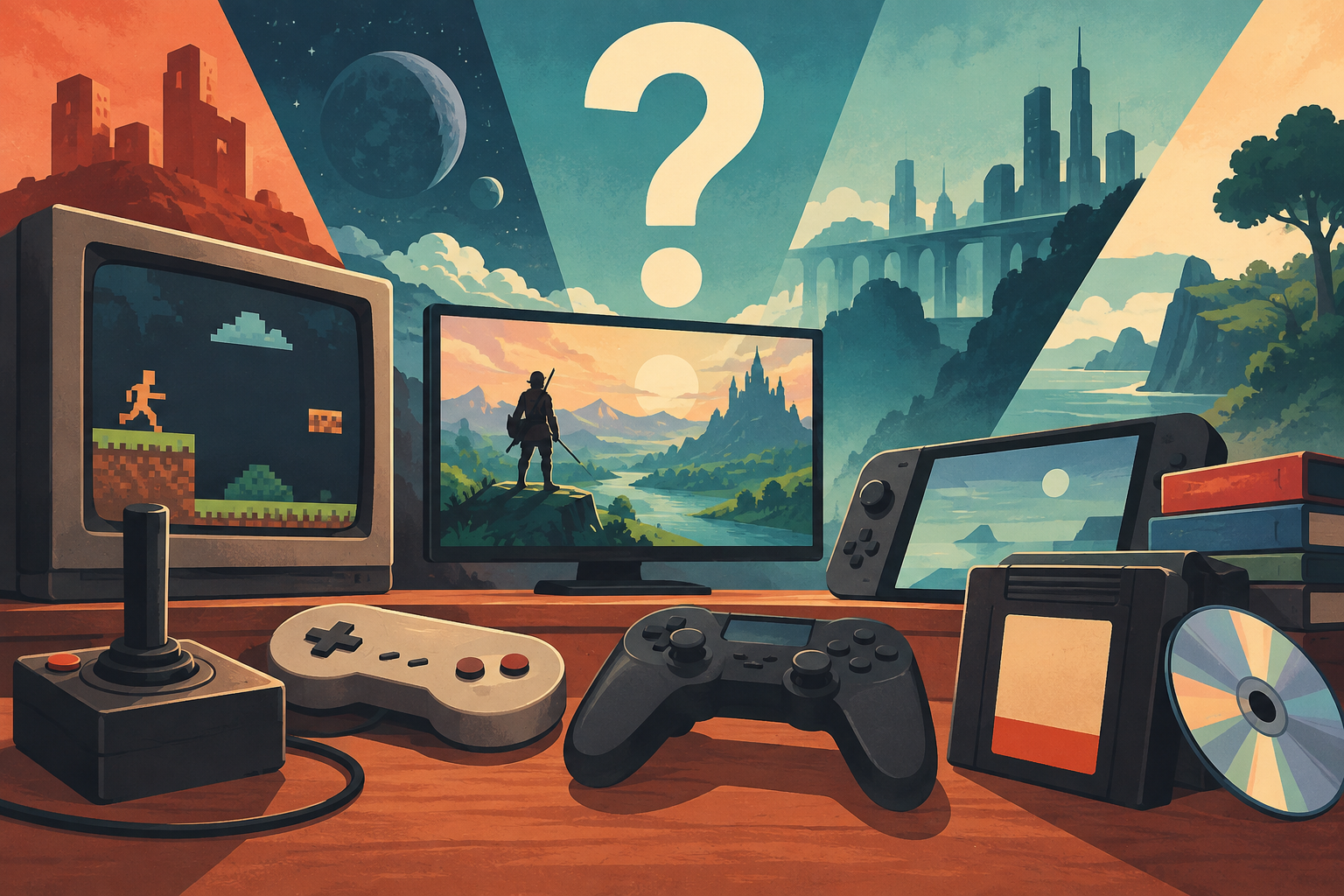
Video game history is often told as a sequence of machines, works and successes. Yet the sources gathered here point in other directions: studying the industry, game translation, possible educational uses, or accessibility for people with visual impairments. These are not interchangeable chapters in one story. Each approach defines what matters and what kind of evidence it seeks.
The sample is small and uneven. It includes a university study of the industry’s evolution, a video game history page from the Universitat Politècnica de Catalunya, and academic records on localization, learning and inclusion. It can suggest questions; it does not represent all research on video games or establish a complete chronology.
The industry as a subject
A study hosted by idUS, the institutional repository of the University of Seville, describes itself as an analysis of key aspects of the industry and its evolution. The available record does not detail its arguments or findings. We can identify its subject, but should not attribute specific conclusions about periods, companies or business models to it.
That distinction matters: discussing video games as an industry is not the same as describing how people played. Reconstructing that experience would require different sources, such as testimony, records of use or contemporary materials. Those are not included here, so this article cannot recover everyday habits or treat one way of playing as representative.
Localization is also transformation
An OpenAlex record identifies a 2008 article by Pablo Muñoz Sánchez on localizing classic video games through romhacking techniques. Its title signals three dimensions: particularities, quality and legal issues. That framing makes localization a technical, editorial and legal question—not merely a matter of replacing words.
The record, however, does not provide the article or summarize its findings. It cannot tell us which techniques or cases are examined, or what conclusions are reached. It does suggest a line of inquiry: comparing versions of a game can reveal adaptation choices, provided the versions and relevant documentation are examined, rather than relying only on a publication’s title.
Learning and participation
Another OpenAlex reference is a 2014 article by Diego Téllez Alarcia and Diego Iturriaga Barco, which connects video games and history education through the Assassin’s Creed series. Its title establishes the subject, but not the study’s results; it is not enough to claim that playing produces a particular kind of learning.
A 2023 article, also identified by OpenAlex, presents video games as an inclusive cultural space for people with visual impairments. Here, too, the record does not let us summarize methods or conclusions. Its presence does remind us that a history focused only on hardware and releases leaves out questions about who can play and under what conditions. Answering them requires the full research and, where appropriate, the experiences of the people concerned.
Chronology and its limits
The UPC page places the beginnings of electronic video games in the early 1970s and refers to games released by Mattel. That is a specific claim made by that source, not a final determination of which game was first. The need to define “first game”—and what counts as an electronic game—is reason not to turn a summary sentence into a universal verdict.
Nintendo’s history page, meanwhile, presents the company’s trajectory from 1889 as that of a provider of entertainment products and experiences. This offers corporate context about Nintendo, but does not establish that its history is equivalent to the history of video games as a whole. A company chronology and a history of the medium operate at different scales.
A history made of layers
Taken together, these references provide no continuous narrative, but a partial map of subjects: industry, technological history, adaptation, education and accessibility. Their editorial value lies in showing that video games can be studied across disciplines, and that claims must match the actual scope of their sources.
Important limits remain: several records provide only a title and metadata; no interviews, primary documents or detailed findings were supplied. The strongest conclusion is not an origin date or a definitive list of milestones, but a method: distinguish what a source announces from what it demonstrates, and let the history grow at the pace of the available evidence.
- Decade
- Contemporary
- Region
- Global
- Level
- Introduction
- Entities
- No linked entities
Sources and references
- La historia de Nintendo | Hardwarewww.nintendo.com · 2026-09-29
- Evolución y análisis de la industria de los videojuegos - idUSidus.us.es · 2026-09-29
- Historia de los videojuegoswww.fib.upc.edu · 2026-09-29
- Videojuegos y aprendizaje de la Historia: la saga Assasin’s Creedopenalex.org · 2026-09-29
- En torno a la localización de videojuegos clásicos mediante técnicas de romhacking: particularidades, calidad y aspectos legalesopenalex.org · 2026-09-29
- Los videojuegos: el nuevo espacio cultural inclusivo para personas con discapacidad visualopenalex.org · 2026-09-29