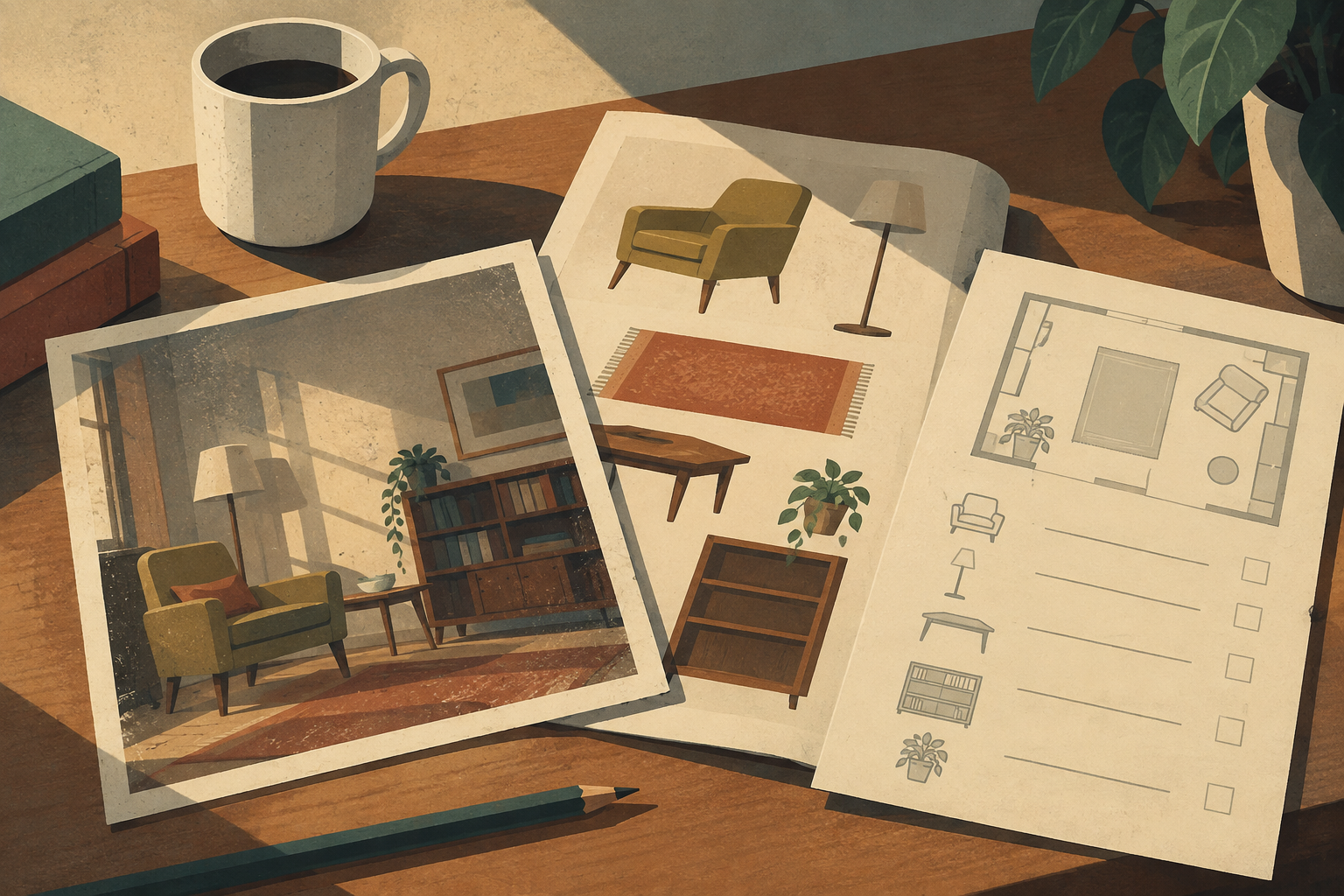
A photograph may show furniture; an inventory may name objects; a catalogue may arrange items according to a particular system. None is the same as entering the room. That distinction matters when researching domestic decoration: an image fixes a frame, a record selects what gets documented, and an institutional description serves the needs of whoever produced it. Reconstruction begins by relating these traces without mistaking them for a complete experience of the space.
What the available sources say
The references available here describe museum archives and documentation, not a specific group of historical homes. The Historical Archive of Spain’s National Archaeological Museum is described as a research resource for its departments and for external researchers. The Prado Museum Archive reports that it holds seven documentary fonds, including records produced and received by the museum itself. These details help explain that an archive may contain different kinds of material and that its organization depends on provenance; they do not, by themselves, establish what furnishings occupied a particular home.
Ibermuseos’ visual-documentation protocol addresses methods for inventorying and documenting collections. An article on the social function of archives in a provincial museum, indexed in Dialnet, presents archives and museums as institutions that safeguard historically valuable objects and documents. These are sources for considering how information is recorded and preserved, not direct testimony about domestic life.
An image is not a room
A photograph allows us to examine visible relationships: what appears beside what, what falls outside the frame, and which objects seem prominent. But an image alone does not prove its date, the everyday function of each item, or whether the scene was typical. Those points require additional contextual information. It is worth noting what is literally visible, what is inferred, and what remains unknown.
The same caution applies to catalogues. Their arrangement may help identify objects or collections, but it does not necessarily preserve the original layout of a room. A description is evidence of how something was documented as well as a possible source about the thing described.
Inventories and objects out of context
An inventory can help identify object names and investigate what a person or institution chose to record. Without information about the document’s provenance, date or purpose, it is risky to transfer a list into an imagined domestic floor plan. The appearance of an object in a record is not enough to establish which room it occupied, who used it, or how long it remained there.
A study of textiles in Spanish museum collections, indexed in OpenAlex, addresses the valuation and conservation of textiles in collections. It may prompt questions about how a material object comes to be preserved and studied, but it is not direct evidence about textiles in a particular home. Keeping that distinction prevents a museum context from being turned into an unsupported domestic history.
A method that preserves uncertainty
For each document, record who produced it, if known; what kind of source it is; which object or space it names; and what information is missing. Compare photographs, descriptions and inventories only when they share verifiable references, such as a place or an item identified in the documentation itself. Where no connection is established, treat them as separate clues rather than parts of one scene.
It is also useful to distinguish three levels: what the source states, what it allows us to observe, and what the researcher proposes as interpretation. This separation does not remove uncertainty; it makes it visible and allows revision if new documents emerge. The references gathered here support the relevance of archives, inventories and visual documentation to heritage research, but do not provide a complete domestic case that would let us reconstruct a particular room.
The limit is a finding
Reconstructing an interior does not mean filling every gap with plausible objects. The available sources must determine how far a claim can go. In this case, they allow us to discuss museum archival and documentation practices, as well as tools that may be useful for researching objects. They do not allow us to attribute a particular decoration, use or layout to a historical home.
That negative conclusion is informative too. It indicates what material would be needed to proceed—for example, photographs or catalogues demonstrably connected to a space—without pretending that such material has already been found. A vanished interior may leave traces; reading them rigorously means preserving both what they reveal and what we still do not know.
- Decade
- Contemporary
- Region
- Spain
- Level
- Enthusiast
- Entities
- Museum, Museo Arqueológico Nacional
Sources and references
- Los tejidos en las colecciones de los museos españoles, una larga historia de valoración y conservaciónopenalex.org · 2026-10-06
- Archivo histórico - | Ministerio de Culturawww.man.es · 2026-10-06
- Archivo - Museo Nacional del Pradowww.museodelprado.es · 2026-10-06
- El archivo y su función social en el Museo Provincial Hogar ...dialnet.unirioja.es · 2026-10-06
- protocolo-documentacion-visual.pdfwww.ibermuseos.org · 2026-10-06