A work that happens through play
A video game is presented as a work, but it is also an activity: people play it, learn its rules and respond to what it offers. That dimension raises a question for any archive or museum: what must be preserved so that someone in the future can understand not only what a game looked like, but also what it did and how it was experienced? The evidence gathered here does not settle the debate. It does show that preservation, research and museum interpretation are part of an active cultural conversation.
An event titled “The video game: a cultural product to preserve” brings together the terms cultural product, libraries, museums and preservation. Its framing is a useful starting point: a video game can be studied as a cultural object without losing its playable character. The available listing names participants but provides no transcript of their contributions; therefore, specific arguments cannot be attributed to them. This limitation matters: a title and a list of names confirm that an event existed, not what was said.
A museum is more than a display case
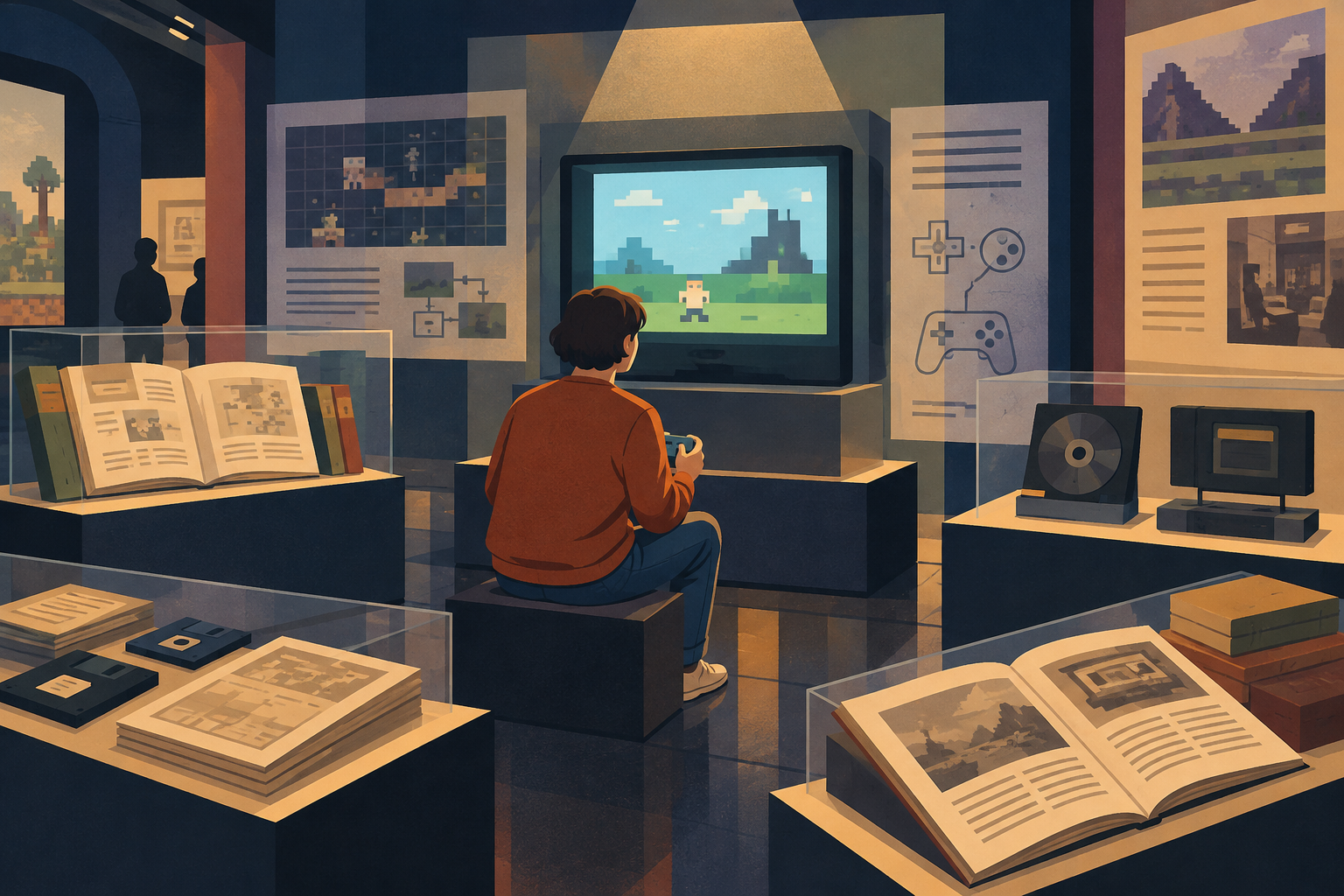
A 2023 article on museums and video games describes museum initiatives that use games to communicate their collections. This allows us to consider games both as cultural subjects and as a means of communication. A museum can place a work within a narrative, but it can also use rules and participation to bring collections closer to visitors. These are related but distinct operations: exhibiting a video game is not the same as playing it, and using a game to present a collection does not necessarily make the game the exhibition’s central object.
The educational programme of the Museo Nacional Thyssen-Bornemisza adds a further caution: the idea of the video game as a museological element remains the subject of academic debate. That debate should not be presented as settled. It is more useful to treat it as an invitation to specify what is being shown, what the institution wants to communicate and what kind of experience it offers visitors.
Preserving more than an executable file
The Museu del Videojoc de Catalunya describes itself as a cultural and museum project devoted to preserving, studying and sharing video game history through temporary and travelling exhibitions. The Museo del Videojuego’s Digital Archive, meanwhile, brings together documentation, publications and audiovisual materials related to that history. These descriptions point to several routes of access: exhibitions, documentary research and public interpretation. They do not, by themselves, establish the contents of each collection or its technical preservation policy.
Even with that caveat, the range of materials suggests a useful research method. If publications and audiovisual materials are preserved alongside games, researchers can compare a work with the ways it was explained, presented or remembered. Manuals and magazines may offer evidence about the rules communicated to audiences; images and recordings may document aspects of presentation. Each document has limits, however: printed explanations do not replace play, and an audiovisual record may not capture every possibility of an interactive work.
Emulation, access and memory
A 2022 academic article indexed by OpenAlex addresses the abandonware movement as a tool for preserving video games as cultural heritage. Its title identifies the subject, but it is not enough to summarise its conclusions. It does point to a field where preservation, availability and public memory may intersect. Those issues should be distinguished: finding a work does not prove that it has been preserved completely, and keeping a file does not by itself guarantee that it can be experienced under equivalent conditions.
Microsiervos describes the Embracer Games Archive as an initiative devoted to preserving the cultural legacy of video games. This offers another example of preservation framed as an archival or institutional task, but the supplied material does not detail its scope, selection criteria or procedures. It cannot support claims about which games it includes, how they are preserved or what access is available. Its more limited value here is to show that preserving the legacy is publicly described as a cultural undertaking.
Playing also depends on context
RetroPause’s research questions help organise the analysis: what does a work contribute to its genre’s language, and how does the experience change between versions and playing contexts? The evidence in this search identifies no specific titles and compares no versions. Inventing a case would be irresponsible. Still, it supports the argument that context deserves documentation: the exhibition space, the documents accompanying a game and the opportunity to interact with it can affect what visitors understand and remember.
Personal memories and documentation should also remain distinct. Someone may remember a work as difficult, social or absorbing; that testimony can be valuable, but it should not automatically be treated as a universal description of the game. Manuals, publications and institutional sources can help test memories against what can be verified. Comparison does not erase memory; it places it alongside other evidence and makes visible what remains unresolved.
What the sources allow us to say
The available sources support a cautious conclusion. Museum and archival projects state that they aim to preserve, study or communicate video game history; some initiatives use games to present collections; and academic debate continues about their place in museums. There is also identifiable research on abandonware and preservation. These indications do not amount to a comprehensive history, nor do they prove a single definition of preservation.
Understanding a work requires questions that go beyond its medium: what rules it offers, how it presents them, what documents explain them and under what conditions people play. This is a framework for interpretation, not a finding attributed to the sources. Preservation has cultural value when it allows works to be examined again and helps distinguish documentation from recollection. The goal is not to freeze an ideal play session, but to care for the evidence future interpretations need in order to debate, compare and play with an awareness of their limits.
- Decade
- Contemporary
- Region
- Global
- Level
- Enthusiast
- Entities
- Museum, Museo del Videojuego
Sources and references
- Contra las arenas del tiempo, el movimiento abandonware como herramienta de preservación del patrimonio cultural de los videojuegosopenalex.org · 2026-10-06
- Jornada "El videojuego un producto cultural a conservar"www.youtube.com · 2026-10-06
- Vista de Museos y videojuegos. La renovación de los ...revistas.uma.es · 2026-10-06
- MUVIC – Museu del Videojoc de Catalunya | Castellanomuvic.cat · 2026-10-06
- La conservación de la historia de los videojuegos en el ...www.microsiervos.com · 2026-10-06
- Educación en museos a través del videojuego (I)www.educathyssen.org · 2026-10-06
- Descargas - Museo del Videojuegowww.museodelvideojuego.com · 2026-10-06