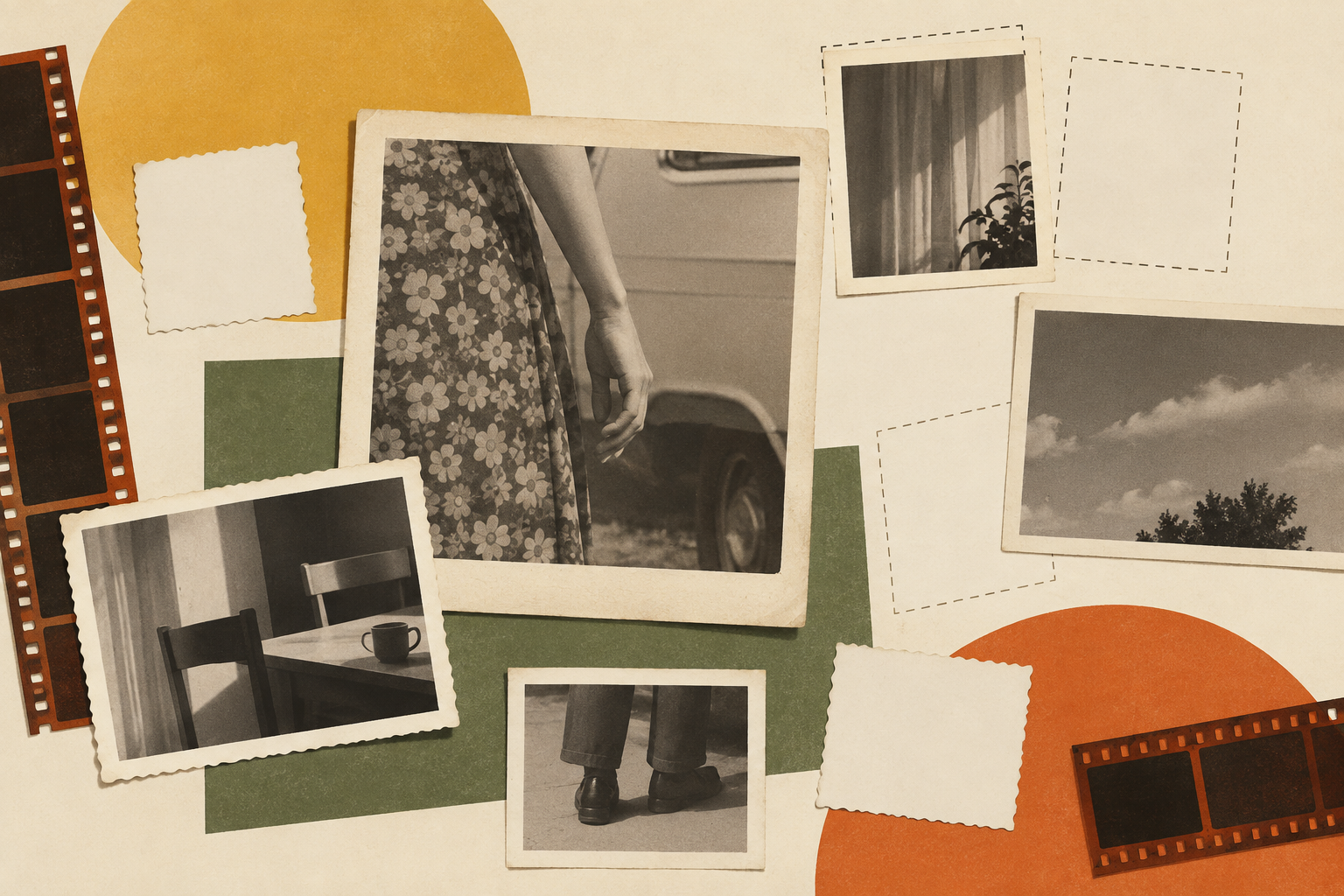
A photograph may preserve an interior, a gesture, or a gathering; it does not, by itself, preserve the whole routine of the people in it. That distinction matters when telling the story of everyday life in the 1970s. The exhibition Años 70. Fotografía y vida cotidiana, announced by ArteInformado and included in the Teatro Fernán Gómez programme, offers a starting point: its descriptions connect the decade with closer links between art and life and with a renewed attention to the everyday. They do not, however, license us to treat one image—or one selection of images—as a universal portrait of a generation.
The everyday needs context too
“Everyday life” sounds self-evident, but it is not a self-sufficient category. Inmaculada Arias de Saavedra Alías’s academic article, available through the journal Chronica Nova, places the history of everyday life among the flourishing approaches of renewed social history. That positioning matters: looking at ordinary experience does not mean leaving historical research behind. It means asking how to investigate what often remains outside large-scale narratives.
The very sources that make a history possible also limit what can be claimed. A photograph gives access to what fell within the frame and was preserved. An exhibition title, its institutional presentation, or an archive description can establish a stated purpose or the kind of collection being described; none replaces examination of each image or, on its own, supplies information about the people photographed. The editor’s first task is therefore to distinguish a source’s reach from the reach of an interpretation.
A decade is not one household
The exhibition on photography and everyday life provides a way to think about the 1970s, but the evidence supplied here does not establish that the images represent a single region, social group, or type of household. Nor does it show that any documented practice was shared by an entire generation. We should resist turning “the seventies” into a uniform backdrop. A decade label organizes a narrative; it does not prove that people experienced life in the same way.
A photograph of a domestic setting may show a room at a particular moment. Without additional evidence, it cannot tell us how the rest of the home looked, who usually lived there, or how often the pictured situation occurred. An image of a gathering records a visible arrangement, not every relationship among those present or the meaning each person gave it. These limits do not make a photograph less valuable as evidence. They prevent us from asking it to answer questions for which we have no support.
Archives have different viewpoints
The Spanish Ministry of Culture describes its Historical Archive of Social Movements as holding a collection of 750 photographs made “from within” social movements. Its description highlights a privileged perspective on those movements. This is a useful reminder that the position from which images are made is part of their documentary value: an internal perspective may record aspects that an external representation would not record in the same way.
But an institutional description should not be extended beyond what it says. The supplied text gives the collection’s size and character as described by the archive; it does not identify every photograph, the circumstances in which each was made, or all the people represented. A specialised collection offers an important view of its field, not a statistical sample of society as a whole. Selection, preservation, and archival arrangement all affect what can be consulted and which questions are reasonable to ask.
The CSIC Royal Botanical Garden page on Imágenes de un siglo en España adds another frame: it notes that the exhibition catalogue brings together images and articles. This establishes a form of contextualisation through publication, but is not enough to describe the catalogue’s individual images. Alongside the Fernán Gómez listing and the ArteInformado notice, it reminds us that an exhibition is also a selection and an interpretation, not the entirety of the life it documents.
Reading an image without filling its silences
When studying a photograph, it helps to separate three levels. First, what is visible: details that can be described without assigning them a story the image does not contain. Second, the external information actually available: title, attribution, provenance, or context that the documentation supplies. Third, interpretation, which should be identified as such and kept proportionate to the first two levels.
This separation also helps us ask better questions. In what place and for which group is a practice documented? Do we have a sequence, or only one isolated image? What information identifies the photographer and the conditions of production? Does an exhibition explain its selection criteria? If the answers are unavailable, we can name the gap rather than fill it with an invented familiar scene. RetroPause’s article on everyday life entering the archive likewise foregrounds the question of what museum documents can tell us, rather than treating objects or images as complete narratives.
From image to responsible account
Photographs of the 1970s matter not because they settle the history of daily life, but because they let us ask specific questions about how that life was documented. Projects on photography and everyday life offer a framework; archives and catalogues identify collections and selections; historiography reminds us that ordinary experience must also be researched. None of these, on its own, represents every household, place, or group.
The most honest result may be a bounded account: these images document this aspect, within the context described, and the available evidence does not support a broader claim. In this way, a photograph remains meaningful without becoming a compulsory collective memory. Attending to the frame and provenance, and naming what is missing, does not diminish everyday life. It lets us describe it more precisely while leaving room for experiences the archive does not yet show.
- Decade
- 1970s
- Region
- Spain
- Level
- Enthusiast
- Entities
- Museum
Sources and references
- Años 70. Fotografía y vida cotidianawww.arteinformado.com · 2026-10-02
- La vida cotidiana entra en el archivo: qué pueden contar los ...www.retropause.com · 2026-10-02
- Años 70. Fotografía y vida cotidianawww.teatrofernangomez.es · 2026-10-02
- inmaculada Arias de saavedra Alías* La historia de la vida ...revistaseug.ugr.es · 2026-10-02
- Portada - Archivo Histórico de los Movimientos Socialeswww.cultura.gob.es · 2026-10-02
- Imágenes de un siglo en España: una mirada a la historia y la ...rjb.csic.es · 2026-10-02