What aired is not the same as what survives
A history of television cannot be built simply by collecting programmes that can still be watched. Broadcasts took place within a schedule and before an audience; an archive, by contrast, preserves only particular materials and documents. That distinction is the soundest starting point for investigating what appeared on screen and how Spanish television was organised between 1970 and 2000.
The sources available here point towards an account based on archives, research and writing about broadcasts. An academic article on RTVE’s audiovisual archive describes surviving material relating to programmes about the Spanish Civil War, covering a period reaching back to 1956. Other works and resources address changes in Spanish television, historical representation on television, or the development of regional television. Together, these offer different paths into the subject, not a complete set of schedules or proof that everything broadcast has survived.
The schedule as a record of programming
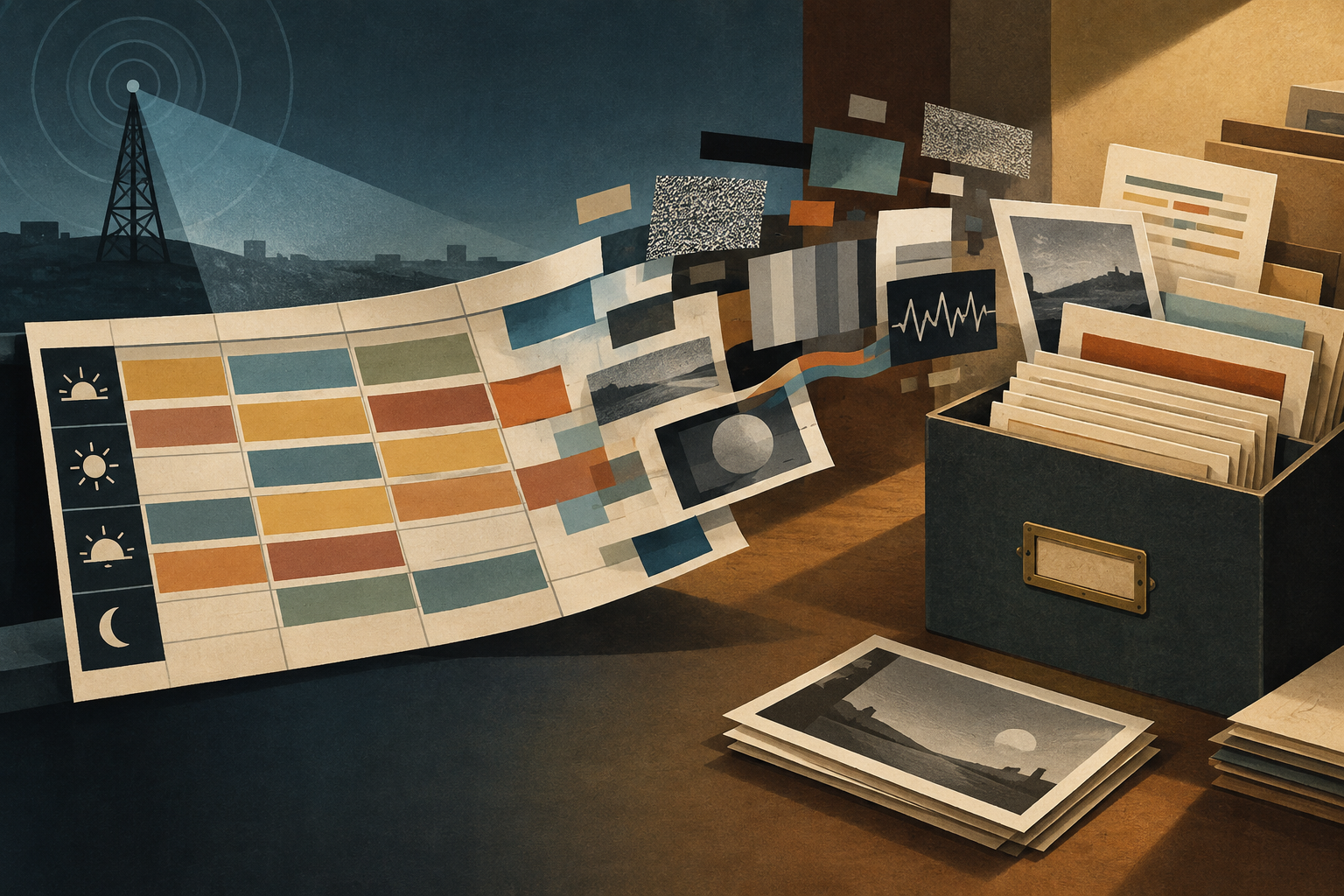
A schedule raises questions that an isolated recording cannot answer on its own: where a programme sat in the timetable, which other programmes shared its day and slot, and what audience its placement seemed to address. Answering them requires programming documents and references that allow dates, times and channels to be checked. The evidence gathered for this proposal does not provide a specific schedule from the period, so it cannot support claims about which programmes occupied a particular hour.
It does support a basic research principle: treat the schedule as a source to find and verify, not as a memory that can be reconstructed from a broadcast’s later popularity. A surviving programme proves that an accessible record exists; by itself, it does not establish how often it aired, where it sat in the schedule, or how audiences received it.
The archive opens a door—and sets limits
A study of RTVE’s audiovisual archive addresses preserved materials about programmes concerning the Spanish Civil War. It is an important clue to how an archive can support research both into content and into the traces of preservation. It does not, however, justify extending its findings automatically to every type of programme or to the whole period from 1970 to 2000.
The supplied editorial resources on Spanish television likewise emphasise the value of consulting archives, research and accounts, and of considering supports, equipment and documents alongside programmes. This suggests a necessary caution: a catalogue or available collection represents only part of the history, shaped by the circumstances and decisions of preservation. The absence of a recording from a collection that has been consulted is not enough to prove that a broadcast never existed.
From a national history to regional histories
Research on regional television in Castilla-La Mancha reminds us that television history can also be examined at regional scale. In that case, the project itself begins by noting a shortage of available information about media in the region. This is a methodological warning, not a general measure of what is missing from every Spanish archive.
Extending research beyond a single institution may help identify differences between national, regional and local histories. But connections between sources must be demonstrated: a study of one regional broadcaster cannot, by itself, establish how programming worked in other communities. Each source’s geographical scope should remain visible in any account of its findings.
Recording is not the same as reconstructing viewing habits
The possibility of recording programmes raises a central question about reception: how might a shared schedule have changed when some viewers could watch content at another time? The evidence gathered here does not document how widespread that practice was, when it developed, what equipment was used, or how it affected viewing habits. A relevant question should not be turned into a conclusion without supporting sources.
Answering it would require attributable testimony, technical or commercial documentation, audience research and materials that establish when and where particular practices became common. A preserved recording can provide an object of study, but it cannot alone prove who made it, how many people watched it, or what effect it had on shared conversation.
Reading broadcast, reception and memory together
Television was a medium and also a way of organising time. Reconstructing that experience requires keeping three layers distinct: what the schedule announced, what recordings preserve, and what the sources allow us to say about reception. The supplied titles and summaries support the importance of archives and historical research, not a complete chronology of changing habits or an exhaustive account of audiences.
The firmest conclusion is also the most cautious: the history of a broadcast does not end at the screen, but neither can archival gaps be filled with assumptions or memories. Located schedules, identifiable documents and contextualised studies can bring us closer to the timetable and its audience; the evidence available here offers an initial map for that search, not a definitive inventory.
- Decade
- 1970s
- Region
- Spain
- Level
- Enthusiast
- Entities
- Televisión
Sources and references
- De la pantalla doméstica al archivo: cuatro décadas de ...www.retropause.com · 2026-10-02
- El archivo como puerta de entrada a la televisión española de ...www.retropause.com · 2026-10-02
- El archivo audiovisual de RTVE. Programas emitidos entre ...revistas.ucm.es · 2026-10-02
- La televisión española también se reconstruye desde sus ...www.retropause.com · 2026-10-02
- Historias de la pequeña pantalla: representaciones ...dokumen.pub · 2026-10-02
- Historia y evolucion de la television autonomica en Castillariunet.upv.es · 2026-10-02
- La ley que olvidaron. Itinerarios del desamparo de ...www.redalyc.org · 2026-10-02
- La televisión también se conserva: qué cuenta el archivo de ...www.retropause.com · 2026-10-02