Material is not a biography
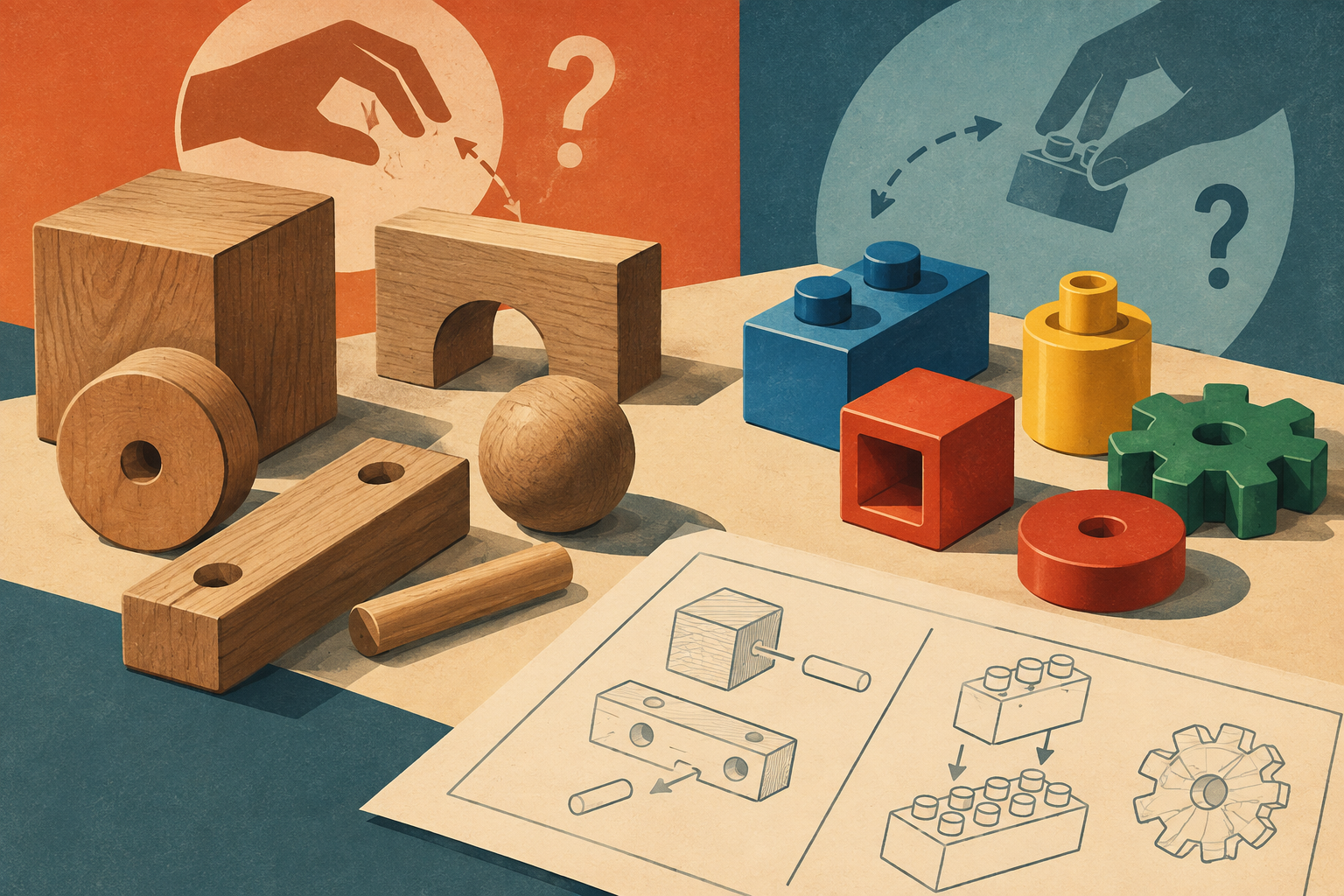
A wooden piece and a plastic one may suggest different stories, but material alone cannot reconstruct how they were made, who owned them or how they were played with. When researching a toy, begin with what can be observed: its shape, parts, joints, surviving instructions and signs of use. Then distinguish those observations from hypotheses.
Several sources on toys in Spain refer to changing materials. A study from the University of Salamanca connects the spread of plastic, from the second half of the twentieth century, with the decline of some crafts. A publication on popular toys in Guadalajara describes plastic as a material introduced around 1950. These sources indicate a transition, but do not show that every toy changed at the same time or that one material uniformly replaced another.
What form lets us ask
A form suggests possibilities; it does not provide complete instructions. A wheel may invite rolling; a joint may allow a part to move; a piece that fits another suggests some kind of assembly. These are initial readings to check against instructions, packaging or contemporary documentation, if any survive. Without such evidence, it is not safe to claim what the object’s designer intended it to be used for.
The study of wooden toys published in Eikón offers a starting point for examining how certain types of wooden objects—including yo-yos, spinning tops, wheeled animals, dolls and rocking horses—appear in cultural imaginaries. The presence of these examples does not justify assigning them a mechanism or function that the source does not describe. It does remind us that a toy can be an object of use and also acquire broader meanings.
Instructions, packaging and signs of use
Surviving instructions may help reconstruct a sequence: which parts were handled, in what order and toward what stated purpose. Packaging may provide clues about the audience a product addressed, provided its text or images are legible and interpreted in context. Neither kind of document, on its own, proves how children actually played.
Physical traces also have limits. Wear in one area may be consistent with repeated handling, but does not necessarily identify who handled it or why. A break may have resulted from play, storage or later intervention. First describe the mark—its location and appearance—and present its interpretation as a possibility, not as a recovered memory.
Wood and plastic: a comparison without a false opposition
The available sources support discussion of a change in materials and its effects on some craft practices. They do not support a simple opposition between traditional wooden toys and modern plastic ones. Objects, techniques and uses varied; moreover, material alone does not determine the quality of play, the player’s age or the object’s emotional value.
The Colombian Pedagogical Museum notes that some plastic toys from a particular period used pigments made with chemicals such as lead and cadmium. This is a reason to treat claims about composition carefully: appearance cannot identify the pigments or composition of an individual object. Nor can the information be generalized to all plastic toys. A particular object would require appropriate documentation or analysis; its colour is not enough to draw conclusions.
What can be stated, and what remains open
The article in Revista Colombiana de Pensamiento Estético e Historia del Arte on plastic toys in three paintings by Pablo Ferrer illustrates another line of inquiry: studying how toys are represented in images. A painting can document a representation, but it cannot replace a manual, catalogue or examination of an object. The SciELO article on childhood toys, intervention and dialogue also places toys within broader questions of childhood, collecting and museums; its abstract mentions, among other examples, a plastic game held by a museum.
The strongest outcome is not to assign each piece a single life, but to describe what evidence exists and what questions it can open. Material, instructions, packaging and wear complement one another; none speaks outside its context. That brings the focus back to play: not to assumed nostalgia or the object’s rarity, but to the actions its design made possible and the limits of what we can now demonstrate.
- Decade
- 1950s
- Region
- Spain
- Level
- Enthusiast
- Entities
- Museum
Sources and references
- Cultura Material - MUSEO PEDAGÓGICO COLOMBIANOmuseopedagogico.pedagogica.edu.co · 2026-10-01
- El triunfo de los juguetes de plástico en tres óleos de Pablo Ferrerdoi.org · 2026-10-01
- Del taller a la vitrina: qué puede contar un juguete españolwww.retropause.com · 2026-10-01
- Juguetes de madera o el palimpsesto del árbolrevistas.ucm.es · 2026-10-01
- El uso social del juguete en Ciudad Rodrigo - Gredos Principalgredos.usal.es · 2026-10-01
- EL JUGUETE POPULAR EN GUADALAJARA arqueología y ...amigosmuseodeguada.es · 2026-10-01
- Los juguetes de la infancia: intervención y diálogo ...www.scielo.org.ar · 2026-10-01