The museum as a place for play and interpretation
Video games can enter a museum in several ways: as a means of sharing a collection, as cultural objects worthy of study and preservation, or as experiences that invite visitors to participate. These roles are not interchangeable. A game designed to introduce museum holdings is not necessarily a historical artefact, and exhibiting a game does not, by itself, solve how it should be preserved. Research on museums and video games reflects this variety: cultural institutions have adopted the medium to communicate their collections, while the museological status of video games remains under discussion.
This distinction encourages us to look beyond the screen. Asking what is presented, why, and in what context helps us understand video games as part of cultural practice, not simply as interactive activity. It also prevents us from mistaking an engaging installation for the preservation of an object or work.
Sharing collections is not the same as preserving games
Ricart’s academic article on museums and video games describes the medium’s adoption in museum initiatives for dissemination. This supports the claim that institutions use video games, but it does not justify attributing the same method, purpose, or outcome to every initiative. The Museo Nacional Thyssen-Bornemisza’s educational page on education in museums through video games notes that their status as museological elements remains a subject of academic debate.
The distinction matters. A video game might be a mediation tool created for an exhibition; in another case, the game or its associated materials may be the object being documented. The available sources do not provide a shared inventory of practices or allow their results to be measured. They do show that dissemination, education, and heritage-making are related but distinct questions.
Preservation widens the field of view
Preserving video game history is not limited to keeping a machine. MUVIC describes itself as a museum project dedicated to preserving, studying, and sharing that history. A RetroPause article about the Embracer archive refers broadly to preserving video games’ cultural legacy. The Museo del Videojuego’s Digital Archive description says it brings together documentation, publications, and audiovisual materials related to video game history.
Taken together, these sources indicate that historical accounts can draw on varied materials beyond the game itself. But the supplied excerpts do not detail technical protocols, selection criteria, access conditions, or preservation outcomes. It would therefore be excessive to present a universal method or suggest that preservation challenges have been solved. What can be verified is the existence of projects that explicitly describe preservation as a goal and archives that gather related documents and other materials.
The visitor’s experience is part of the question
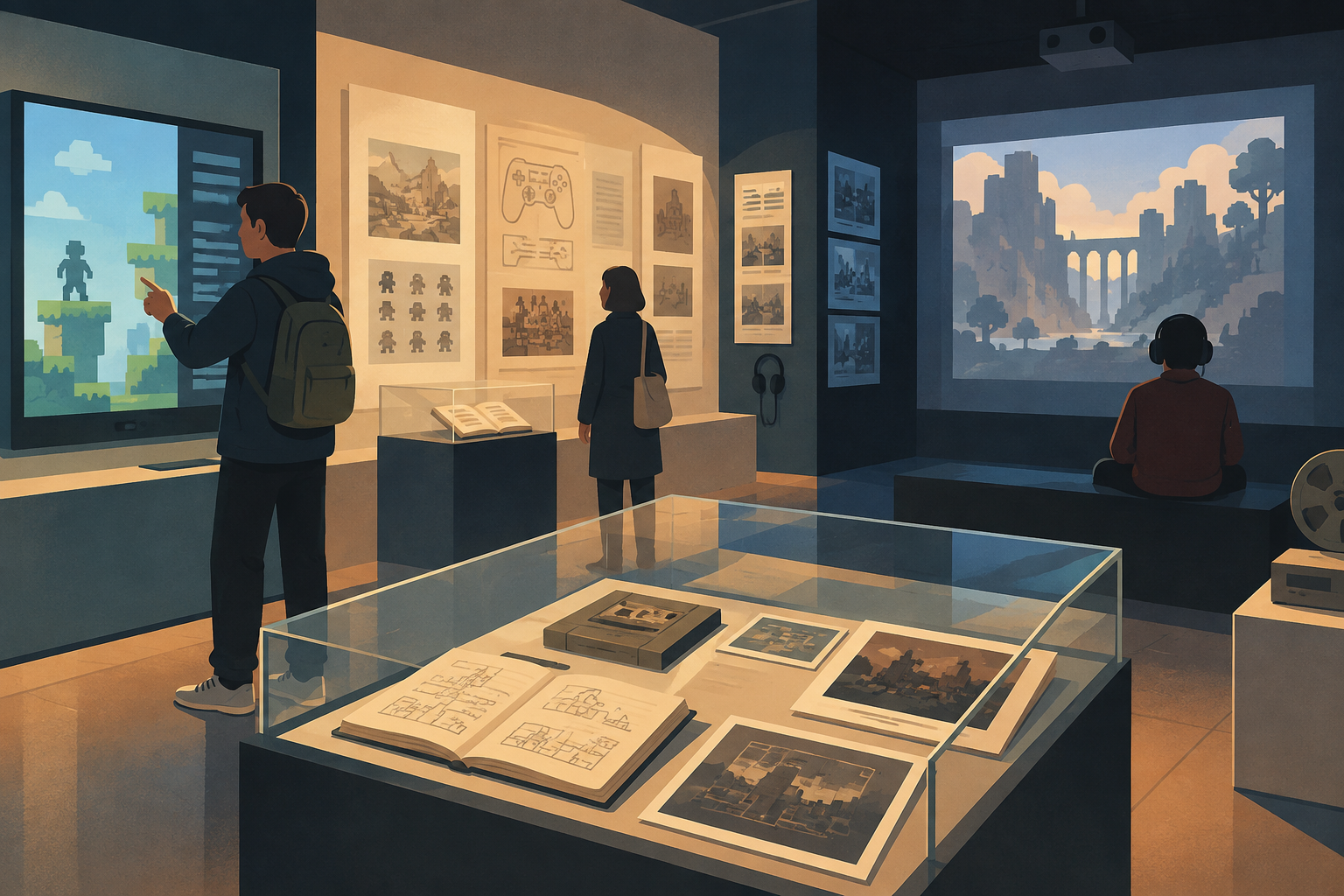
Playing in a gallery can bring an audience closer to a work in a way that exhibition text cannot reproduce. However, the supplied sources do not establish that interaction is possible or desirable in every exhibition, nor do they describe specific technical requirements. Experience is better treated as a curatorial decision that needs context: which aspects of a game should be communicated, and what is lost when it appears only as an image, demonstration, or memory?
Museum education offers another perspective. The Thyssen initiative places video games within museum education while acknowledging the academic debate about their place as museological elements. That combination cautions against assuming that play automatically teaches. Mediation matters: visitors need points of reference to connect the experience with the collection, the exhibition’s argument, and its historical questions.
What we can say—and what remains open
The sources describe a varied landscape: museums using games to communicate collections; projects presenting themselves as dedicated to preserving, studying, and sharing video game history; and archives bringing together documentation, publications, and audiovisual materials. They also document debate over the museological status of video games. They do not, however, allow us to compare institutions, verify the completeness of collections, or determine which practices produce the best results.
This caution does not diminish the subject’s importance. It clarifies the questions worth asking: whether a game is presented as a tool or as an object, what materials accompany it, and what context makes it interpretable. A museum can be a place to play, but also to observe, document, and debate. Distinguishing those functions is a first step towards telling video game history without relying on the screen alone.
- Decade
- Contemporary
- Region
- Spain
- Level
- Introduction
- Entities
- Museum, Museo del Videojuego
Sources and references
- Vista de Museos y videojuegos. La renovación de los ...revistas.uma.es · 2026-09-29
- MUVIC – Museu del Videojoc de Catalunya | Castellanomuvic.cat · 2026-09-29
- La conservación de la historia de los videojuegos en el ...www.microsiervos.com · 2026-09-29
- Explorar - RetroPausewww.retropause.com · 2026-09-29
- Educación en museos a través del videojuego (I)www.educathyssen.org · 2026-09-29
- Descargas - Museo del Videojuegowww.museodelvideojuego.com · 2026-09-29