Reading beyond the bodywork
A car or motorcycle on display invites us to look at its shape and materials, but it cannot by itself explain how it was made, maintained or used. Museum documentation can extend that reading. An article in Tábula on archives in science and technology museums says that records management helps organise cultural activities and exhibitions and supports the treatment of vehicles as heritage. This is a general observation, not a detailed account of any particular museum’s holdings.
Different parts prompt different questions
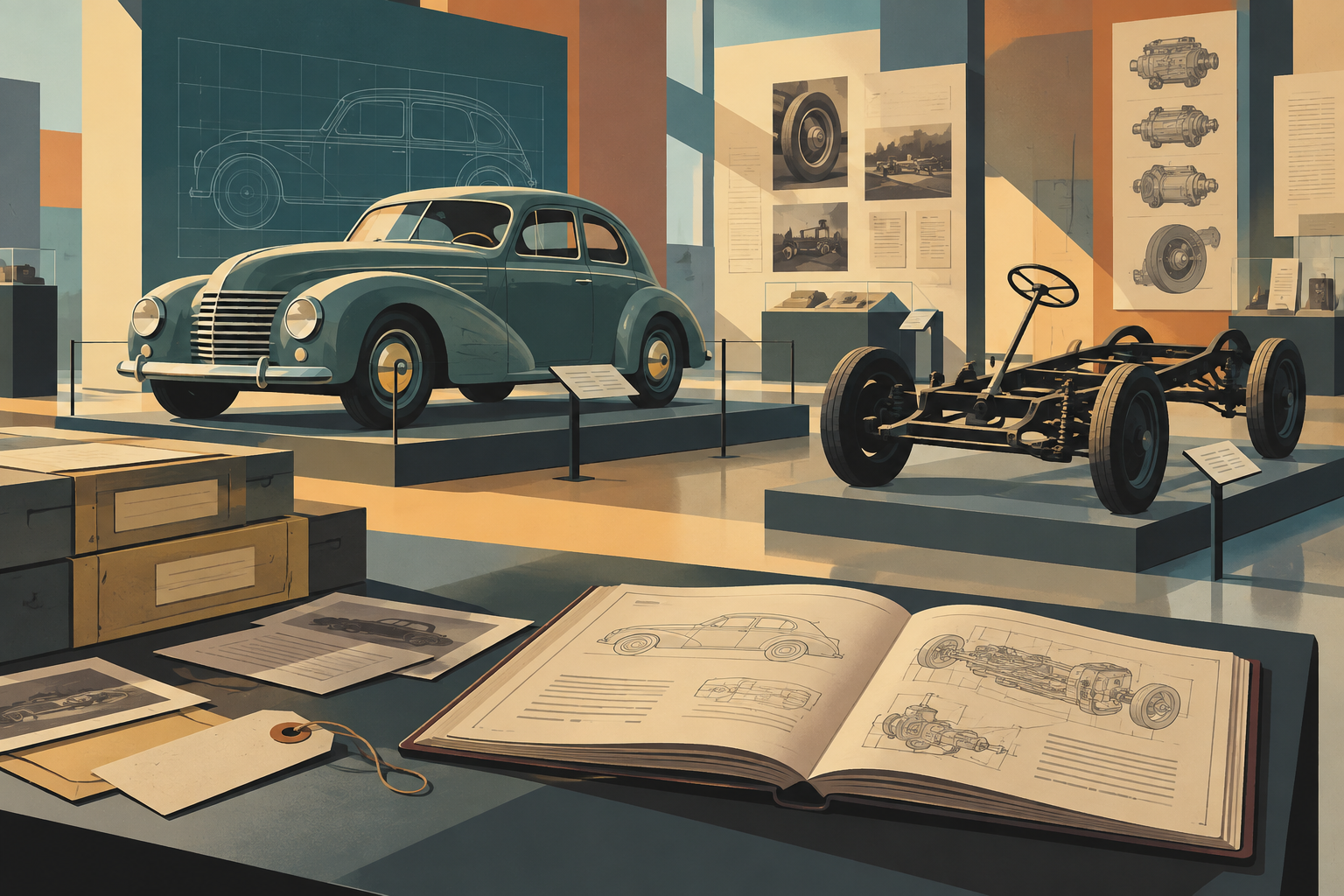
An earlier RetroPause editorial proposal distinguishes several ways of reading an object: the engine as evidence of production techniques; the chassis as a source on construction and materials; and the manual as a document of training and maintenance. This distinction is useful because it avoids treating a vehicle as if it contained a single, self-evident story. It also calls for caution: the available excerpt identifies no specific model, manual or conservation procedure.
What an exhibition can—and cannot—tell us
Tourism information for the Museum of Automotive History in Salamanca says that its permanent exhibition includes around ninety vehicles and presents the evolution of the automobile through design. This supports a description of the exhibition’s stated approach, but it does not establish the function, performance or use history of each vehicle. Claims of that kind require records, catalogues or other documents linked to the individual objects.
Other pages offer different perspectives, but they do not replace object documentation either. Turismo Ambroz-Cáparra describes European and American vehicles that travelled the roads between 1920 and 1970 at the Motorcycle and Classic Car Museum. The Costa Blanca Motor Museum presents itself as an exhibition of classic cars that includes road-safety education. These descriptions tell us how institutions frame their collections; by themselves, they do not verify technical specifications or individual histories.
What a manual can establish
A manual may provide evidence about instructions, maintenance or training, as the RetroPause reference suggests. But that possibility should not become a claim about a particular document without checking it. To separate documented characteristics from inherited reputations, the practical question is specific: which document relates to which vehicle, and what does it record? A figure or use attributed to a vehicle needs an identifiable source; a received impression about a model is not the same as a verified specification.
Reading objects together without jumping to conclusions
Considering a vehicle, its components and its documentation together can help us ask better questions about technology, work and use. Yet the sources available here are institutional descriptions and summaries, not object catalogues or technical reports. They do not provide enough evidence to compare model performance, reconstruct particular maintenance practices or establish a vehicle’s provenance.
The value of this approach lies in distinguishing what an exhibition says from what an object-specific record might demonstrate. The vehicle has a material presence; an archive and catalogue, when linked to it, can add context. Moving from a plausible interpretation to a verifiable claim requires identifying and consulting that documentation.
- Decade
- Contemporary
- Region
- Spain
- Level
- Introduction
- Entities
- Museum, Museo de Historia de la Automoción de Salamanca
Sources and references
- El archivo en los museos de ciencias y tecnologías | Tábulapublicaciones.acal.es · 2026-10-02
- El automóvil como archivo: qué conservan los museos del motorwww.retropause.com · 2026-10-02
- Museo de Historia de la Automociónwww.turismocastillayleon.com · 2026-10-02
- Museo del Motor - Costa Blancawww.museodelmotor.com · 2026-10-02
- Museo de la Moto y el Coche Clásico - Turismo Ambroz-Cáparraturismoambrozcaparra.es · 2026-10-02