The device does not tell the whole story
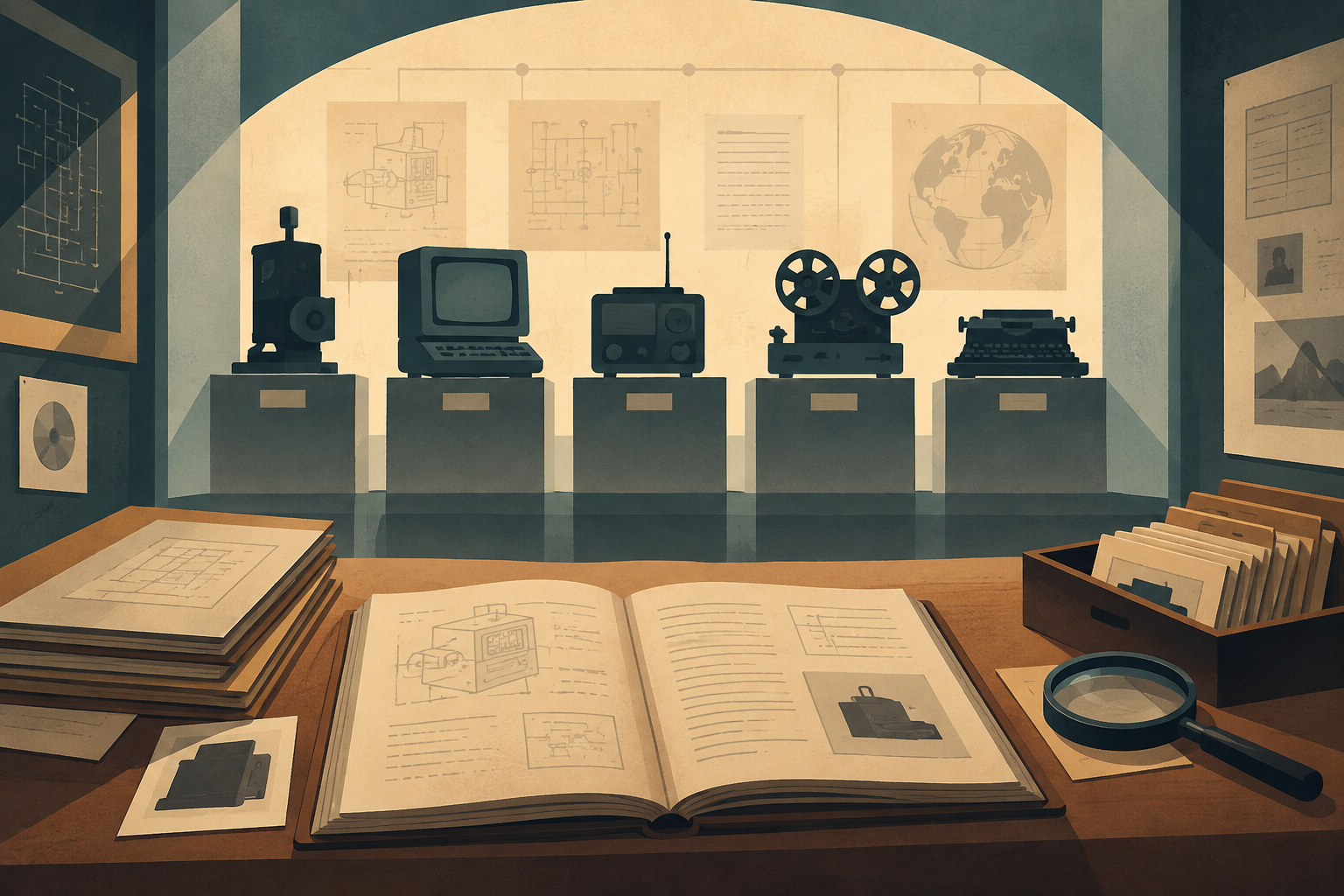
A preserved technological object lets us examine what remains present: materials, form and visible components. On its own, however, it may not document how it was described, what purpose was assigned to it, or what place it held within an institution. Answering those questions requires documents and a method of reading that does not confuse a written promise with actual use.
The evidence available for this article is deliberately limited. The paper published in Tábula addresses the role of archives in science and technology museums and highlights their contribution to preservation and dissemination. That perspective makes it possible to focus on a specific point: an archive is not an ornamental addition to a collection, but part of the conditions that make the collection researchable and communicable.
Preserving and providing access
The MUNCYT Archive description says that it organizes, processes and stores historical and administrative documentation. These are distinct but related tasks: preserving materials does not automatically make them findable or interpretable. The Historical Archive page of the National Archaeological Museum, in turn, describes its purpose as facilitating public access through information tools that are subject to updating.
These institutional examples support discussion of documentary tasks, not of specific holdings that the cited pages do not detail. We cannot infer from them which manuals, advertisements or files concerning a particular device each archive holds. That distinction matters: a service description tells us about an archive and its aims, but it does not replace examination of an individual document.
Reading a document without treating it as total proof
A document may record a description, an administrative decision or an institutional intention. By itself, it does not prove that an object was used exactly as advertised or that such an experience was widespread. The article on museum archives published by Edicions i Edicions invites readers to consider the document as a space of communication too; the available source, however, does not support attributing more specific conclusions to it.
Editorial caution means first identifying what kind of document we have and what it explicitly states. Then we should distinguish that evidence from interpretation. If an item promises a function, the promise is documented; actual use would require additional evidence. The sources gathered here contain no detailed cases that would allow us to trace that comparison for a particular device.
The archive as part of museum work
An explanatory piece about how museum archives operate describes their relationship with institutional history, collections, exhibitions and programmes. Read alongside the MUNCYT and National Archaeological Museum examples, it helps explain why document access and organization shape what can be researched and told.
This does not make an archive a complete narrative. Preserved documents result from processes of creation, selection and description; failing to find something in a search does not prove that it never existed. For a history of technology, that limitation is a reason to explain the scope of each search and avoid filling gaps with memories or generalizations.
What the sources allow us to say
The sources consulted support a measured conclusion: archives associated with science and technology museums perform preservation, organization and dissemination functions, and public access can be supported by information tools. They do not, however, provide enough evidence to reconstruct the everyday uses of a specific device or to assess generally the gap between its promises and limitations.
That limitation does not diminish the question; it defines the next step in the research. We would need to locate specific documents, verify their provenance and compare their statements with other evidence before presenting a history of use. The archive is part of technological history because it preserves and organizes traces. The history those traces can tell depends on what can actually be consulted.
- Decade
- Contemporary
- Region
- Spain
- Level
- Introduction
- Entities
- Museum, Museo Arqueológico Nacional
Sources and references
- El archivo en los museos de ciencias y tecnologías | Tábulapublicaciones.acal.es · 2026-10-03
- Archivo histórico - | Ministerio de Culturawww.man.es · 2026-10-03
- Archivomuncyt.es · 2026-10-03
- Archivos de Museo: Funcionamientoevemuseografia.com · 2026-10-03
- Archivos de museos. Una oportunidad para liderar el ...edicionsedic.es · 2026-10-03