A word in a record is not the film
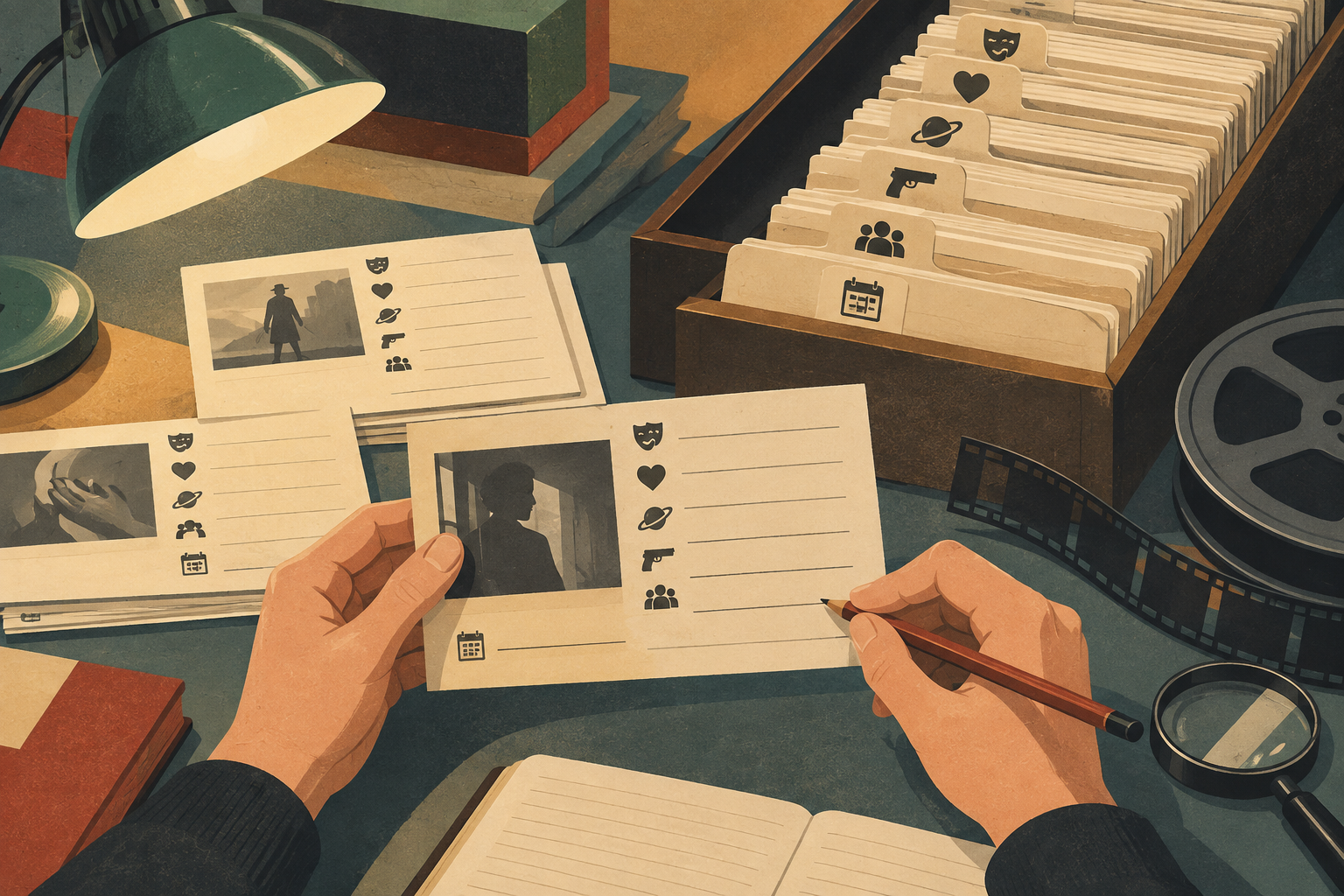
A film archive record may list a title, filmmakers, genre and shooting dates. R. Domínguez-Delgado’s study of film documentation identifies these as elements of a record: a starting point for research, not a neutral reproduction of everything a film means. The genre field helps organise searches and locate material, but it cannot on its own sum up a work’s form, context or viewing experience.
It is useful to distinguish three things: the film, the record describing it, and the interpretations built from both. Confusing them can make us attribute to a work a classification that may instead belong to the way it was catalogued or studied.
What a category makes possible
Classification allows researchers to group and compare. A. Cuarterolo’s account of archival research describes searching materials through fields such as genre, direction and year. This is practical: it makes a body of documents navigable and helps researchers ask what is preserved and how information is organised.
Categories also have limits. The presence of a genre in a record establishes that the category forms part of its description; it does not, by itself, tell us who assigned it, when it was added or whether it reflects the terms used in original promotion. Those questions require specific documents and further context. A label guides the search; it should not replace it.
From record to history
The volume on history and film published by the Institución Fernando el Católico places films in relation to the construction of the past. Studies of film heritage and its presentation, in turn, address cinema’s documentary value and the decisions involved in preserving and displaying it. Taken together, these approaches encourage us to treat the record not only as a tool for finding a film but also as evidence of how knowledge about cinema is organised.
That does not mean every classification is arbitrary, or that one record can reconstruct a film’s history by itself. It means researchers should ask what a record actually documents, what it leaves out and what other documents could be used to check it. A catalogue tells us about its own fields; it does not automatically prove production, circulation or reception conditions that are absent from them.
Circulation needs other evidence
The question of how reception changed between theatrical exhibition and video cannot be answered with a genre label. To study such a change, we need sources documenting the different circumstances of exhibition and reception. The evidence available here gives no details about particular films, campaigns, video release dates or audience responses. It therefore cannot support a claim that a genre was received one way in cinemas and another on video.
It does suggest a way to proceed: distinguish what a record classifies from what circulation sources can demonstrate. Elena de la Cuadra and Iris López de Solís’s study of archive images in fiction films based on true stories offers an example of research focused on the relationship between documentary images and cinematic narrative. Its subject is specific; it should not be treated as general evidence about the reception of every genre or format.
What can—and cannot—be established
Records, archives and film-heritage research allow us to examine how cinema is preserved, described and organised. They also make visible that cataloguing fields, including genre, are tools for consultation. Without supplementary documentation, they do not permit conclusions about audience tastes, promotional intent or different reception across media.
The conclusion is simple: reading a record means reading one part of a film’s documentary context, not replacing the film or its history. Genre can open a research path; the sources determine how far that path goes.
- Decade
- Contemporary
- Region
- Global
- Level
- Enthusiast
- Entities
- No linked entities
Sources and references
- Imágenes de archivo en cine de ficción: cine basado en una historia realopenalex.org · 2026-10-03
- Historia y cine. La construcción del pasado a través de ...ifc.dpz.es · 2026-10-03
- La Documentación Fílmica: marco contextual históricorevistas.ucm.es · 2026-10-03
- Museos y archivos del cineunesdoc.unesco.org · 2026-10-03
- El archivo en la época de su reproductibilidad técnicawww.vivomatografias.com · 2026-10-03
- musealización y puesta en valor del patrimonio cinematográficodigibug.ugr.es · 2026-10-03