The object does not speak by itself
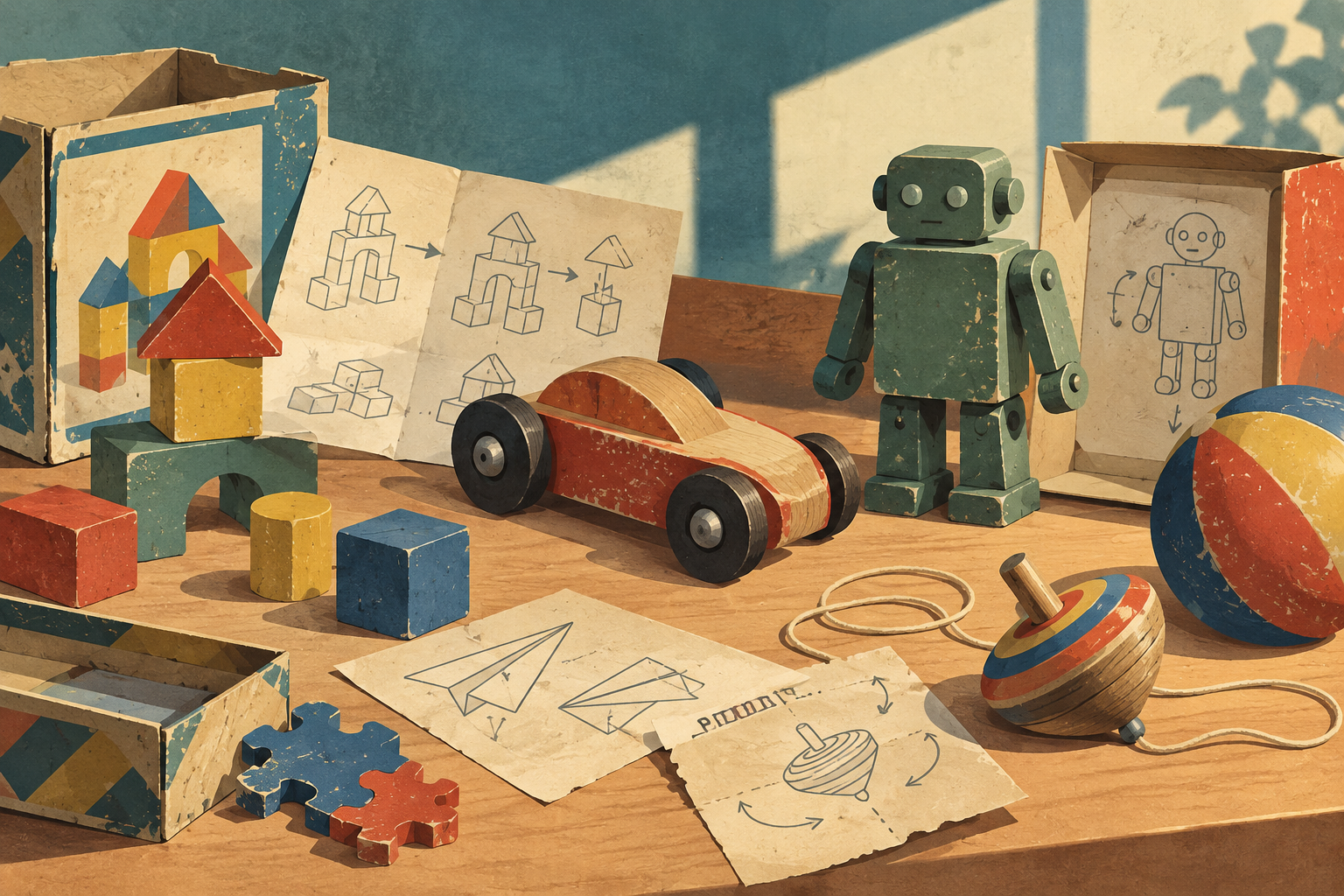
A preserved toy may seem to answer a simple question: how was it played with? But an object on its own does not always make its use clear. Getting closer to that experience requires other traces: instructions, packaging, collection records and the context in which the object was made or collected. The available evidence about toy museums and archives encourages us to approach play through these connections, without turning an evocative appearance into certainty.
Different sources, different questions
The Málaga Municipal Archive described its exhibition “Tesoros de infancia” as a history of toys in Spain connected with social, technical, cultural and political change. That description suggests a broad historical reading: not only the shape of a toy, but also the world of its manufacture. The Documentation Centre and Photographic Archive of the Catalan Toy Museum, meanwhile, describes itself as a consultation and research space specialising in play and toys. These are complementary ways of situating an object: an exhibition offers an interpretive route; an archive provides a place to consult and investigate documents.
Reconstructing play without filling in the gaps
A collection record helps identify how an institution classifies an object, but it is not necessarily an instruction manual. CER.es lists record CE1010 under “Recreational objects,” “Games and toys” and “Toy,” with a stated date range of 1876–1900. This identifies an object and its cataloguing framework; the supplied result does not describe its instructions, maker or sequence of play. A careful reading therefore separates what the record states from hypotheses suggested by the toy’s shape or materials.
The same caution applies to wear. A visible mark may be consistent with handling, but on its own it cannot establish who used an object, how often, or under what rules. Without specific documentation, those questions must remain open. The point is not to fill the silence, but to recognise what evidence would be needed to go further.
Why documenting the object matters
An academic paper on two pedal toys made by the Sauquillo factory—a car and an aeroplane from the Toy Museum of the Universitat Politècnica de València—is described as a contribution on their restoration and conservation. The article record confirms its subject and authors, but the supplied material does not include the full text or treatment details. It therefore supports the claim that these objects have received specialist study, not descriptions of procedures or conclusions absent from the evidence.
Museum initiatives also remind us that a toy is not preserved solely because it is rare. Memoria Viva, at the Universitat Politècnica de València, presents its museum initiative as a way to share the playful, historical, social, cultural and technological values conveyed by toys. This framing puts play first: an object matters both for what it is and for the questions it allows us to ask about use and context.
Making the limits visible
The sources gathered here do not include original instructions, detailed photographs of the pieces or attributable accounts of how they were used. Nor do they let us connect every cited toy to a specific package or reconstruct a complete play experience. They do offer something useful: institutions that research and exhibit toys, a catalogue record with an identification and date range, and an academic reference on pedal toys.
With these limits clear, research can proceed without confusing interpretation with fact. A surviving instruction sheet might explain intended actions; packaging might reveal how a toy was presented; an archival record might illuminate its documentary history. Each would answer a different question.
Play as a research question
Looking at a toy is a beginning, not an ending. Its form can prompt questions, but instructions, documents and observable traces—read cautiously—bring us closer to what could be done with it. The available sources do not reconstruct a complete game; they do show why object, archive and context should be studied together. In this way, toy history need not depend on rarity alone: it can approach the experience a toy was designed for without claiming more than the documents support.
- Decade
- Contemporary
- Region
- Spain
- Level
- Introduction
- Entities
- Museum, Museo del Juguete de Cataluña, Museo del Juguete
Sources and references
- Los juguetes a pedales de la factoría Sauquillo. Restauración de un coche y un avión del Museo del Juguete de la Universitat Politècnica de Valènciadoi.org · 2026-10-10
- 'Tesoros de infancia', en el Archivo Municipal - Visita Málagavisita.malaga.eu · 2026-10-10
- El Centro de Documentación y Archivowww.mjc.cat · 2026-10-10
- Museo del Juguete - Memoria Viva - UPVmemoriaviva.upv.es · 2026-10-10
- La importancia del museo de juegos y juguetes tradicionales ...dialnet.unirioja.es · 2026-10-10
- Objetos recreativos - CER.es - Ministerio de Culturaceres.mcu.es · 2026-10-10