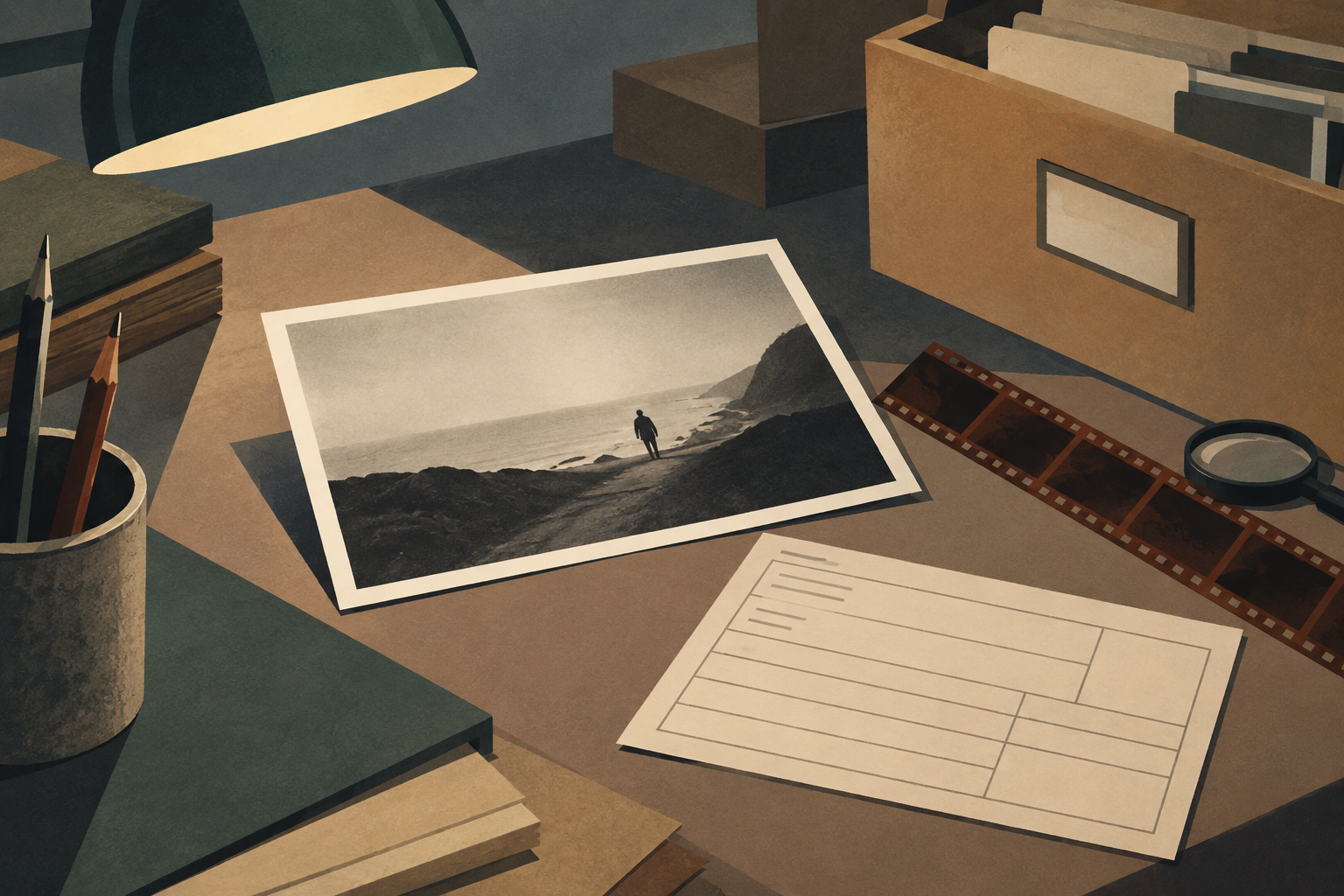
A photograph seems to offer an immediate answer: it shows something. Yet that impression does not settle basic questions. What object are we looking at? How did it enter a collection? What information accompanies the image, and what has been lost? Ibermuseos’s protocol defines the visual documentation of museum collections as the photographic recording of the objects they contain, with the explicit purpose of identification. That function is valuable, but it does not automatically make an image a complete explanation of the object or its history. A careful reading keeps three layers distinct: the visible image, the support or record that is preserved, and the documented context.
Identification is not explanation
A photograph in a collection can help recognize an object and associate it with a record. The identification purpose described by Ibermuseos clarifies why visual archives are useful: they help connect an image with what an institution preserves. But identification alone does not establish who made the photograph, under what circumstances, or with what intention. If those details are absent from the available documentation, they should remain open questions.
This distinction prevents us from claiming more than the image supports. A frame is a selection, not an exhaustive description. An image records an appearance, but not necessarily the complete history of the object photographed. An institution’s preservation or cataloguing of an image supplies a documentary framework; it does not guarantee that every aspect of its production and use is known.
An archive provides context, with limits
The Banco de España photographic archive offers a concrete example of a collection’s contextual value: the institution’s account describes photographs of its events as a record of its participation in political and economic life. That wording links images to events and institutional activity. It also reminds us that archival meaning does not depend only on what appears in the frame: arrangement, provenance, and relationships with other documents matter too.
However, a general description of an archive cannot automatically establish the context of each photograph. To support a specific claim about an image, its own record and associated documents would need to be checked. A series may offer clues about uses and practices; it does not authorize assigning a date, maker, or purpose to every photograph when these have not been documented.
Dates and creators: questions for the record
The study of press photographic archives available through the journal of the Complutense University of Madrid includes, among its descriptive fields, the dates on which the producer generated the photographs. This is useful because it separates a question that is often conflated: when an image was produced and when it was later described, incorporated, or consulted. When reading a record, check what its date field actually denotes and which activity it refers to.
The existence of a field does not mean every record contains complete information or that a date can always be verified. Nor should an attributed date be confused with an explicitly documented one. If the record does not explain the basis for dating, the responsible approach is to preserve the uncertainty rather than turn an approximation into a certainty.
Photography and video do not organize time in the same way
An academic article titled “The temporal factor and rhythm as a distinction between photography and video” signals, in its title, a relevant editorial difference: the relationship to time and rhythm is part of the comparison between the media. The reference supports a question, not details or conclusions absent from the supplied information. When comparing a photograph and a video, research should attend to what kind of record is preserved and which claims about duration, sequence, or rhythm are actually supported.
The Museum of Photography Archive and the exhibition “Documentary Genealogies. Photography 1848–1917” offer other ways to approach the medium in their descriptions: a museum devoted to a photographic archive, and an exhibition presenting historical antecedents of photography. They are useful references for considering photography as a subject of collecting and study, but they are not enough to assign a particular process, support, or history of use to an image that has not been described.
A reading that separates evidence from interpretation
The publication Photography and the Museum is presented as an invitation to learn about the photographic legacy preserved in museums and museum collections. This broadens the focus: alongside individual images, the ways groups are preserved and described matter. Documentation can help identify objects, organize evidence, and make institutional context visible. It does not, however, replace research into each item.
A responsible reading can begin with straightforward questions: What does the record identify? What does it say about support or process? What does it state about creator, date, and use? What remains undocumented? Then explicit information can be separated from interpretation. If a source says that a collection reflects an institution’s participation in public life, that characterizes the archive as a whole; it does not by itself prove the circumstances of every exposure.
A photograph provides evidence, but it does not speak without mediation. Records, archives, and context help explain how an image was produced and used only when their claims stay within what is documented. Recognizing those limits does not diminish photography’s value; it makes it possible to describe that value more precisely.
- Decade
- Contemporary
- Region
- Global
- Level
- Introduction
- Entities
- Museum
Sources and references
- El factor temporal y el ritmo como distintivo entre fotografía y vídeodoi.org · 2026-10-11
- La exposición "Genealogías documentales. Fotografía 1848 ...www.facebook.com · 2026-10-11
- protocolo-documentacion-visual.pdfwww.ibermuseos.org · 2026-10-11
- Fotografía y museo - Librería de Culturalibreria.cultura.gob.es · 2026-10-11
- ARCHIVOS FOTOGRÁFICOS DE PRENSArevistas.ucm.es · 2026-10-11