At first glance, a toy may seem straightforward: an object made to be played with, kept or given as a gift. But when it enters a collection or exhibition, it speaks about more than one child’s private experience. It also raises questions about the materials, techniques, educational ideas and habits of consumption around it. It will not always provide complete answers; that is precisely why it is worth approaching as a document, not just a keepsake.
From personal memory to a shared object
The evocation of a particular childhood can be powerful, but it is not enough to reconstruct a toy’s history. An individual memory tells us how one person related to an object; on its own, it cannot establish who made it, how it circulated or what it meant to other families. The Madrid exhibition «¡Me lo pido!» is presented as an invitation to return to the private space of childhood. That sentimental starting point can open a broader conversation, provided that the viewer’s memory is not mistaken for a complete historical explanation.
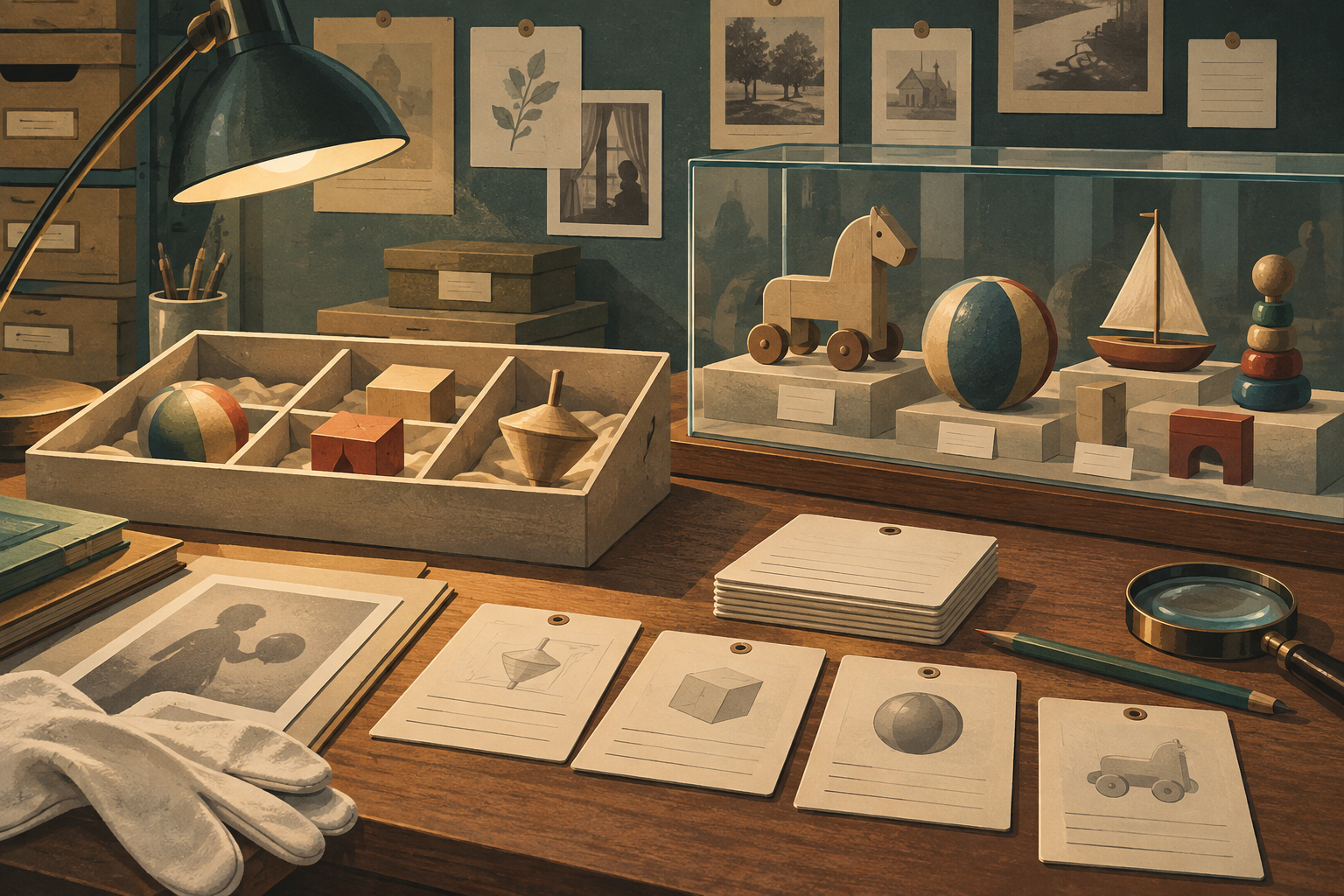
The distinction matters in a display case. Visitors may recognize a shape or a kind of play and mentally fill in what is not on view. That response matters as an experience, but it does not, by itself, prove a piece’s date, origin or typical use. Such claims require documents, records and context.
Manufacture tells a story too
The Málaga Municipal Archive’s announced exhibition «Tesoros de infancia» proposes examining the evolution of toys in Spain in connection with social, technical, cultural and political changes at the time they were made. This approach shifts the focus from an isolated object to the conditions that made its production and presentation as a toy possible. Without further information about the specific objects on display, it is not possible to detail particular materials, makers or periods; the value of the perspective itself, however, is clear.
Asking how a toy was made does not mean inferring its history from appearance alone. Size, surface or a visible mechanism may suggest hypotheses, but they do not independently establish a place of origin or a date. Collection records and related documentation are needed to distinguish observation from verification. That caution prevents a visual impression from being turned into a fact.
Archives and collections beyond the display case
The Documentation Centre and Photographic Archive of the Toy Museum of Catalonia is described as a consultation and research space specialising in play and toys. The existence of such a documentary centre changes the scale of the work: alongside the objects, the information that helps identify, situate and study them matters. A collection cannot be understood simply by looking at its objects; it also depends on records and sources that allow relationships to be established rather than assumed.
According to Memoria Viva, the Toy Museum of the Universitat Politècnica de València has designed a travelling exhibition using representative pieces from its collection, arranged in fourteen display cases that recreate the museum’s history. This describes a specific way of presenting a collection and taking it on tour. It does not, however, provide a complete account of the selection or establish which objects appear in each case. The difference between what a source confirms and what it leaves unspecified is part of responsible interpretation.
Conservation adds new questions
Restoration also appears in the documentation on toys. A scholarly paper in the proceedings of OCIGOLONTE 2023 is titled «Los juguetes a pedales de la factoría Sauquillo. Restauración de un coche y un avión del Museo del Juguete de la Universitat Politècnica de València». The record establishes that a specialised publication addressed the restoration of a pedal car and an aeroplane. The available title does not describe the treatments, materials or condition of the objects, so those details should not be invented.
Even so, the example shows why conservation is not simply a matter of making an object look new. Restoration makes decisions about a piece part of its documented history. For visitors, the challenge is not to treat the displayed appearance as a transparent window onto the past: where documented, the intervention belongs in the account too.
What an object lets us claim
Reading a toy as a document means holding two ideas together: it can offer clues about material culture, yet it cannot speak entirely for itself. The exhibitions cited here suggest different scales of inquiry: changes connected to manufacture in Málaga, childhood memory in Madrid, and the touring presentation of a collection associated with the Universitat Politècnica de València. The specialist archive at the Toy Museum of Catalonia, in turn, points to the importance of consultation and research.
Taken together, this evidence supports an approach to toys, not a complete history of them all. Each interpretation should identify its source and distinguish documented information from personal association. In that way, an object can still awaken memories without being reduced to nostalgia: it can also prompt questions about what was made, what has been preserved and what information is still missing.
- Decade
- Contemporary
- Region
- Spain
- Level
- Enthusiast
- Entities
- Museum
Sources and references
- Los juguetes a pedales de la factoría Sauquillo. Restauración de un coche y un avión del Museo del Juguete de la Universitat Politècnica de Valènciadoi.org · 2026-09-29
- 'Tesoros de infancia', en el Archivo Municipal - Visita Málagavisita.malaga.eu · 2026-09-29
- El Centro de Documentación y Archivowww.mjc.cat · 2026-09-29
- Museo del Juguete - Memoria Viva - UPVmemoriaviva.upv.es · 2026-09-29
- '¡Me lo pido!'www.comunidad.madrid · 2026-09-29
- Cuando un juguete entra en el museo: infancia, cultura ...www.retropause.com · 2026-09-29