A source is not a custom
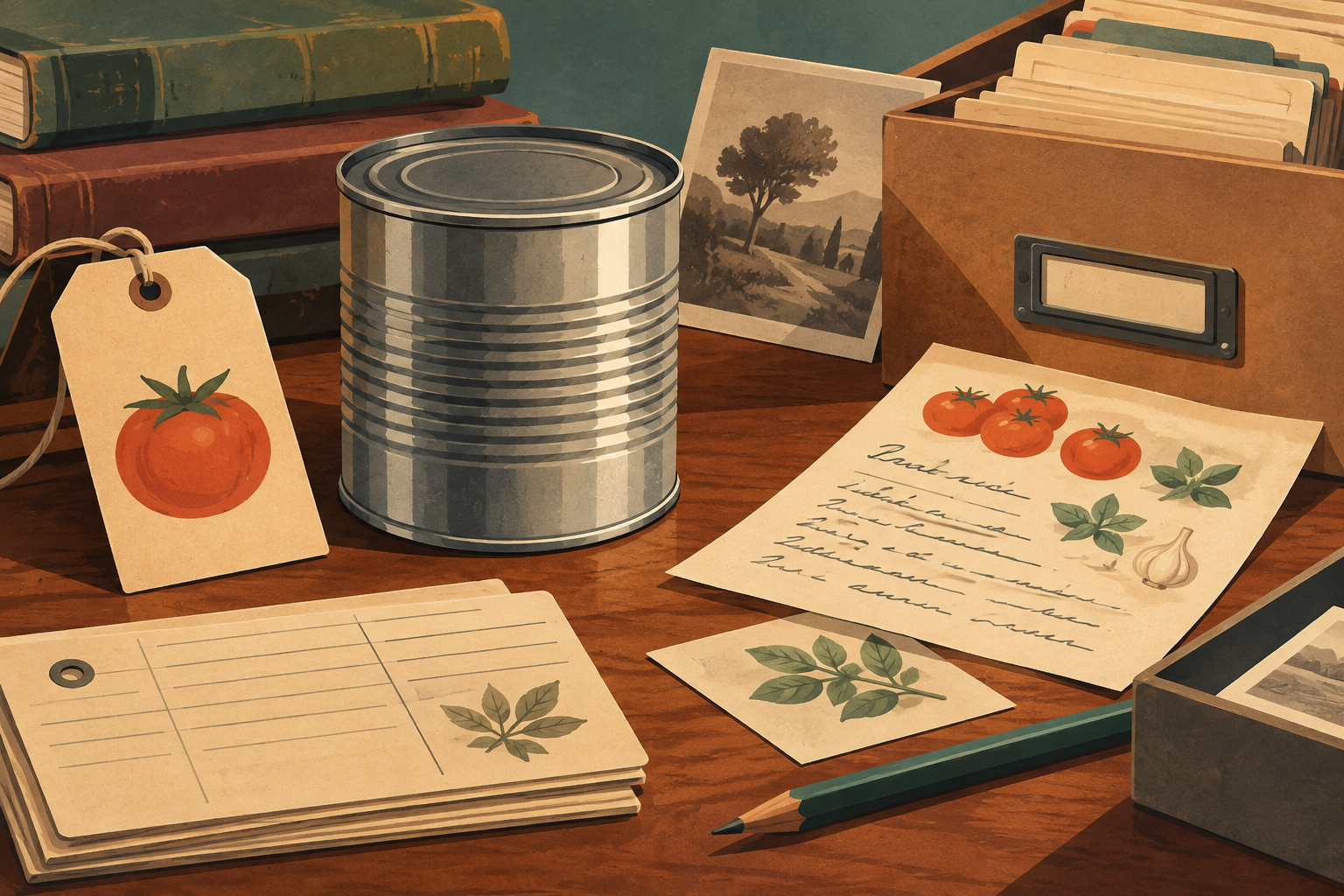
A tin, label or advertisement preserves a way of presenting food. On its own, it does not show who bought the product, how often it was eaten, or how it fitted into a meal. That distinction is the starting point for studying food culture without turning a commercial image into a portrait of domestic life.
The material available brings together sources of different kinds: an introduction to recipes, packaging and cultural memory; an exhibition text about sweets and women confectioners; a museum collection record; a bibliographic archive devoted to food culture; and publications about food museums and the Mediterranean diet. Each raises different questions and has its own limits.
Packaging speaks to presentation
The RetroPause text proposes cookbooks, tins, labels and archival documents as material for approaching food as tangible and intangible heritage. That list suggests a research framework, but does not itself provide the history of a particular product or data about its consumption. It should be treated as a starting point, not as proof of a specific practice.
Packaging can help researchers study imagery, wording and presentation when the object and its context are identified. Moving from promotion to habits requires additional sources: domestic documents or attributable testimony, for example, where they exist and can be verified. The supplied evidence contains no sales figures, detailed ingredient information, audience data or consumption frequency. Filling those gaps would be speculation.
Recipes and memory, with attribution
The Spanish Ministry of Culture text about Patrimonio Comestible: Una historia de dulces y de sus reposteras confirms an exhibition project with that title and describes its focus as sweets and women confectioners. The supplied excerpt gives no details about its objects, dates or conclusions. It is therefore a lead for locating exhibition documentation, not sufficient grounds for attributing particular recipes or biographies.
FoodCultura’s archive is described as a bibliographic collection devoted to food culture, containing books, cookbooks, magazines, fanzines, CDs and memorabilia. This range invites comparisons between media, but the description does not identify specific titles or guarantee that every item documents domestic practice. Research should catalogue each object and distinguish its contents from later interpretation.
Museum records and their silences
A CER.es search lists a result from the Muséu del Pueblu d’Asturies under reference FD012479. The excerpt includes the terms “Chocolates,” “Alimentos” and “Industria,” and identifies a “Calendario” associated with S. Subías. This is a concrete cataloguing clue, but it is not enough to establish the calendar’s appearance, date, promotional function or the precise relationship between all those terms.
The example shows why a catalogue entry must be separated from a researcher’s inference. Before using it to tell the story of a brand or custom, one would need to consult the full record and, if available, the object itself. The evidence supplied here contains no image, expanded physical description or detailed provenance.
From museum to table: different questions
The academic article listed by Dialnet is titled Museos de la alimentación: sabores detrás del cristal and is dated 2021. The National Archaeological Museum dossier presents CONVIVIUM: Arqueología de la dieta mediterránea as an exhibition examining the meaning of that practice and mentions its recognition as Intangible Cultural Heritage of Humanity. The excerpts identify museological and heritage approaches; they do not allow us to summarise the publications’ full arguments.
The material also includes Alimentos con historia, a popular book by Ismael Díaz Yubero, according to Mercasa’s description. Its search record highlights the breadth of its information, but the material provided here does not verify particular chapters or claims. To distinguish advertising from habit, combining sources is more useful than relying on one object: advertisements and packaging document representation; cookbooks and domestic records may offer other clues; catalogues and studies explain how objects are preserved and displayed.
What can be said
These references establish that resources exist for studying food, sweets, memory, collections and museum representation. The excerpts available do not provide a verifiable reconstruction of what a particular group ate, or a consumption history of a specific sweet. The editorial conclusion should remain at that scale.
A sound investigation would begin by describing each object, recording provenance and date where documented, and comparing the advertising promise with other kinds of evidence. Packaging is valuable evidence of design and communication; it is not a transparent window onto the dining table. Recognising the difference does not impoverish the history. It makes the account more precise and keeps visible the questions that still require archival research.
- Decade
- Contemporary
- Region
- Spain
- Level
- Enthusiast
- Entities
- Museum, Museo Arqueológico Nacional, Archivo de FoodCultura
Sources and references
- Cuando la comida entra en el museo: recetas, envases y ...www.retropause.com · 2026-10-03
- Patrimonio Comestible: Una historia de dulces y de sus ...www.cultura.gob.es · 2026-10-03
- CER.es Colecciones en Red - Resultados de la búsquedaceres.mcu.es · 2026-10-03
- Archivowww.foodcultura.org · 2026-10-03
- Museos de la alimentación: sabores detrás del cristal - Dialnetdialnet.unirioja.es · 2026-10-03
- CONVIVIUMwww.man.es · 2026-10-03
- Alimentos con historiawww.mercasa.es · 2026-10-03