A search that leads to an identifiable item
The question of which catalogue identifies series and variants seems to call for a straightforward answer: a catalogue with names, images and comparable data. The available evidence permits a first step, but not a complete solution. CER.es is described as an online collective catalogue bringing together information and images of a significant selection of cultural objects. Its search results include a collectible album titled “Colección Zoológica,” dated 1907 and associated with the Museo Pedagógico. This is a specific record that helps locate an object and distinguish some of its documented attributes.
Precision matters. The record gives a title, a date and an institution; the supplied information does not show a list of collectibles, complete numbering, printing variants or the album’s full contents. It can therefore identify that catalogued item, but it does not establish that CER.es is a comprehensive catalogue of collectibles or that it can identify every series on its own.
A catalogue is not the entire collection
CER.es describes its contents as a selection of cultural objects, not as comprehensive coverage. That distinction is particularly important for collecting: a search result for one album does not demonstrate that every copy, loose sheet or related variant has been recorded. Nor would a missing result prove that an item never existed or was never collected.
The description of state museum archives points to another documentary layer. Museum archives hold documentation relating to objects in their care from the time of deposit. Such records may provide context for an object’s institutional history, but the supplied text does not specify which papers accompany the 1907 album. A general description of an archive should not be turned into a claim about the file of a particular object.
What the visible fields identify
In the CER.es result, “Colección Zoológica” functions as the collection title; “1907” as its date; “Reinado de Alfonso XIII” as cultural context or style; and the Museo Pedagógico as the associated museum. These fields make an initial identification possible and provide starting points for further questions. They are not the same as an inventory of variants, and they do not suffice to assign each collectible to a particular print run or edition.
An Ibermuseos protocol on visual documentation describes photographic recording as a tool for identifying the objects that make up collections. An image may help compare visible features, but a photograph alone does not establish that two examples belong to the same variant. Supporting that conclusion would require comparable images and descriptive criteria not provided in the available evidence.
Albums, series and collecting practices
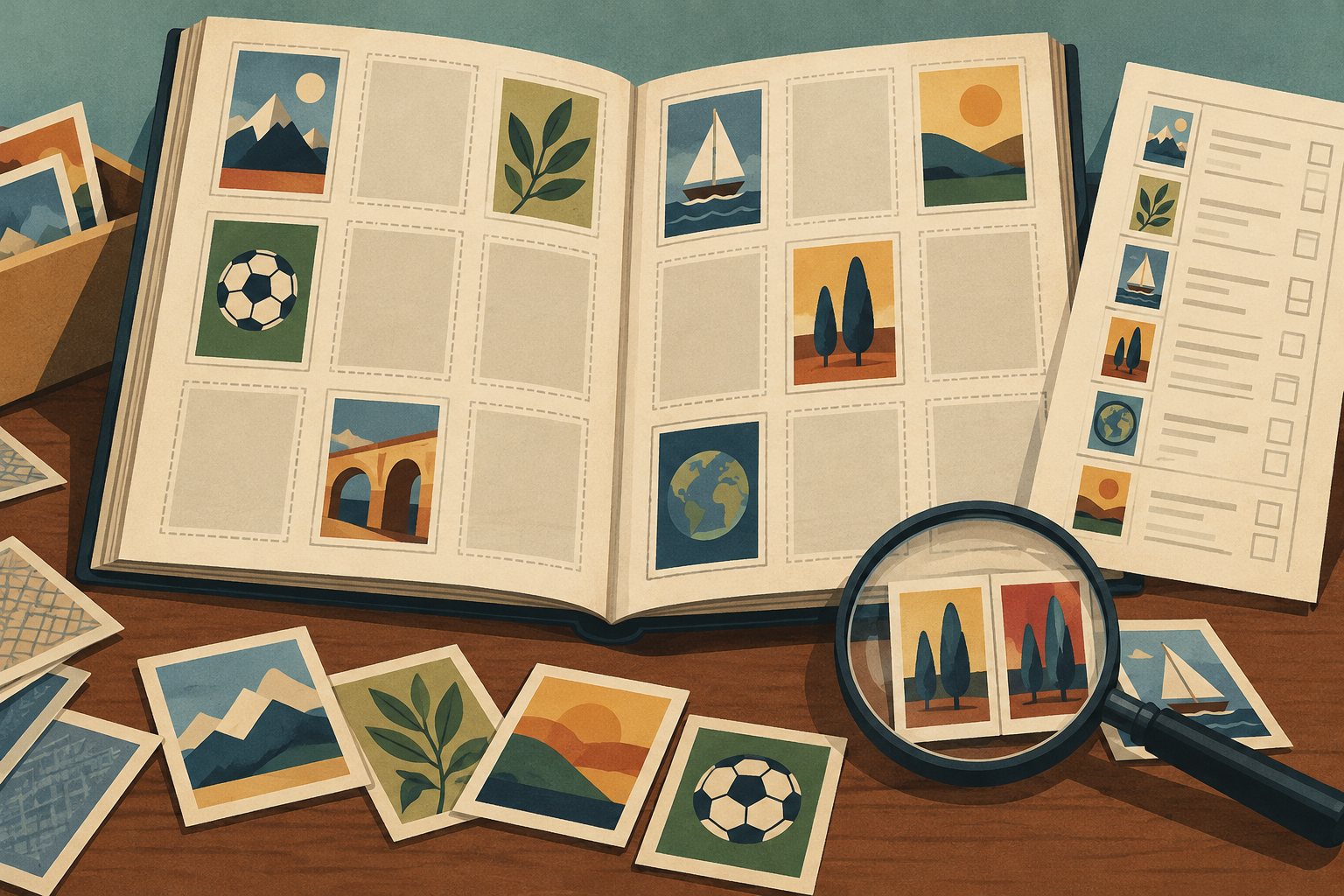
The Museo del Álbum de Cromos Villa de Estadilla (MACVE) states that its aim is to exhibit a century of albums, beginning in 1900. This presents the album as an object that can form part of a broader history of collecting. The information supplied here, however, does not provide a catalogue of the series held, rules for distinguishing editions or documentation of exchange practices.
This distinction helps separate three questions that are often conflated: what an object is, which series it belongs to, and how it circulated among collectors. The available record partly answers the first. The second would require comparison with other sources or identified examples; the third would require specific records of exchanges, circulation or attributable testimony. The supplied sources do not support reconstructing particular exchange networks, even though such networks are a valuable part of collecting’s social archive.
Reading variants with care
For research into variants, a catalogue can be a point of access, not an automatic verdict. Record exactly what each entry shows—title, date, institution and image, where available—and keep those facts separate from hypotheses. For “Colección Zoológica,” the supplied search result documents the date 1907; it does not document a more precise printing date, the number of collectibles or the existence of different versions.
Museum visual documentation and institutional archives offer complementary avenues: one for comparing appearance, the other for investigating the documentary history of objects. The available evidence does not show that these avenues are linked for this album. Rigorous research should keep that gap visible rather than filling it with estimates of value, assumptions about rarity or uncorroborated recollections.
The limits are part of the record
The strongest finding is deliberately bounded: CER.es provides a record for “Colección Zoológica,” a collectible album dated 1907 and associated with the Museo Pedagógico. It is a useful example of catalogue identification, not proof that a catalogue can resolve the whole history of a series. MACVE and the sources on archives and visual documentation point towards questions for further research, but they do not by themselves answer which variants exist or how they were exchanged.
A catalogue identifies an item when its data make it distinguishable and retrievable. Reconstructing a series requires further comparison and evidence. Keeping these tasks separate does not diminish a catalogue’s value; it clarifies what is known, what remains open and what would need to be documented before a hypothesis about collectibles and collecting could become verifiable history.
- Decade
- Before 1950
- Region
- Spain
- Level
- Introduction
- Entities
- Museum, Museo del Álbum de Cromos Villa de Estadilla
Sources and references
- Archivo histórico - | Ministerio de Culturawww.man.es · 2026-10-11
- CER.es Colecciones en Red - Ministerio de Culturaceres.mcu.es · 2026-10-11
- ARCHIVOS DE LOS MUSEOS ESTATALESwww.cultura.gob.es · 2026-10-11
- protocolo-documentacion-visual.pdfwww.ibermuseos.org · 2026-10-11
- MACVE. Museo del Álbum de Cromos Villa de Estadillaculturadearagon.es · 2026-10-11
- CER.es Colecciones en Red - Resultados de la búsquedaceres.mcu.es · 2026-10-11
- ALMACENES DE MUSEOSwww.icom-ce.org · 2026-10-11