Music leaves more than one kind of trace
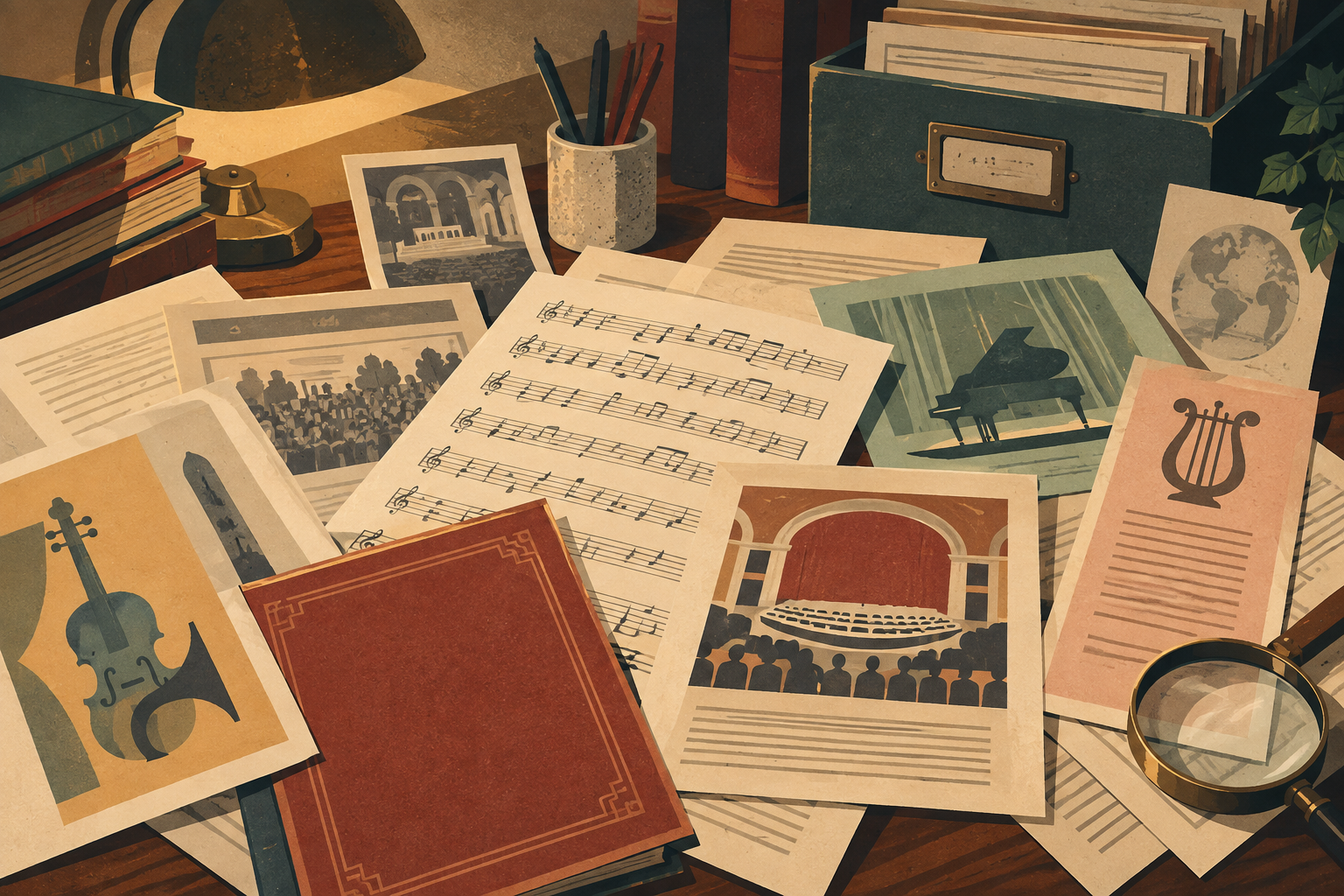
Researching music does not mean looking only for a recording. The holdings described by El Museo Canario include written music and scores; the Musical Archive of the National Museum of Performing Arts is likewise presented as a heritage collection connected to historical holdings. At El Museo Canario, a guided visit takes written music as its starting point. That choice recalls something essential: a musical document can be studied even when it does not itself reproduce a listening experience.
The distinction matters. A score, a printed programme and a regulation are different documents; they should not be treated as equivalent versions of a sound work. They may help raise questions about circulation, use or the context in which music was presented, but each answer requires specific evidence. An archive does not erase the distance between paper and sound; it makes that distance available for research.
A score is not a performance
A score preserves musical notation, not a complete sonic experience. Finding one is therefore not enough to establish how a particular performance sounded, who attended, or how an audience responded. The document offers a way in, but also sets a limit: it makes what was written visible while leaving matters that require other sources unresolved.
This caution does not diminish its interest. It allows us to read the score as one kind of evidence rather than confuse it with the music itself. The holdings described by El Museo Canario offer a real archival point of departure, although the supplied information does not identify individual items or make it possible to reconstruct a particular performance.
Programmes and printed sheets widen the questions
The archival blog of El Museo Canario lists scores, programmes, loose printed matter and regulations among the musical documents in its holdings. This variety makes it possible to think about the archive beyond the notated work: music also appears in publications and documents connected with its organisation and presentation.
These materials do not all tell the same story. A programme is an identifiable kind of printed document; a regulation belongs to another documentary category. Their presence among the holdings does not automatically prove a direct connection to a particular score. Establishing one would require comparing the documents and checking their details. The value of bringing them together lies precisely in opening questions that no single item can answer on its own.
Archives, institutions and historical accounts
The National Museum of Performing Arts states that most of the musical heritage in its Musical Archive comes from the Museum-Archive of the Teatro Real, created by its director Luis París in 1919. This places part of the collection’s institutional history, but the claim should not be extended without evidence: it does not say when each document entered the collection or describe all of its provenance.
Institutional beginnings shape what can be researched. Rather than imagining an archive as a neutral, self-sufficient collection, it is useful to attend to its descriptions, documentary groupings and the limits of the available information. A 2005 study of musical archives frames the importance of organising, preserving and sharing this heritage. The supplied record does not provide specific findings that would justify attributing more detailed recommendations to it here.
What the archive preserves—and what it cannot establish
A project by the Reina Sofía Museum titled “Escuchar un país” (“Listening to a Country”) invites readers to think of the archive as a space in motion and of the past as something that can be heard in the present. That framing resonates with written holdings: an archive can prompt new questions, but printed documents do not thereby become sound recordings.
The available evidence supports the existence of musical holdings described through scores and other documents, and of institutions presenting them as heritage. It does not identify particular editions, reconstruct complete repertoires or establish how each work was heard. Acknowledging those limits does not mean abandoning the story. It is a more precise way to distinguish work, document and listening experience.
Reading printed materials alongside archival descriptions makes it possible to tell a musical history attentive to its sources. Paper does not replace sound; it preserves another part of the story and helps raise questions that a recording alone may not answer.
- Decade
- Before 1950
- Region
- Spain
- Level
- Enthusiast
- Entities
- Museum, Museo Nacional de Artes Escénicas, El Museo Canario, Museo Reina Sofía
Sources and references
- la organización de archivos musicales marco conceptual ...agora.edu.es · 2026-10-06
- “Los Sonidos del Archivo”, una visita para conocer el ...www.elmuseocanario.com · 2026-10-06
- Archivo Musical - Museo Nacional de Artes Escénicasmuseodeartesescenicas.inaem.gob.es · 2026-10-06
- Documentos musicales: El Museo Canario y la Sociedad ...blogarchivoelmuseocanario.wordpress.com · 2026-10-06
- Escuchar un paíswww.museoreinasofia.es · 2026-10-06