The catalogue as a starting point
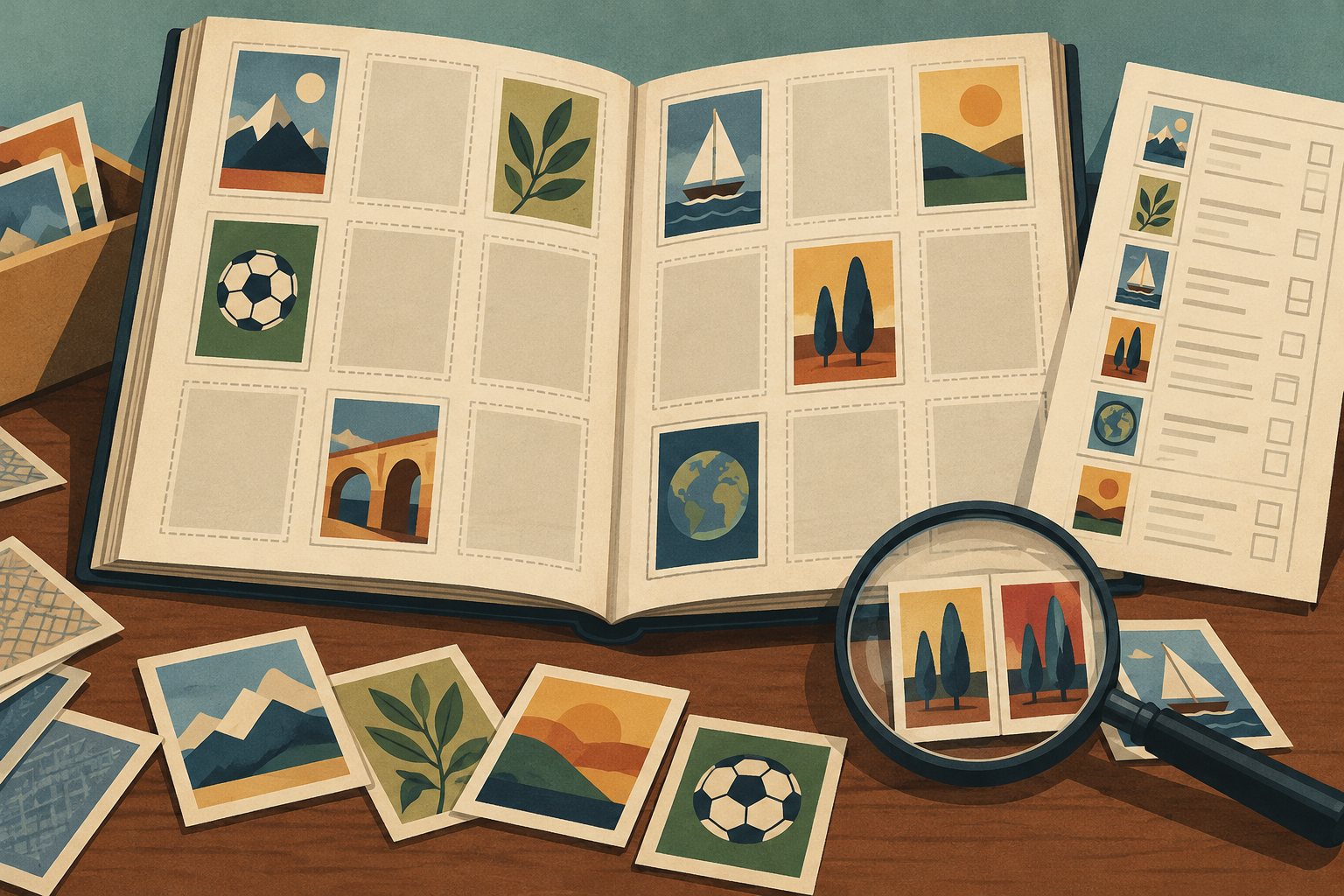
A sticker album seems to offer a simple answer to “Which collection is this?”: read the cover title or recognise an image. Rigorous identification, however, requires separating what can be seen on an object from what an institution records and from what still needs proof. Catalogues are useful for arranging those layers, not erasing their differences.
A CER.es search for “Álbum de cromos” returns, among other results, a record titled Historia del Circo. The record attributes it to Rosés, Barcelona, and Ediciones Ada, also in Barcelona, and places it at the Museo del Traje. These are concrete details that describe the identification offered by the record. On their own, though, they do not provide a complete list of stickers, a publication date, or a system of variants. Those fields should not be filled in by intuition.
A date that needs context
The Cultural Property Thesaurus offers a different historical reference: it says that the first album of this kind in Spain was Historia de la Península Ibérica and notes that an album for collecting wrappers was published in 1901. This points to an early precedent, but does not automatically explain how that object relates to every later form of sticker album.
In research, phrases such as “first album of this kind” should retain their attribution and scope. The source uses that category, but the material available here does not explain the criteria for defining “this kind” or provide a comparative list of editions. So 1901 can be reported as a date recorded by the thesaurus; it should not, without qualification, become the universal origin date for every collecting practice involving stickers.
Series, objects and variants are not the same
A series is a grouping; an object is an individual example; a variant is a difference that needs verifiable comparison. An album title helps identify a publication, but does not prove that two similarly titled examples belong to the same edition. Supporting that conclusion would require comparable features—for instance, recorded publication details, described material differences, or images of identified examples. The supplied sources do not provide a variant table for Historia del Circo or a complete inventory of its stickers.
The institutional record offers a documented starting identification—title, attributions and museum—while the thesaurus provides a frame of reference for albums and precedents. They complement one another; they are not interchangeable. A general-interest account of sticker history may help orient further questions, but it cannot replace an object record or comparative catalogue when the aim is to establish the variant of a specific item.
Trading also leaves traces
Trading is part of the history of how stickers were used, but not everything known about an object is recorded on the object itself. A catalogue entry may describe a preserved item; it does not necessarily record who traded it, how it circulated, or what completing the album meant to its users. The material consulted does not document specific exchanges connected with Historia del Circo, so particular practices or memories should not be attributed to it.
That limit does not make the question useless. It indicates what evidence to seek: provenance documentation, contemporary records, or attributable testimony. The sources available here do not provide such documentation for the album in question. Circulation can be raised as a relevant research dimension, but must remain a question until evidence connects it to particular examples.
A method for reading without filling the gaps
A useful record is not necessarily exhaustive. To identify a collection, record the title, attributions and institution exactly as stated; distinguish these details from information supplied by other sources; and mark as unknown any field none of them confirms. Examples can then be compared, while making clear which observed feature justifies calling something a variant.
Here, the sources support describing Historia del Circo as an album recorded by CER.es, attributed to Rosés and Ediciones Ada, and held by the Museo del Traje. They also allow us to say that the thesaurus mentions Historia de la Península Ibérica and a reference to 1901. They do not identify every series, establish a complete sequence of editions, or reconstruct trading networks. This boundary between recorded information and open questions is not an editorial flaw: it is what allows a catalogue to support identification without turning estimates or hypotheses into facts.
- Decade
- Before 1950
- Region
- Spain
- Level
- Introduction
- Entities
- Museum, Museo del Traje
Sources and references
- CER.es Colecciones en Red - Resultados de la búsquedaceres.mcu.es · 2026-10-12
- Una historia de cromos - Pixartprintingwww.pixartprinting.es · 2026-10-12
- Cromos y coleccionables Paniniwww.panini.es · 2026-10-12
- ¿Quién creó Panini? Origen e historia de los cromos más ...www.brandstocker.com · 2026-10-12
- Álbum de cromos - Tesaurostesauros.cultura.gob.es · 2026-10-12