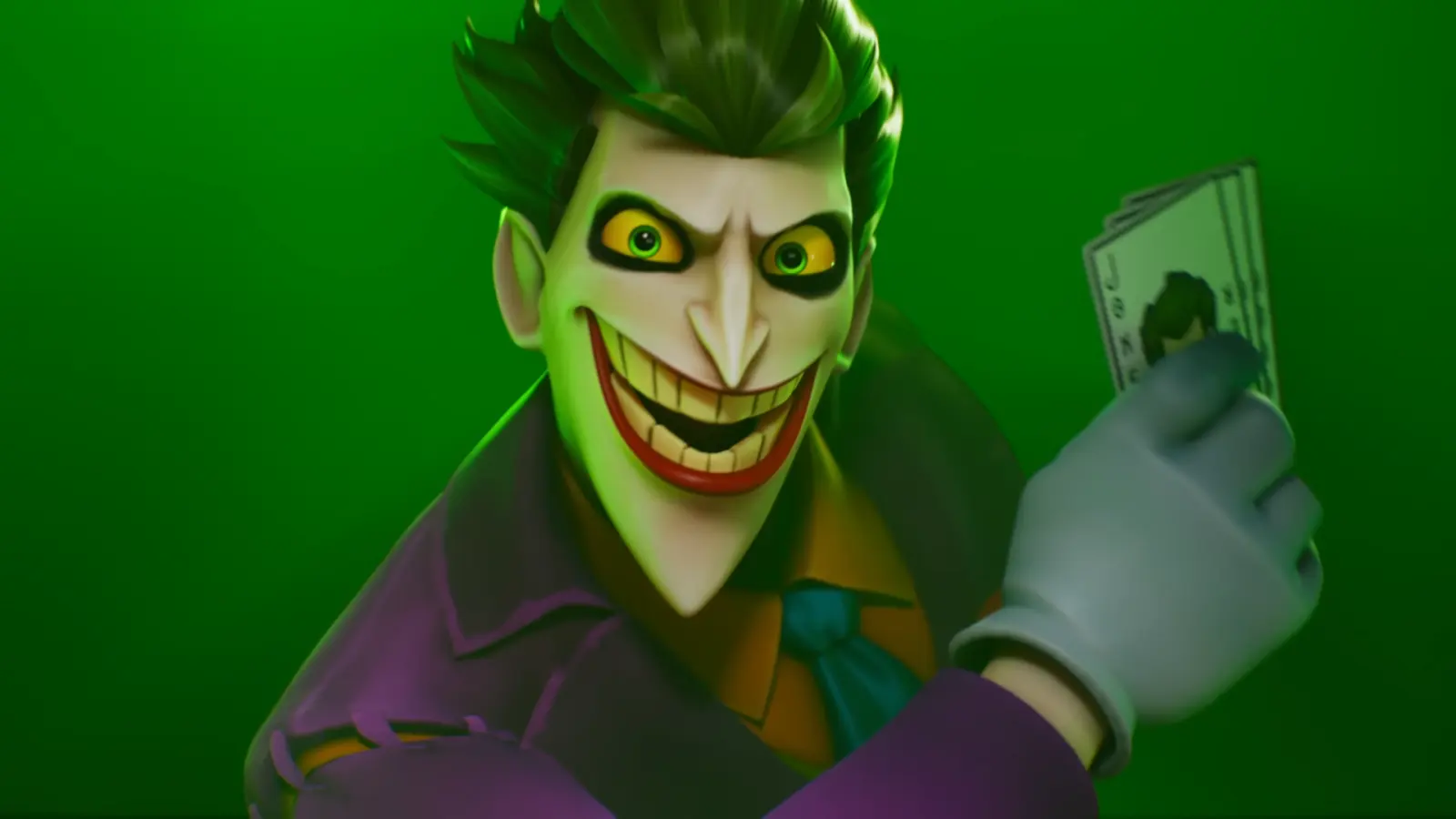
The Joker is recognisable by his white face, green hair and a smile that turns violence into spectacle. Yet no single biography definitively explains who he is. Since his debut in Batman #1 in 1940, the character has changed in tone, motive and backstory: a consistent visual identity and rivalry with Batman coexist with versions that contradict one another or cast doubt on the Joker’s own memories.
A villain built to return
The early stories established several lasting elements: a theatrical presence, crimes staged as performances and a toxin associated with laughter. The blend of humour and danger was there from the start, even though the Joker of those first years was not identical to the darker versions that followed.
Authorship also calls for nuance. In an interview with The Comics Journal, Jerry Robinson said the Joker concept was his and that he proposed the playing-card motif. He credited Bill Finger with scripting the first story and recalled Finger connecting the image to The Man Who Laughs. Robinson described the character’s creation as collaborative work with Finger and Bob Kane. His account recognises his role and Finger’s, while leaving room for the history and differing perspectives behind the attribution rather than reducing it to a simple formula.
An origin that never quite settles
In 1951, Detective Comics #168 introduced the criminal Red Hood and linked his fall into chemicals to the transformation that would produce the Joker. Decades later, Alan Moore and Brian Bolland drew on that tradition in Batman: The Killing Joke (1988), which suggests that the character may once have been a failed comedian before becoming a criminal.
The story, however, undermines the certainty of that explanation: the Joker admits that he remembers his past in different ways. The possibility of a tragic origin carries dramatic force, but it never becomes a reliable case file. That ambiguity lets later stories reinterpret the character without necessarily erasing earlier versions. The Killing Joke sets his nihilism against Commissioner Gordon’s moral resolve and frames a mirrored relationship between Batman and his enemy; its version of the past is influential, not compulsory biography.
Between farce and horror
The Joker’s register has shifted over the decades. Valentin Yurievich Skryabin’s study of different portrayals contrasts, among other examples, the physical comedy of the 1960s television series with later, more menacing interpretations. In the comics, The Joker’s Five-Way Revenge (1973) is among the stories associated with a return to a more dangerous criminal.
This was not a straight march towards ever-greater darkness. Jokes, puns and traps remain essential to his performance. What changes is the weight of the consequences: sometimes the joke presents him as a criminal buffoon; elsewhere, it becomes a mask for an unpredictable threat. The tension between those possibilities gives the character more range than any single psychological explanation could.
The Killing Joke: how images and editions shape the story
Moore and Bolland’s graphic novel alternates between the Joker’s attack on Gordon and a possible origin story. It also leaves a lasting mark on Barbara Gordon’s life: the Joker shoots her, leaving her paralysed in the continuity of the time. The violence inflicted on her has drawn criticism as well as becoming part of the narrative consequences the comic carried into the characters’ histories.
The edition also changes the visual experience. Bolland wanted the memories to appear in black and white with muted colours, but the original edition used John Higgins’s colouring. For the 2008 deluxe edition, Bolland recoloured the work, bringing the flashbacks closer to his initial intention. The contrast between a more saturated present and washed-out memories makes the shifts in time more perceptible and affects how the story’s structure reads.
The ending gives no unequivocal answer about the two adversaries’ fate. It has been read as a brief truce or as something more final. Alan Moore said he wanted to show a moment of clarity before the cycle between Batman and the Joker began again. The gap between what readers can infer and what the story confirms is part of its ambiguity.
The rivalry widens
In Death of the Family, written by Scott Snyder and drawn by Greg Capullo, the Joker returns with his face mutilated and directs his threat at Batman’s allies. The arc is not confined to a single series: the collected edition brings together chapters from several titles, including Batman, Batgirl, Nightwing and Detective Comics.
That format broadens the conflict. The threat is no longer just a duel between Batman and his enemy; it tests the trust and bonds of an entire network of allies. The collected volume lets readers follow the arc in one place, even though its original publication was spread across different series.
The Joker endures because recognition does not depend on one definitive explanation. His appearance, laughter and relationship with Batman provide continuity; shifts in tone, origin and publishing format allow each era to reconsider the kind of threat he represents. His comics history is less an orderly biography than a succession of interpretations in tension: some lean towards drama, others towards farce, and none prevents a later story from reshuffling the cards.
- Decade
- 1980s
- Region
- North America
- Level
- Enthusiast
- Entities
- Joker, The Comics Journal, The Joker, The Killing Joke, Batman: The Killing Joke
Sources and references 6
- Analysing Joker: an attempt to establish diagnosis for a film icon - PMCpmc.ncbi.nlm.nih.gov · 2026-11-24
- The Joker | Official DC Characterwww.dc.com · 2026-11-24
- Jerry Robinson: Been There, Done That - Page 2 of 9 - The Comics Journalwww.tcj.com · 2026-11-24
- The Joker: Death of the Family (The New 52) : Snyder, Scott, Capullo, Greg: Amazon.es: Libroswww.amazon.es · 2026-11-24
- The Joker Reading Order | Graphic Novel & Comics Timelinewww.comicbookherald.com · 2026-11-24
- Batman: The Killing Joke - Wikipediaen.wikipedia.org · 2026-11-24