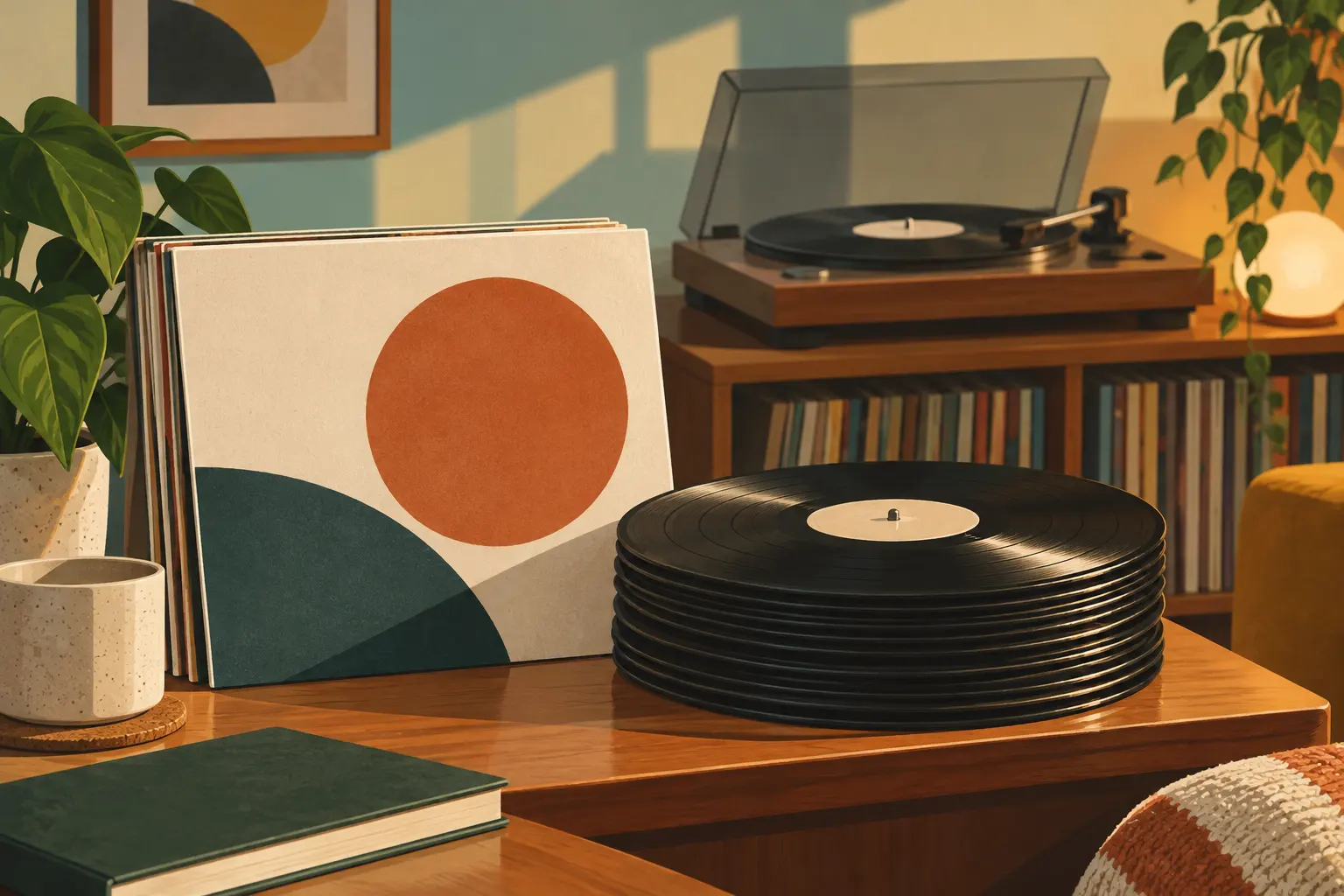
Collecting vinyl can bring together music that matters to you and the pleasure of the object itself: the cover, the notes, the act of sliding a record from its sleeve and listening one side at a time. You do not need to chase first pressings or assume that analog always sounds better. Start with records you genuinely want to play, a budget that feels comfortable, and equipment that is compatible.
Build a collection you want to hear
Make a short list of records you would like to hear all the way through—not titles that seem mandatory or potentially valuable. You might begin with albums you already know, explore a genre, or follow a curiosity. A small, personal collection can be more satisfying than accumulating records quickly.
Decide what you can spend on the hobby without affecting essential expenses. Include the full cost of each purchase: the record, shipping, and applicable taxes; if you do not yet own playback equipment, factor that in too. There is no correct starting amount. You can buy a record when a suitable copy turns up, set aside a regular sum, or set a limit for each purchase.
Formats, speeds and compatibility
A common LP is a 12-inch record played at 33⅓ revolutions per minute (rpm). A common 7-inch single plays at 45 rpm. EP means extended play: a shorter release than a full-length album, but the term alone does not specify diameter or speed. Common formats have exceptions, so check the record’s label, its diameter and the indicated speed.
Make sure the turntable and its stylus or cartridge can play the format, too. A turntable with a speed setting does not necessarily have a stylus suitable for every record. As a brief historical note, Audio-Technica dates Columbia’s 12-inch, 33⅓-rpm LP to 1948 and RCA Victor’s 7-inch, 45-rpm single to 1949.
78-rpm shellac records and lacquer or acetate instantaneous discs are not ordinary vinyl. Their materials, condition and playback requirements may differ; they need appropriate equipment and material-specific care. Do not try them on an ordinary turntable or stylus without first confirming compatibility.
Buying new records, reissues and used copies
A new record or reissue can be a straightforward choice if you want a copy with no known previous wear and a current presentation. A used record may offer access to a different edition, another cover or a cost that better fits your budget. Neither choice is automatically better: the individual copy, its condition, the edition and what you want to hear all matter.
To identify an edition, note the artist, title, label, catalogue number, country, format and edition details where available. Compare those details with the actual record and sleeve. Two copies with the same cover may be different editions, and the cover alone does not establish a pressing or provenance.
You can look at local record shops, secondhand shops and record fairs, or browse specialist shops and online marketplaces. Whichever channel you use, inspect photos of the actual copy and read its condition notes. Check what is stated about edition and provenance, the return terms and the shipping cost; make a decision based on the total, not only the listed price.
Judging condition
The labels below are common in record listings, but sellers’ grading practices differ. Read the particular seller’s scale and notes. Assess the record and sleeve separately: a record may be well preserved while its cover is damaged, or the reverse. These descriptions are guides, not guarantees of how a copy will sound. Visual inspection cannot prove that playback will be quiet, and a sealed record is not a guarantee of perfection.
The table below summarises Boomshanka Records’ own grading policy as one seller’s example, not a universal standard. Read it with that attribution for every row; other sellers may use different definitions.
| Grade in Boomshanka’s policy | Boomshanka’s description for the record |
|---|---|
| M — Mint | Unused and flawless; this seller reserves the grade for exceptional copies. |
| NM / M- — Near Mint | Almost pristine, with no obvious wear. |
| VG+ — Very Good Plus | Light cosmetic wear; minor marks should not materially affect listening, according to the seller’s scale. |
| VG — Very Good | Audible noise and wear, though the music remains clear. |
| G / G+ — Good / Good Plus | Plays throughout, with substantial wear and noise, according to the seller’s description. |
| F / P — Fair / Poor | Severe damage; playback may skip, repeat or fail. |
The grade descriptions above reflect Boomshanka Records’ own policy, not a universal standard or guarantee. Sellers’ practices differ, so consult the particular seller’s scale and notes. A sleeve grade describes packaging condition—such as wear, marks, splits or damage—not the sound of the record. Ask whether you can inspect a copy or hear a sample; do so only with permission and if the available equipment is suitable.
When inspecting, look for warping, scratches, stuck-on dirt, signs of moisture or mold, and damage to the sleeve. Do not aggressively dry-wipe a dirty surface or play a copy with mold, serious damage or uncertain materials. Keep it apart from other records and ask someone qualified in audiovisual preservation for advice. Household cleaning cannot reverse damage or restore information lost from the grooves.
A hypothetical comparison to help you decide
Imagine two copies of the same album, without assigning them real prices. Copy A has a VG+ record and a VG sleeve: the disc shows less visible wear, while the cover is more worn. Copy B has a VG record and a VG+ sleeve: the cover is in better shape, but more playback noise can be expected. Assume both are the edition you want and the seller allows you to inspect them.
If your priority is listening with less noise and you care little about a marked cover, compare copy A with the total cost of B. If the cover matters a lot to you and you can live with some noise, B may be the better fit. Add shipping and any other known charges, check the notes and return terms, and decide whether the particular copy meets your goal. This is a hypothetical comparison, not a price forecast or a playback test.
Keep a useful record
A simple catalogue helps you remember what you bought and why, and distinguish similar editions. For each record, note:
- Artist and title.
- Label, catalogue number and country, if known.
- Edition details and format.
- Record grade and sleeve grade, using the seller’s stated scale.
- Total paid, shop or seller, and purchase date.
- Observations about the copy and listening notes.
This is a personal record, not an appraisal or an estimate of resale value.
Handling, storage and cleaning
Wash and thoroughly dry your hands before handling a record. Hold it by the edges and label, without touching the grooves. Return it to a suitable inner sleeve and keep that sleeve with the cover. If the original inner sleeve is worn or unsuitable, consider replacing it with a stable, inert option. Avoid PVC storage sleeves: vinyl in many records is also PVC, but that does not make a PVC sleeve suitable for storage.
Store records upright, fully supported and not tightly packed; do not stack them horizontally. Use a sturdy shelf that distributes their weight evenly. Choose a cool, relatively dry and stable place, away from radiators, heat, direct light, leaks and extreme fluctuations. Avoid basements, attics and garages if they are at risk of damp, flooding or temperature extremes. For home collections, the Library of Congress suggests a cool, relatively dry—about 35–40% relative humidity—and stable environment; do not confuse this home guidance with different recommendations for institutional collections.
Inspect a record before playing it. If it has only loose dust, remove it gently with a soft brush suitable for records, without pressing hard or forcefully dragging dry dirt across the surface. For stuck-on grime, use only a product specified as compatible with the material and follow its manufacturer’s instructions; if the disc is old, fragile or of uncertain composition, seek qualified advice. Do not improvise mixtures with alcohol, soap or tap water, or apply one universal cleaning method. Record grooves are not a CD surface, so cleaning rules designed for optical discs do not apply to them.
Maintain the turntable and stylus according to the manufacturer’s manual. If a record is damaged, moldy or of uncertain material, do not play it or clean it by trial and error. The safest choice may be to set it aside and ask a specialist for guidance.
First-purchase checklist
- Choose an album you genuinely want to hear.
- Check format, diameter, speed and compatibility with your equipment.
- Identify the edition using record details, not the cover alone.
- Read the seller’s grading scale; distinguish record condition from sleeve condition.
- Review photos, notes, total cost and return terms.
- Avoid records that are warped, badly damaged, moldy or of uncertain material; seek qualified help when appropriate.
- Store the record properly and note the purchase so you remember what you learned from it.
- Decade
- Contemporary
- Region
- Global
- Level
- Introduction
- Entities
- Sounds, Vinilo
Sources and references 7
- Vinyl Record Collecting: Aboutwestportlibrary.libguides.com · 2026-11-17
- Care, Handling, and Storage of Audio Visual Materialswww.loc.gov · 2026-11-17
- AT-LP8X: Playing a recordwww.audio-technica.co.jp · 2026-11-17
- Caring for audio, video and data recording mediawww.canada.ca · 2026-11-17
- Audio/Visual Materials: Frequently Asked Questionswww.loc.gov · 2026-11-17
- Record formats: LP, EP and SPwww.audio-technica.co.jp · 2026-11-17
- Condition explained: seller's grading policywww.boomshankarecords.uk · 2026-11-17