Building a car industry
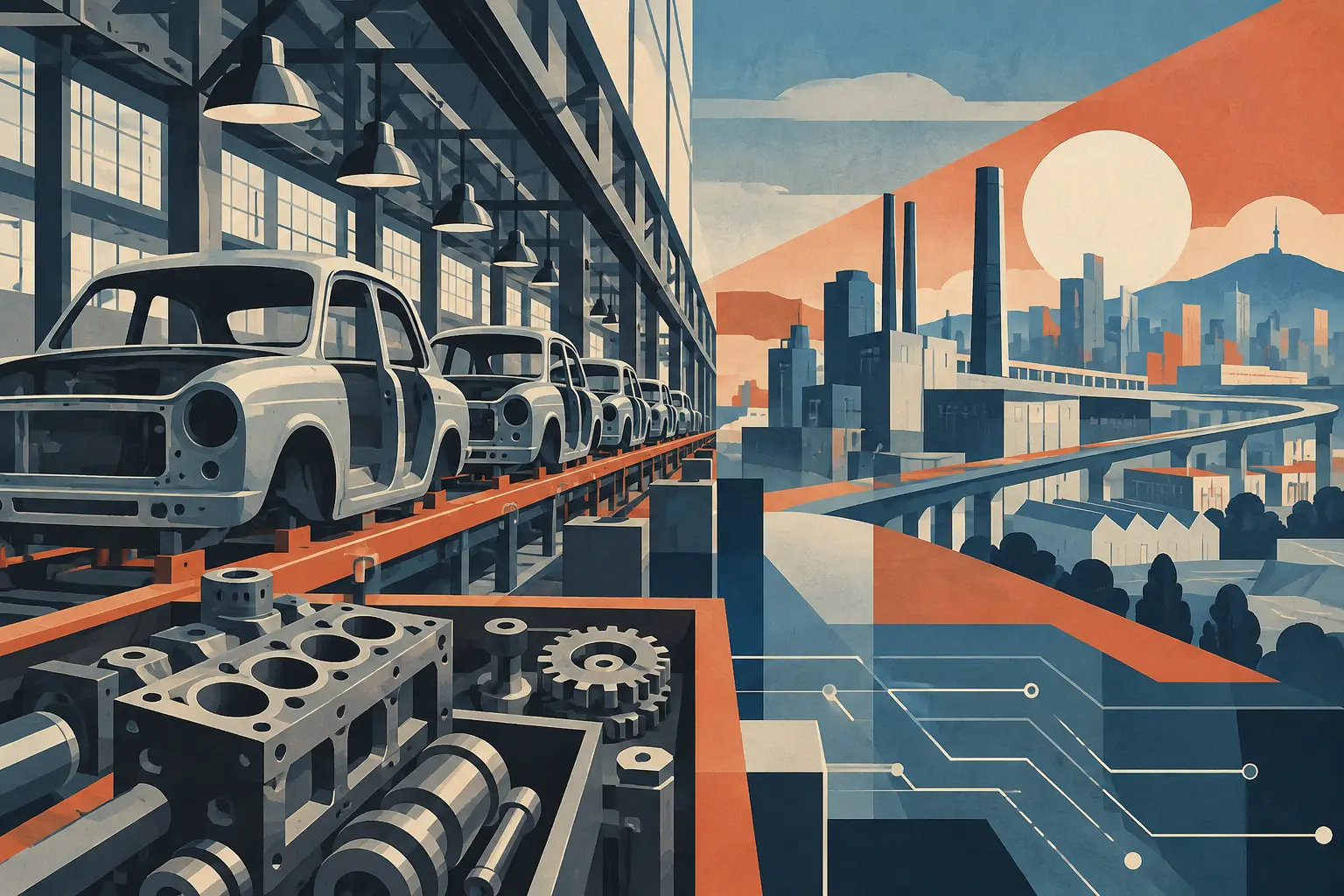
SEAT was founded on 9 May 1950 as Sociedad Española de Automóviles de Turismo, at a time when Spain’s domestic market and capacity for mass car production were both limited. Its ownership brought together the Instituto Nacional de Industria (INI), which held the majority, Spanish banks and Fiat, its technical partner and supplier of models. The aim was not simply to assemble vehicles: the company was also expected to help build manufacturing capabilities and a supplier network in Spain.
The factory was established in Barcelona’s Zona Franca, an area with industrial experience and transport links. Production began in 1953 with the SEAT 1400, derived from Fiat’s 1400. Licensing made it possible to start with an existing design and technical know-how while developing the ability to manufacture on a larger scale. From the outset, technology transfer and the ambition to foster local industry went hand in hand.
From the 1400 to the 600: a factory and market expand
The 1400 launched production, but its price put it beyond the reach of many households. Introduced in 1957, the SEAT 600 became a far more popular car and one of the defining symbols of post-war motorisation. Demand drove higher output and helped expand an auxiliary industry capable of supplying more components locally. The 600’s historical significance therefore lies not only in its success as a model: it also reflects the growth of an industrial system around it.
Over the following decades, the range grew to include cars such as the 850, 124 and 127. SEAT established itself as the dominant manufacturer in a Spanish market that remained protected for much of this period. A new agreement in 1967 increased Fiat’s stake and opened the way for exports. Expansion beyond Spain did not, however, mean technological independence: Fiat continued to influence the models and manufacturing processes.
This relationship points to a recurring tension in SEAT’s history. Cooperation with a foreign company provided designs, technology and production expertise; at the same time, state initiative sought to use that cooperation to build a national industry. Manufacturing capacity grew, but technical and corporate autonomy did not advance at the same pace.
The break with Fiat and the turn towards Volkswagen
SEAT’s investment requirements and economic difficulties strained the partnership. In 1980, Fiat declined to take part in a capital increase and later sold its stake to the INI. The break left SEAT facing the challenge of sustaining production and defining its own identity, as well as finding new technical and commercial partners.
The Ronda, introduced in 1982, was the first model sold under the new badge without Fiat’s involvement. Its resemblance to the Fiat Ritmo led to a dispute over the differences between the two cars. In 1983, an arbitration tribunal in Paris ruled in SEAT’s favour. The episode mattered beyond the design dispute: it raised the question of how far the company could modify licensed models and sell products under its own identity.
Volkswagen began cooperating with SEAT in 1982. The industrial agreement included the manufacture of Volkswagen models in Spain. In June 1986, the German group acquired a majority stake, raising it to 75% before the end of the year. In 1990 it bought the rest of the company. The change of ownership brought SEAT into an international automotive group, but did not automatically settle how the brand should distinguish itself or how much autonomy it would retain.
The Ibiza, launched in 1984, makes this transition especially clear. SEAT presented it as its own car, although its development involved outside contributions: Giorgetto Giugiaro designed the body, Karmann worked on its development, and Porsche contributed to engines marked System Porsche. A model’s authorship cannot be reduced to a single origin: its commercial identity could be Spanish while its design and technology reflected an international network of collaboration.
Martorell: changing the place and scale of production
The transformation was visible in the geography of industry, too. Zona Franca had concentrated vehicle production from the company’s beginnings, but SEAT needed a larger, more modern facility. Martorell began operating in 1993. It brought vehicle production together with engineering and development functions; its opening coincided with the second-generation Ibiza and the launch of the Córdoba.
The move did not immediately end Zona Franca’s activity, which continued to produce components. Rather than a simple change of address, the process reorganised functions across several sites and turned production into a broader industrial network. Martorell opened after Volkswagen had acquired all of SEAT, symbolising both a new manufacturing scale and deeper integration into the German group.
A history of partnerships and capabilities
SEAT’s trajectory is difficult to understand as either a self-contained story of national success or a mere succession of owners. Its first phase combined state initiative, private bank financing and Fiat technology. Expansion relied on large-scale production and protection of the Spanish market. The break with Fiat forced the company to seek new partnerships and build a distinct identity; integration into Volkswagen reshaped how manufacturing and model development were organised.
The 600, the Ibiza and Martorell are milestones of different kinds: a car associated with the widening of motorisation, a model that embodied the transition towards a distinct identity, and a factory that concentrated new industrial functions. Read alongside agreements, ownership changes and the history of the plants, they show how SEAT’s role changed—from a state-backed industrial project using Fiat technology to a manufacturer integrated into an international group, with production and development increasingly organised at a European scale.
- Decade
- 1980s
- Region
- Spain
- Level
- Introduction
- Entities
- SEAT, SEAT 600
Sources and references 5
- ASIENTOtranslate.google.com · 2026-11-17
- Todo sobre los 70 años de historia de SEATwww.seat.es · 2026-11-17
- SEAT - Wikipedia, la enciclopedia librees.wikipedia.org · 2026-11-17
- Historia del SEAT Ibiza: 30 años de éxito en las carreterasnoticias.coches.com · 2026-11-17
- Fabricamos coches desde 1950 – Historia de SEATwww.seat.es · 2026-11-17