A console designed like a toy
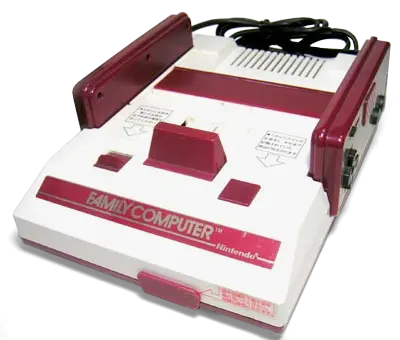
The Family Computer, known in Japan as the Famicom, went on sale on July 15, 1983. Its design served a clear purpose: to offer home gaming on a relatively affordable, straightforward machine. The original model was compact, made of light-coloured plastic with red details, and came with two controllers permanently attached to the casing. When not in use, they could be stored in molded recesses at the sides. The cartridge went into a top-loading slot, fully visible.
The launch line-up brought familiar arcade games into the home. It included Donkey Kong, Donkey Kong Jr. and Popeye, adaptations of Nintendo arcade hits. The connection between console and catalogue was central to the product: the machine could stay in the home while games arrived as interchangeable objects.
Simplicity also meant leaving things out. During development, Nintendo considered home-computer features such as a keyboard and disk drive, but prioritized cost and ease of use. Cartridges suited that approach and made it possible to expand the game library without replacing the console. Nintendo later offered the Famicom Disk System as an add-on in Japan, but it was not part of the original machine.
From Advanced Video System to NES
Taking the system to North America meant persuading a different market. In January 1985, Nintendo presented the Advanced Video System at an electronics trade show. This home-computer concept included a keyboard, a cassette data drive and wireless controllers. The response was lukewarm. In the wake of the 1983 North American video game crash, retailers were wary of consoles.
Nintendo reworked the product. The system that reached stores as the Nintendo Entertainment System had a more restrained grey casing and a front-loading mechanism reminiscent of a video cassette recorder. Rather than sitting on top of the console, the cartridge disappeared behind a flap. The Famicom’s fixed controllers gave way to detachable pads plugged into front ports.
The change was more than cosmetic. Nintendo called the console the Control Deck and its cartridges Game Paks, terms that distanced the system from the language associated with earlier consoles. The Zapper light gun and R.O.B. robot broadened the idea of what the system could do and helped present it as a different kind of entertainment platform. The marketing focused not only on the console’s ability to run games but also on specific accessories and interactions.
The redesign therefore changed how the console related to games and to the home. Its front-loading profile made it look more like other electronic equipment in the living room, while detachable controllers made the whole system seem less like a compact toy. Before anyone inserted a cartridge, the console’s form suggested how it was meant to be used.
The cartridge as object and promise
On both Famicom and NES, the cartridge connected the machine to a library that could grow over time. Each game was a physical object with its own connectors and packaging, and switching titles did not require replacing the hardware. The console offered something different from systems built around a single game: the machine could remain in place while its library changed.
That shared principle did not make the two versions identical in everyday use. The cartridges’ size and shape, the way they were loaded, the console’s appearance and the way its controllers connected all influenced how the system was presented and used. The North American redesign did not abandon cartridges; it changed how they were framed.
The adaptation also addressed commercial conditions. Retailers’ caution after the 1983 crash made it important to distinguish the NES from earlier consoles. Its new appearance and the terms Control Deck and Game Pak were part of that strategy, as was the promotion of accessories. The core system remained, but its presentation and the expectations it created changed.
A sound shaped by constraints
The identity of Famicom and NES extended beyond their casings. Their early soundtracks were composed for hardware with limited resources, and composers had to divide the available channels between melody, accompaniment and sound effects. Those limits did not dictate a single style; they created a set of musical choices.
In his study of the percussive aesthetics of Famicom and NES from 1983 to 1987, Joseph Chang examines how the noise channel was used for both sound effects and percussion. Using audio-analysis tools to study ten game soundtracks, he traces how composers manipulated noise timbre and duration to suggest different instruments and rhythmic patterns. His research includes work by Yukio Kaneoka, Hirokazu Tanaka, Koji Kondo, Kinuyo Yamashita and Manami Matsumae.
In Super Mario Bros., for example, Koji Kondo used distinct timbres to suggest different percussion sounds: lower noise could evoke a bass drum, while other sounds suggested snare and hi-hat. In Metroid, Hirokazu Tanaka explored changes in texture and rhythm, and conceived parts of the music as a more atmospheric soundtrack. In Mega Man, Manami Matsumae also used metallic sounds to expand the system’s rhythmic possibilities. These were different approaches to shared resources.
That musical language was tied to play itself. Sound effects competed with music for the same channels, so a player’s actions could change what was heard. Sound was not separate decoration: it depended on how the machine, software and interaction worked together.
Two versions, one history of adaptation
The Famicom became dominant in Japan, and the NES did so in North America, but the console’s European fortunes were less uniform. There it faced competition from the Master System and from a home-gaming culture also shaped by computers such as the ZX Spectrum. A system’s reception depended on more than its features: distribution, gaming habits, software libraries and local competition all affected its place in each market.
Seen together, Famicom and NES show that console design is not a neutral shell. The cartridge-based foundation remained, but the presentation, controllers, loading mechanism and accessories changed to meet different commercial expectations. The way the games sounded changed too: technical limits prompted compositional decisions that became part of the system’s identity.
The story of these two machines is one of continuity and adjustment. Nintendo kept the same fundamental idea—a home console with interchangeable games—and translated it visually and commercially for another context. The machine, cartridges, controllers, accessories and sound formed a connected experience whose meaning took shape both in the living room and in front of the screen.
- Decade
- 1980s
- Region
- Japan
- Level
- Enthusiast
- Entities
- Nintendo, Nintendo Entertainment System, Sounds
Sources and references 5
- L’esthétique percussive de la Famicom et de la Nintendo Entertainment System de 1983 à 1987doi.org · 2026-11-17
- Nintendo Entertainment Systemtranslate.google.com · 2026-11-17
- Super Nintendo - Wikipedia, la enciclopedia librees.wikipedia.org · 2026-11-17
- Bruno Gariazzo Leon - Arte, Ciencia y Tecnéartecienciaytecne.com · 2026-11-17
- Videoconsolaes.wikipedia.org · 2026-11-17