Industrial policy and the ambition to build cars in Spain
SEAT was founded on 9 May 1950 as Sociedad Española de Automóviles de Turismo. Its creation served an industrial goal: to establish a manufacturer capable of producing cars on a large scale in a country whose market remained limited after the Civil War and the post-war years. The National Institute of Industry (INI) held the majority stake; Spanish banks also contributed capital, while Fiat provided technology and models.
Working with Fiat enabled SEAT to begin production without designing its own cars and processes from the outset. The agreement gave the company access to industrial expertise and allowed it to build models based on Italian designs. This was not unique to Spain: technology transfer and licensed production were common ways to develop car industries in countries with limited manufacturing experience.
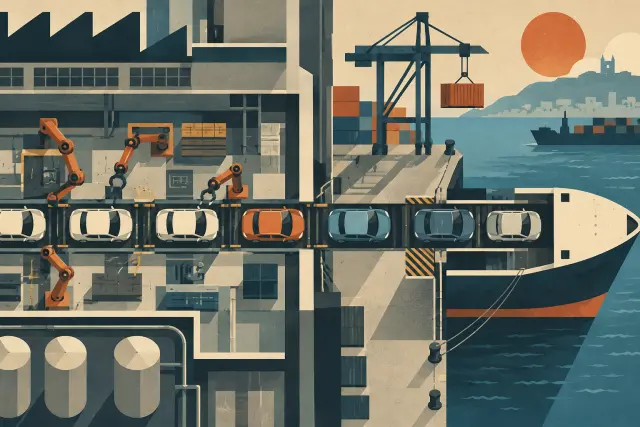
Barcelona’s Zona Franca was selected for the factory. The site combined a long industrial tradition with port and rail connections useful for transporting components and vehicles. Construction began in 1950, and production started in 1953.
The 1400 and the 600: production and motorisation
The first car to leave the production lines was a SEAT 1400, on 13 November 1953. Initial output was small: the company says the plant began by making five cars a day. The 1400 launched production, although its price put it beyond the reach of many households.
More affordable models brought a change in scale. Introduced in 1957, the SEAT 600 became the emblem of the spread of car ownership among Spanish families. Its importance was industrial as well as social: rising production accompanied the growth of private mobility and changes in everyday life. A local supplier network also developed around manufacturing, helping reduce dependence on imported components.
SEAT’s growth did not bring immediate technical independence. Agreements with Fiat in 1967 and 1970 expanded the company’s ability to export and make its own modifications. SEAT gradually built technical capabilities, but many of its cars remained based on Fiat designs. The transition from assembly and licensed production to developing its own products was gradual.
Fiat’s departure and the challenge of autonomy
By the late 1970s, SEAT faced financial difficulties and needed substantial investment. Disagreements over how to fund it contributed to the break with Fiat, which withdrew in the early 1980s. The INI again took control, and SEAT had to renew its model range and find new technological partners as the Spanish market began opening to international competition.
The Ronda, introduced in 1982, made the complexities of separation visible. Fiat disputed whether the differences from the Ritmo were sufficient for the car to be marketed as a distinct product. In 1983, arbitration ruled in SEAT’s favour. The dispute was more than a design disagreement: it also tested the company’s ability to defend an industrial and commercial identity of its own.
The Ibiza, launched in 1984, strengthened that effort. SEAT developed it as its own model with contributions from outside companies: Italdesign handled the design, Karmann worked on body engineering, and Porsche was associated with the engine technology. The car did not emerge in isolation from earlier partnerships; its significance lies in how those collaborations were combined with an effort to establish an autonomous brand.
Volkswagen: cooperation, shareholding and ownership
SEAT’s approach to Volkswagen also unfolded in stages. In 1982, the two companies signed industrial and commercial cooperation agreements. SEAT would manufacture some Volkswagen models at its plants and could sell them in Spain. The arrangement helped meet the company’s production and technology needs, but it did not make Volkswagen its owner at that point.
Volkswagen entered SEAT’s shareholding in 1986. It first acquired a majority stake and increased it later that year. The purchase changed SEAT’s corporate structure, making it part of an international group with shared industrial and technological resources. Full ownership followed later: according to SEAT’s corporate history, Volkswagen acquired the remaining 25% in 1990.
Distinguishing these dates clarifies the transition: cooperation began in 1982; acquisition of the majority stake took place in 1986; full ownership followed in 1990. This was not one instantaneous transfer, but a shift from a company with state participation and technical links to Fiat to a subsidiary of a German group.
Martorell and the continuity of production
Integration into Volkswagen did not bring car production in Spain to an end. The Martorell plant opened in 1993 and gradually took over as the main site for vehicle manufacturing. It began operations producing the second-generation Ibiza and the Córdoba. Zona Franca retained other industrial functions, including component production.
SEAT’s history helps distinguish three questions that are often conflated: who owns a company, how much control it retains over vehicle design and development, and where those vehicles are made. Ownership and technical partners changed, but production and industrial activity remained in Spain. At the same time, SEAT built up its own capabilities within an international corporate structure.
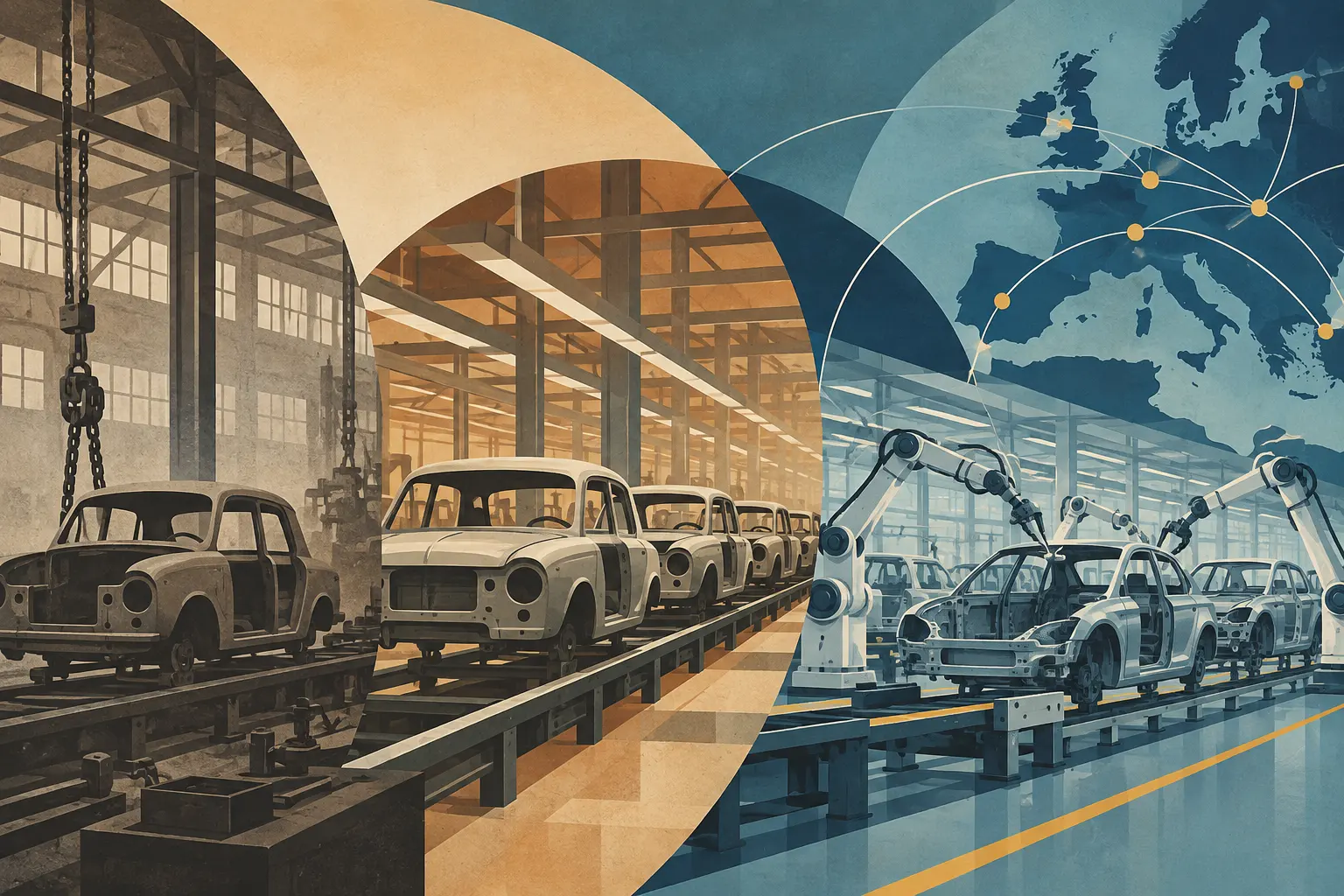
Its story therefore fits neither the image of a mere Fiat factory nor that of a wholly independent brand. SEAT was founded with public support and foreign technology, gradually expanded local capabilities, sought an identity of its own after Fiat’s departure, and found a new framework of integration with Volkswagen. That trajectory accompanied a broader transformation: the shift from a protected industry focused mainly on the Spanish market to production connected to European industrial supply chains.
- Decade
- 1980s
- Region
- Spain
- Level
- Enthusiast
- Entities
- SEAT, SEAT 600
Sources and references 5
- ASIENTOtranslate.google.com · 2026-11-13
- Todo sobre los 70 años de historia de SEATwww.seat.es · 2026-11-13
- Medioambientalwww.seat-cupra-mediacenter.es · 2026-11-13
- SEAT - Wikipedia, la enciclopedia librees.wikipedia.org · 2026-11-13
- De SEAT a CUPRA: cómo se transforma una marca y qué ...www.extradigital.es · 2026-11-13