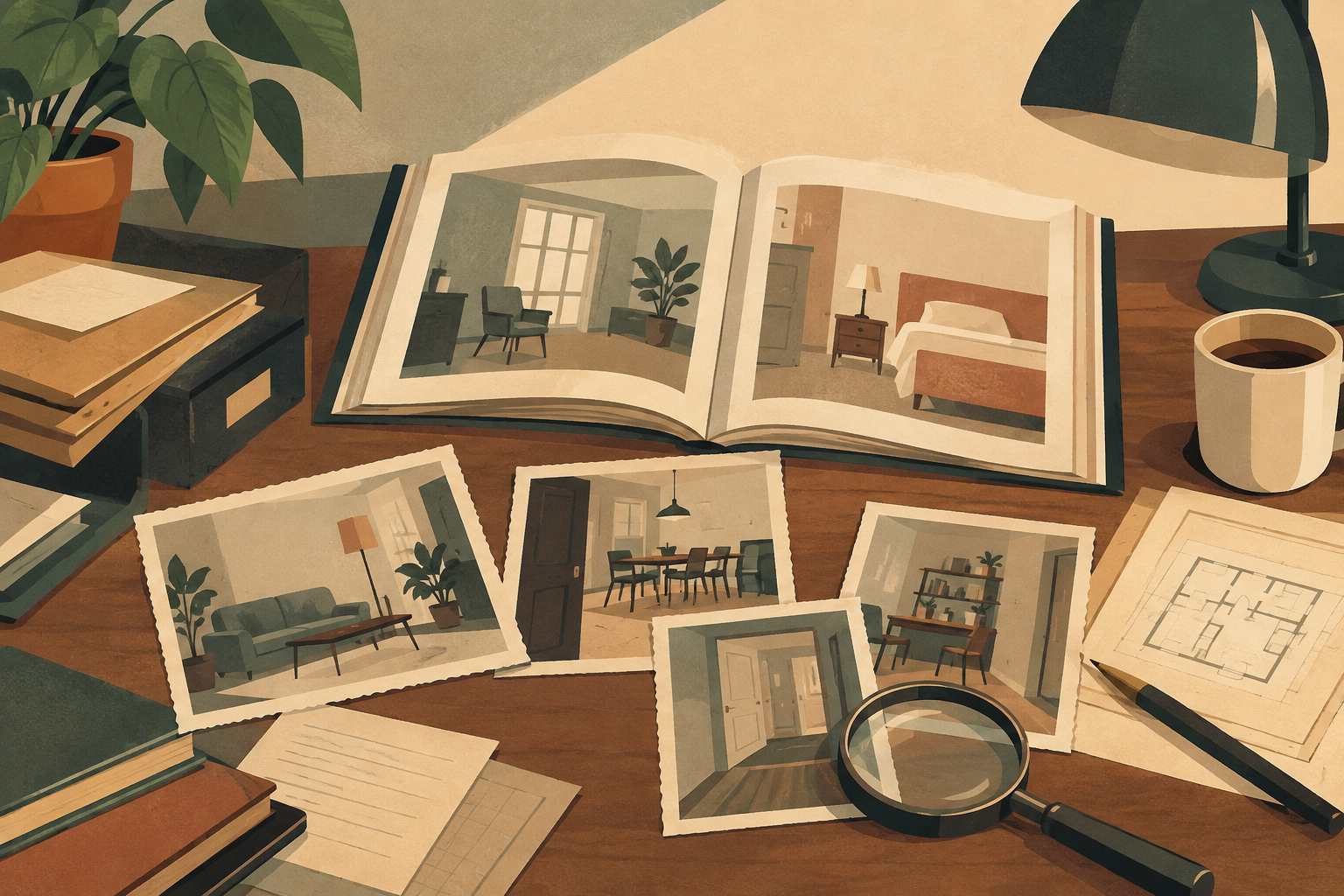
A photograph can make a room seem ready to be reconstructed: furniture, walls and objects remain still within the frame. But an image is not the room, nor does it explain on its own who used it, how they moved through it or what was left outside the frame. Researching a domestic interior means treating each photograph as a situated source and comparing it with other documents without turning gaps into certainties.
The image preserves a point of view
Every photograph has a frame, a position and a moment of capture. Even an apparently comprehensive view selects part of a space and excludes the rest. The frame may record a material arrangement, but it does not establish that the arrangement was permanent, typical or representative of other homes. Nor does it automatically identify the people who appear in, or used, the room.
This caution matters particularly when an image is used to discuss decoration. A visible object can be described as present in that particular photograph; without further evidence, that does not establish its origin, everyday function or how often it was there. Distinguishing description from inference is a basic tool of close reading.
An archive provides context, not a complete scene
The Photographic Library of Spain’s Institute of Cultural Heritage states that it holds almost half a million images, spanning 1844 to the present. This information establishes the scale and chronological breadth of a research resource; it does not show that any particular domestic scene is represented in its holdings. Locating and understanding individual photographs requires their records and metadata, which are not detailed in the information available here.
The existence of a large archive does not remove the biases of preservation. A collection consists of images that were made, kept and eventually reached an institution. There may be many reasons for what is missing; without further documentation, absence cannot be treated as proof that something never existed.
Catalogues: clues for description and comparison
A catalogue can help identify an image, organize material and place a photograph within a group. But each record’s usefulness depends on the information it contains. Without access to the specific record, it is best not to assign a date, authorship, location or history of use.
A careful comparison starts with what can be observed: which parts of a room are visible, which elements recur and how the framing differs. It then separates those observations from hypotheses. If two images seem to show similar spaces, that does not prove they depict the same home or document a continuous change. Evidence linking them would be needed to support that relationship.
Exhibitions and everyday life
The exhibition Años 70. Fotografía y vida cotidiana offers a way to consider the relationship between photography and everyday practices during that decade. The information available says it was coproduced by the Centro Andaluz de Arte Contemporáneo, the Museo d’Arte Provincia di Nuoro and La Fábrica. Its title and short description establish its announced subject; they do not justify attributing specific household images or conclusions about decorating styles to the exhibition.
An exhibition arranges and presents material for public interpretation. Its selection can prompt questions: what was considered worth photographing, how an idea of everyday life is constructed, and what is brought to the foreground. To know the particular works and arguments, one would need the exhibition catalogue or related documentation, rather than infer them from a brief listing.
From visible space to possible use
Decoration and practical needs coexist in an interior, but one photograph cannot fully reconstruct that coexistence. A chair, table or decorative object may suggest possible uses; it does not prove who used it or according to what routine. It is safer to ask questions than to pretend to have answers: what does the space make possible? What remains hidden? Does the image appear staged or spontaneous?
RetroPause’s article on photography and video between 1970 and 2009 argues, in its summary, that research into changes in visual culture should begin by defining what archives allow us to claim. That premise is useful here as a method, not as evidence about any particular room: establish the reach of the document before building a narrative.
What can be said, and what remains open
Responsible research can describe what a photograph shows, record where it comes from and compare documents when their relationship is supported. It can also explain their limits. It should not turn a suggestive image into a complete reconstruction of a home or present an interpretation as if it were directly visible evidence.
The listed proceedings on research in the history of photography define their own subject range as 1839–1939. They serve here as a reminder that chronological frameworks must be read in relation to each project; they are not direct evidence about interiors in the 1970s. The starting question remains specific: what sources allow us to reconstruct interiors and their uses? Photographs and catalogues can provide clues; interpretation becomes more robust when provenance, context and uncertainty are made explicit. The home that emerges from these documents is not a complete scene recovered, but an interpretation bounded by what was preserved and what can be verified.
- Decade
- 1970s
- Region
- Spain
- Level
- Introduction
- Entities
- No linked entities
Sources and references
- ¿Reconoces este archivo? ¿Y sabes su historia? ¡El Archivo ...www.facebook.com · 2026-10-04
- Fotografía y vídeo entre 1970 y 2009: lo que permiten afirmar loswww.retropause.com · 2026-10-04
- Años 70. Fotografía y vida cotidianawww.arteinformado.com · 2026-10-04
- Fototeca - Instituto del Patrimonio Cultural de Españaipce.cultura.gob.es · 2026-10-04
- I Jornadas sobre Investigación en Historia de la Fotografíaifc.dpz.es · 2026-10-04