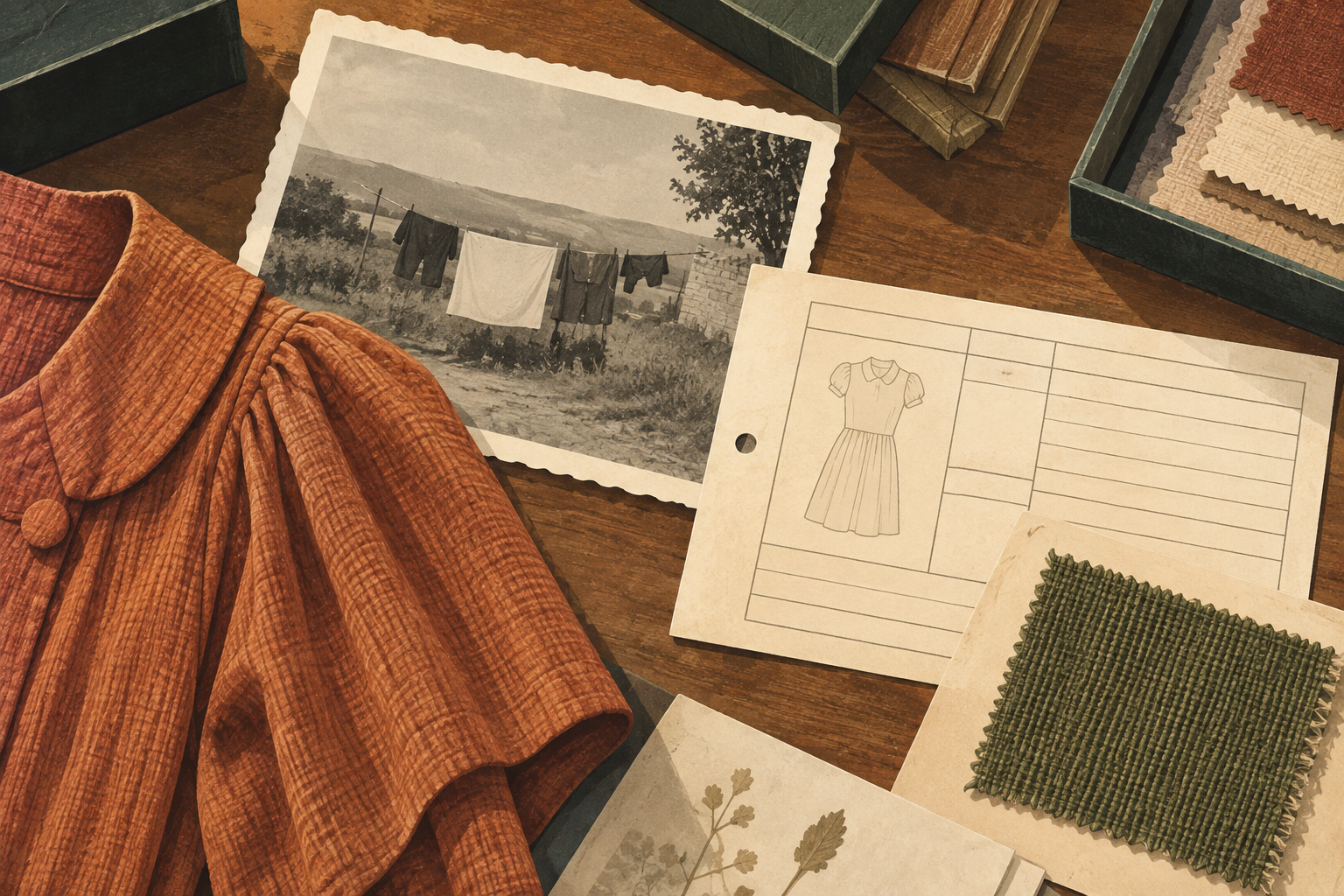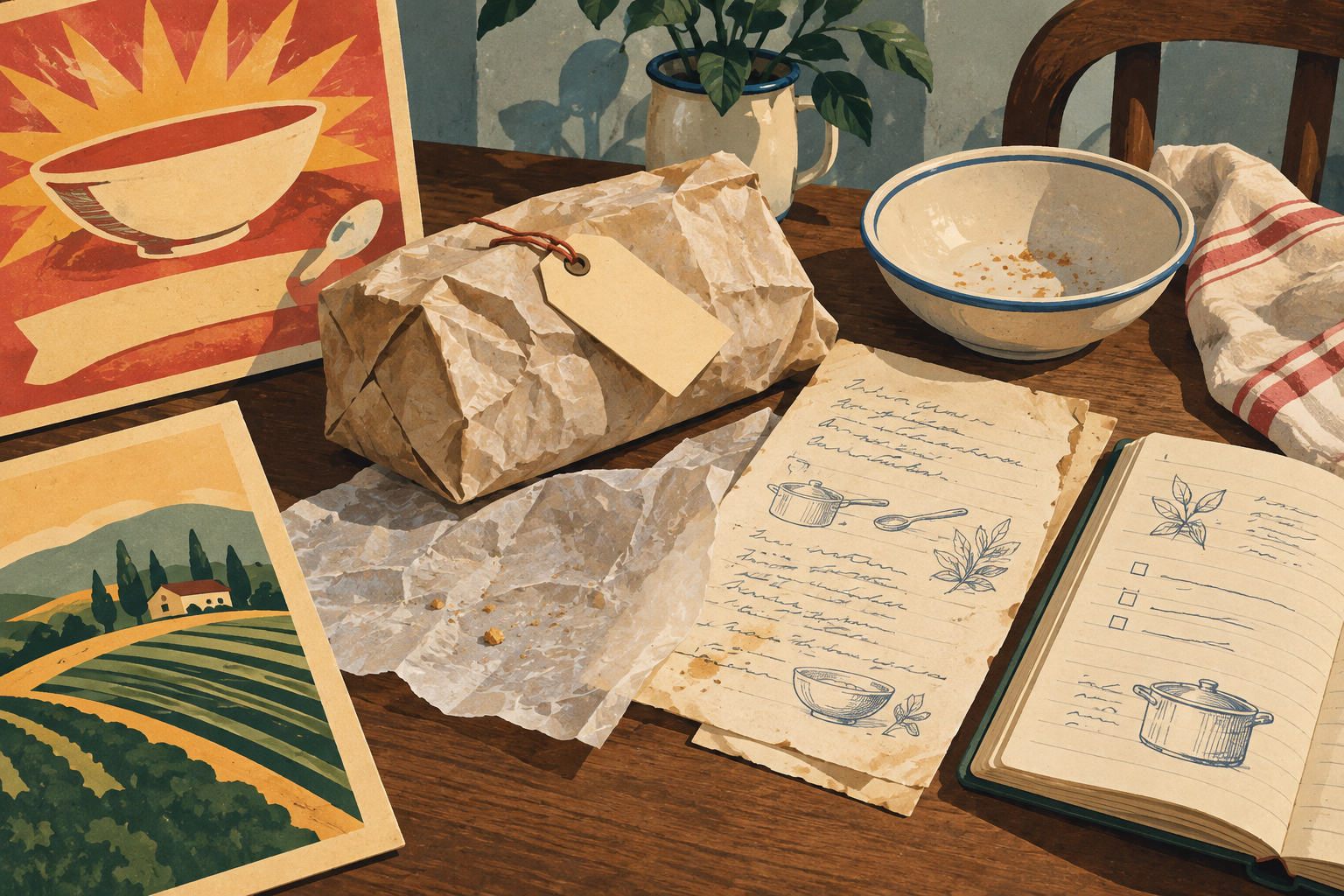
Packaging preserves a commercial proposition; a recipe, instructions; a museum record, information about an object. None of these sources alone amounts to a complete portrait of everyday eating. To study food and sweets without turning advertising into custom, ask what kind of evidence each document offers and where its limits lie.
Three traces, three questions
RetroPause’s article on food and heritage lists cookbooks, tins, labels and archival documents as ways to approach food as material and intangible heritage. This is a useful starting point, not a guarantee that all these materials survive for every product or period. Each answers a different question: a label can document presentation and commercial language; a recipe records a prescribed preparation; a collection record can identify and contextualise an object through the information it contains.
The first editorial task is not to merge them into a single account. Advertising shows what someone sought to communicate; it does not prove that audiences accepted the message, bought the product or consumed it. A recipe presents a way of preparing food, not how often it was made or who made it. A surviving object shows that it entered a collection and was described; it does not automatically represent everything that circulated.
The difference between advertising and eating
The question “which sources distinguish advertising from habits?” calls for evidence of different kinds to be compared, although the material gathered here is insufficient to reconstruct specific consumption habits. A Spanish Ministry of Culture document about Chocolatería “El Indio” describes a shop and mill that made chocolate. This supports describing the establishment as a commercial and manufacturing enterprise; the supplied excerpt says nothing about customers, household recipes or frequency of consumption.
The same caution applies to brands. A Museo del Pueblo de Asturias post mentions the La Herminia factory, established in Gijón in 1885, and names La Herminia, Plin and Sueve chocolates. This is a concrete lead for researching names and production, but it is not proof of sales volume, consumers or advertising methods. Treating a brand’s presence as evidence of a social habit would turn a partial trace into an excessive conclusion.
The object within its record
A CER.es result is associated with S. Subías, titled “Calendario,” and indexed with terms including chocolate, food and the food industry. The record points the researcher towards an object catalogued in an alimentary context. Interpreting the calendar would require, among other things, examining the object and consulting the full catalogue fields. The brief result does not establish who distributed it, for what purpose or which audience saw it.
It is worth keeping the distinction between object and record visible. A catalogue entry is a source about the item, but also about the classification choices that make it findable. The absence of a detail in the excerpt consulted does not prove it is absent from the full record; it does prevent us from asserting it on the evidence available here.
Context is not proof
A video featuring María de los Ángeles Pérez Samper presents a history of food in Spain through foods and recipes from different periods and cultures. The Dialnet record identifies an academic article about food museums and the representation of food; the Museo Reina Sofía describes food through cycles and rhythms. These offer frameworks for thinking about how food is narrated and exhibited, not direct evidence about a particular brand’s history or a household’s habits.
Distinguishing context from evidence avoids inventing continuity. A general reflection on food in museums can help formulate questions; it cannot fill gaps in a label, catalogue entry or advertisement. Claims about domestic practices require sources that document those practices directly and can be compared with commercial material.
A responsible reading
A robust research file should separately identify the object, the document describing it and later interpretations. It should also mark which claims are supported and which remain open. The available sources here suggest lines of inquiry into food heritage, cataloguing, chocolate manufacture and museum representation. They do not suffice to reconstruct diets, sales or household routines.
Food leaves different traces because it is produced, promoted, prepared and remembered in different ways. Reading them together is useful only if their differences remain clear. Packaging may show commercial intent; a recipe, a proposed practice; a catalogue record, how an institution identifies an object. Keeping these layers distinct—and seeking further evidence before connecting them—allows the history of the table to be studied without confusing what was advertised with what was lived.
- Decade
- Before 1950
- Region
- Spain
- Level
- Enthusiast
- Entities
- Museum, María de los Ángeles Pérez Samper, Museo Reina Sofía
Sources and references
- Cuando la comida entra en el museo: recetas, envases y ...www.retropause.com · 2026-10-04
- Oriente | María de los Ángeles Pérez Samperwww.youtube.com · 2026-10-04
- Chocolatería "El Indio"www.cultura.gob.es · 2026-10-04
- CER.es Colecciones en Red - Resultados de la búsquedaceres.mcu.es · 2026-10-04
- Desde Santander retornararon a Gijónwww.facebook.com · 2026-10-04
- Museos de la alimentación: sabores detrás del cristal - Dialnetdialnet.unirioja.es · 2026-10-04
- Sobre la mesawww.museoreinasofia.es · 2026-10-04