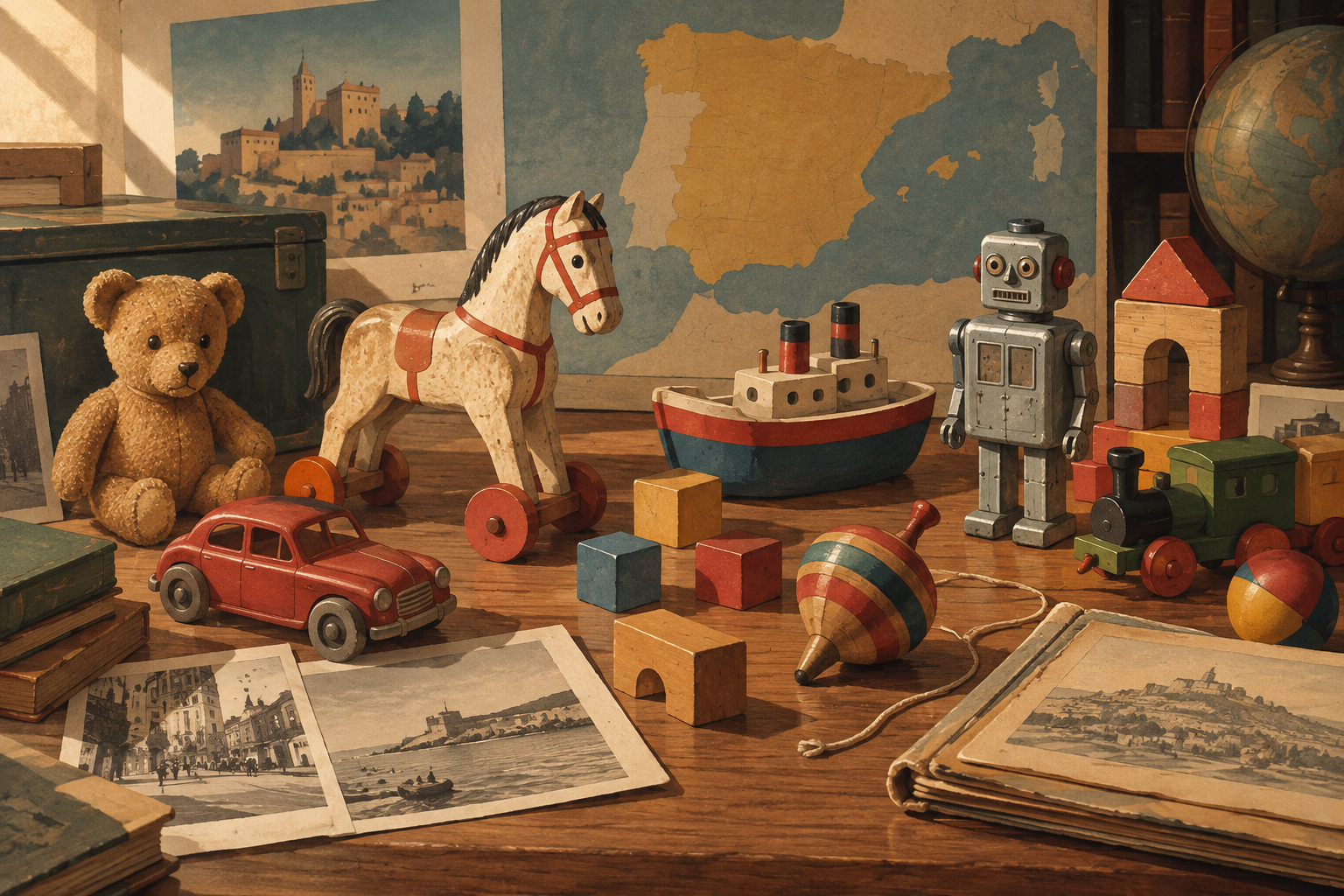
An old toy can seem to offer a direct doorway into childhood in another era. Yet a single object cannot, by itself, reveal who made it, who might have played with it or how it came down to us. Spanish exhibitions devoted to toy history offer a more useful approach: bringing objects together and placing them within a historical account, making visible both what they show and what they cannot establish.
A historical span, not a complete history
The exhibition Tesoros de infancia, described by Málaga’s Municipal Archive, presents the history of Spanish toys from 1870 to 1970 and connects it with social change. The exhibition Historia del juguete español, announced by the Tomares town council, also offers a journey through that period. These dates matter: they mark the framework chosen by each exhibition, not a universal boundary for toy history or proof that every kind of play is represented.
A collection arranged by decade can help visitors notice change, but arrangement is also an editorial tool. Selecting, grouping and labelling objects turns many individual things into an account that can be followed. It is best read as an interpretation supported by objects, not as a comprehensive picture of every Spanish childhood.
The object and its context
The Fundación Ibercaja exhibition Jugar y soñar. Historia del juguete español (1870-1970) names Mariquita Pérez dolls, Scalextric, tinplate cars and Cine Exin among its exhibits. That selection shows how many different things can fall under the word “toy.” They are not interchangeable: each invites different ways of looking, handling or imagining, although the available information does not explain how each was played with or who its users were.
The exhibition’s title also suggests two ways of approaching its subject: the toy as a material object and as part of an imagined experience. That is a possible reading, not a claim about what every visitor or child felt. More precise interpretations would require information about the manufacture, distribution, use and provenance of each object.
Collecting also creates a narrative
A La Vanguardia report about a donation to the Museu d’Història de Catalunya describes a collection of games, toys and educational material assembled by a Catalan collector. The example is a reminder that heritage is not made up only of famous objects or things intended exclusively for play: it can also include educational materials and objects brought together by an individual collector.
A collection preserves a particular selection, not everything that once existed. An object in a display case is evidence that it belongs to a collection or exhibition; that alone does not establish how common it was, what it cost or how widely it circulated. This distinction prevents the survival of an object from being treated as a direct measure of its popularity.
Reading exhibitions as sources
Exhibitions are valuable not only for the objects they display, but also for the questions they ask. Málaga’s description connects toys with social change; Ibercaja frames its exhibition as a history of Spanish toys from 1870 to 1970. In both cases, the institutional framework helps explain how the subject is presented to the public.
At the same time, the material consulted here provides summaries of the exhibitions, not complete catalogues of every object. It therefore cannot reconstruct selection criteria in detail, verify each object’s individual history or systematically compare all the exhibitions. Naming these limits does not diminish a visit; it clarifies the kind of knowledge an exhibition can offer.
Memory needs evidence
When a toy survives, its shape and materials can prompt questions; answering them requires documentation. A label, collection record or source about an exhibition may add context, but should not be confused with direct testimony about how the object was used. It is also important to distinguish what an institution documents from what we infer from it.
Looking at historical toys as documents does not mean stripping away their playful dimension. It means widening the view: seeing them as objects selected, preserved and explained within accounts of childhood and society. The exhibitions discussed here make that approach possible, although the limits of their descriptions are clear. The strongest conclusion is not that one object represents every child of its time, but that it can help us ask better-grounded questions about the objects that have survived.
- Decade
- 1970s
- Region
- Spain
- Level
- Introduction
- Entities
- No linked entities
Sources and references
- El juguete español como retrato de su época - RetroPausewww.retropause.com · 2026-09-29
- 'Tesoros de infancia', en el Archivo Municipal - Visita Málagavisita.malaga.eu · 2026-09-29
- “Historia del juguete español”, una exposición que recorre ...www.tomares.es · 2026-09-29
- Una colección de juguetes para contar la historia del juego ...www.lavanguardia.com · 2026-09-29
- Jugar y soñar. Historia del juguete español (1870-1970)www.fundacionibercaja.es · 2026-09-29


